

A new study published by researchers at the RHS (Royal Horticultural Society) suggests that gardeners who help wildlife and the environment gain a greater boost to wellbeing. Some of the nature-friendly approaches highlighted in the research included avoiding pesticides, providing areas for wildlife, using peat free products and hand weeding.
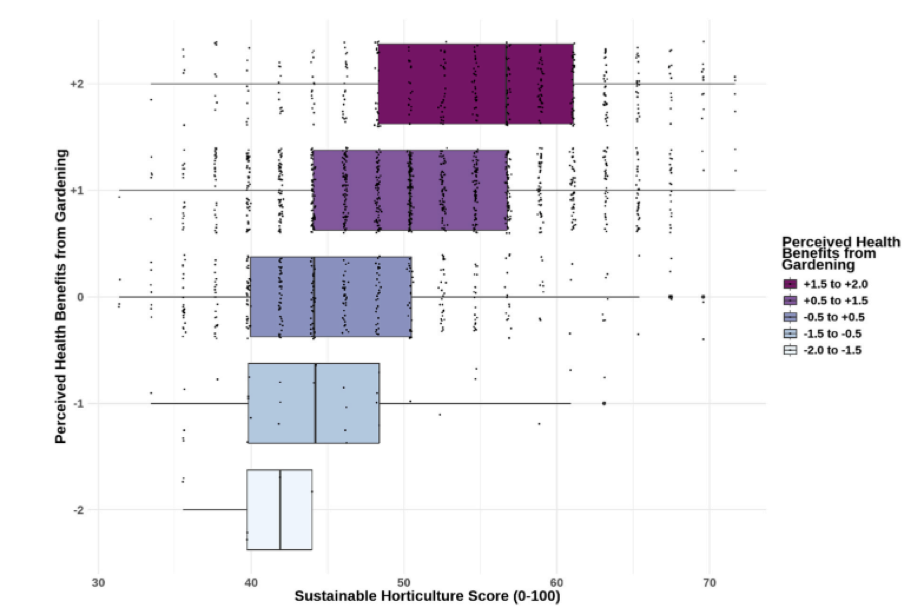
The diagram shows that the more sustainable the gardening practice is, the greater the perceived health benefits from gardening are.
As part of the study, they identified that 83% who gardened considered it both positive for overall health and wellbeing and found a greater connection with nature when you work, with rather than against it.
How, then, can you work with nature when you have a space void of it?
I live in Manchester in a third floor flat with a balcony. When I moved in, it stood out as a blank space, empty and barren. I set out on a mission to change it, take ownership, and create my own garden. Over the course of 9 months the space has been transformed.
First, I began with grasses, and overwintered onions and garlic. Once spring arrived, I sewed seeds of courgette, aubergine, peas, and beans. Now, after generous gifts from various relatives the garden is home to tomatoes, raspberries, strawberries, lavender, rosemary, and mint too. I’ve created a mini oasis in the sky; not only for myself and my housemates, but slowly but surely, for nature too.

In a recent campaigns meeting with the UKY4N team there was discussion of the constant battle against the slugs and other garden critters who munch on your produce before you’ve even realised its grown! I sat there thinking whether I had ever seen a slug in my garden.
‘A mini oasis in the sky’
In relation to the RHS research, I am coming from an alternative perspective to many of my fellow garden-goers. I hope to work with nature and create a space for nature, in a place where it is difficult for nature to grow by itself. Little by little, nature began to appear. I spotted cuckoo spit (the home of the nymph stage of froghoppers) and this was the first sign that the biodiversity of my garden was growing.
In more established pots, every time I see the odd worm or centipede, I celebrate a little, it means my garden is slowly developing and providing habitats and forming ecosystems. Even within the pots, I don’t weed, I let what wants to grow, grow. This is something the RHS research suggests as a good practice for pro-environmental gardening.

I have even seen bumblebees buzzing around the broad bean flowers, and a ladybird on the mint.

An unconventional approach
The way I have approached gardening is not necessarily conventional or fits within any box, but I still see the benefits to my wellbeing as it provides an opportunity for reflection and restoration regardless. I have grown the garden through alternative means, on a budget and as eco-friendly as possible. I used Freegle and Olio (free things apps) to find the grasses and ferns, skip dived for old buckets to use as pots (UKY4N do not condone skip diving!!), just using my hands instead of a trowel, and growing from seeds as this is generally cheaper.
The way I have grown the garden offers a different way of ‘doing’ gardening, highlighting you don’t need a big space, or lots of money to garden. If you are working with nature, any opportunity you provide, unorthodox or not, nature will grow.

For more information, here is a summary of the research plus the open access article itself published in the Journal of Urban Forestry and Urban Gardening.
This is the second blog we’ve published which was inspired by this news article – read Christina’s blog here.
