

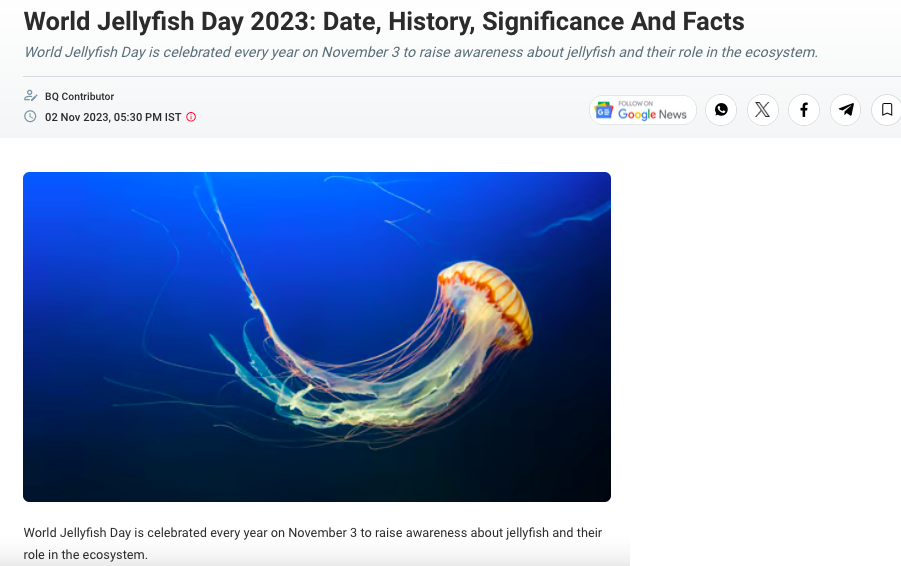
1. Today is World Jellyfish Day! BQ Prime, 2nd November
World Jellyfish Day stemmed from enthusiastic marine biologists to put a spotlight on these creatures. Jellyfish have been swimming in our oceans for over 500 million years, making them one of the oldest living creatures on Earth. Despite this, their understanding among the general populace remained superficial for a long time, often confined to their stinging nature or their beauty. World Jellyfish Day was introduced reportedly in the year 2014 to shed light on the more profound aspects of these creatures.
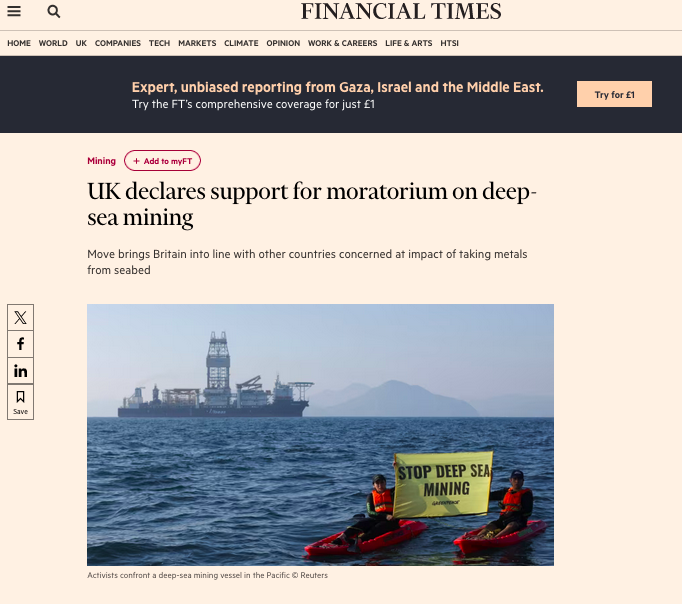
2. UK declares support for moratorium on deep-sea mining – Financial Times, 30th October
The UK has said publicly for the first time that it will back a moratorium on deep-sea mining, after its previously supportive stance for the controversial practice came under fire from scientists and parliamentarians. The government on Monday announced its support for a temporary suspension of sponsoring or supporting licences for projects to exploit metals from the seabed until enough scientific evidence was available to assess its impact. The move brings the UK in line with Brazil, France and Germany, which are among more than 20 countries to have called for a pause in deep-sea mining, at least until the environmental effects are better understood.
3. Claimants take UK government to court over inadequate climate adaptation – Guardian, 1st November
When Kevin Jordan bought his seaside home in Hemsby, Norfolk, he was told it would be safe for a century. In the decade since, 17 of his neighbours’ homes have had to be demolished, or have been swept away into the waters of the North Sea. His is now just 5 metres from the fast-crumbling cliff, isolated and unreachable by car after part of the road collapsed into the North Sea.
The people of Hemsby would seem to be natural beneficiaries of official policies to adapt to the climate crisis. Under the Climate Change Act 2008, the government is required to produce a national adaptation programme every five years, setting out plans protect communities in the UK from the extreme heat, flooding and coastal erosion expected as the climate breaks down.
But critics, including the government’s own advisers, the Climate Change Committee (CCC), have said it is not doing enough. And now, in a case believed to be the first of its kind, Jordan is taking the government to court, alleging its failure to set out lawful “adaptation objectives” in its latest plan is a breach of his human rights.

4. Climate breakdown – a matter of time – Ecologist, 31st October (by UK Y4N community member Ione Howells!)
We need a radical reimagining of the relationship between society, time, and nature In this era of global scorching.
The natural world is collapsing. The IPCC currently reports that our window of opportunity to preserve a liveable world is ‘rapidly closing’.
Averting climate breakdown is increasingly high on the global political agenda – but our current market-based solutions aren’t working.
The commodification of everything in the neoliberal era – especially our own time – has isolated us from the natural world around us.
Reconstruct
Our tenuous relationship with the living planet revolves around profit, loss, extraction and exploitation. It’s unsurprising, then, that our attempts to ‘fix’ it are failing.
We live in a culture of consumerism and commodity, where economic calculations of profit and loss take precedence over traditional systems of care.
Where does this leave us? We are abstracted from our very means of existence, the planet we live on and with.

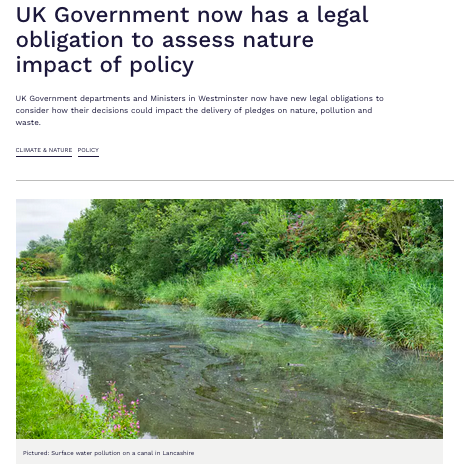
5. UK Government now has a legal obligation to assess nature impact of policy – Edie, 1st November
UK Government departments and Ministers in Westminster now have new legal obligations to consider how their decisions could impact the delivery of pledges on nature, pollution and waste.
This is because the Environmental Principles Policy Statement has been implemented today (1 November).
The Statement was first promised under the Environment Act, which received Royal Assent in November 2021. Then, the Statement in its current form was laid before Parliament this January by the Department for Food, the Environment and Rural Affairs (Defra).
Five environmental principles are covered in the Statement, the first being ‘the integration principle’. This stipulates that the consideration of environmental protection must be integrated into the process of designing policies. Policies are defined in the statement as not only formal Bills and Acts, but also statements, proposals and strategies that intend to inform legislation in the future. Documents prepared by public bodies which ministers are required to approve also count.
The Statement will apply to new policies plus those currently in development and not yet finalised. The UK Government has a long-term vision, under the 25-Year Environment Plan, to leave nature in a better state for the next generation. It has repeatedly been warned that it is failing to deliver on this vision by green groups and academic specialists in the environment.
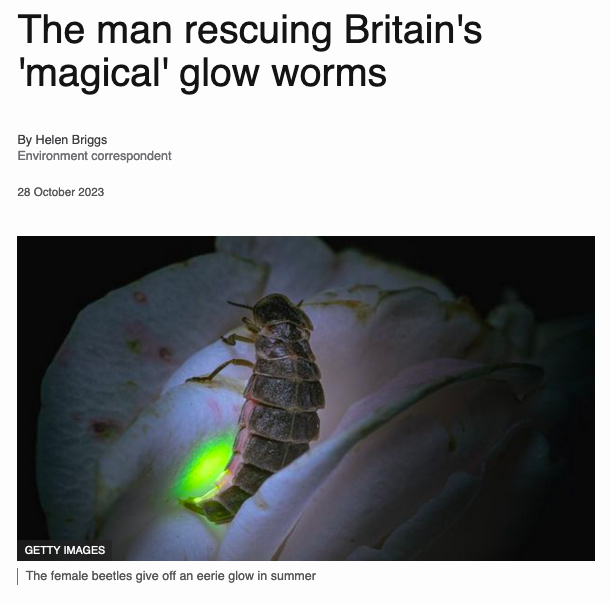
6. The man rescuing Britain’s ‘magical’ glow worms – BBC News, 28th October
“The fascination of glow worms for me is that they are in effect magic,” says ecologist Pete Cooper, as he tramples through thistles and nettles.
“The glow worm has been the symbol of the other world, of love, of hope, of rebirth, of simply the great mysteries of nature.”
The insect is declining in many parts of the UK due to a host of factors, from habitat loss to light pollution. Experts believe artificial lighting is distracting the males so they miss out on a chance to mate.
The young conservationist has a passion for glow worms that’s second to none. He has gone to extreme lengths to breed and release them in the south of England, such as here in Hampshire.
7. ZSL Response to Government Statement on Species Reintroductions – ZSL, 27th October
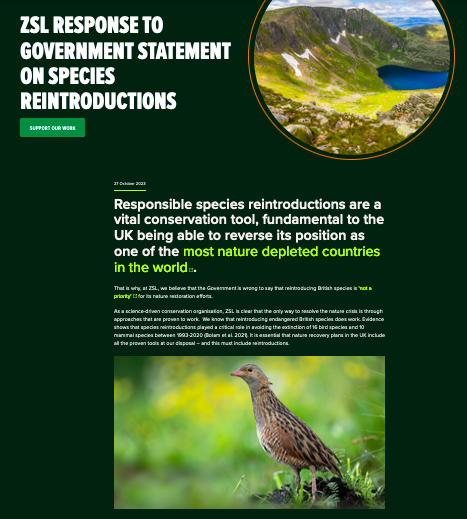
Responsible species reintroductions are a vital conservation tool, fundamental to the UK being able to reverse its position as one of the most nature depleted countries in the world.
That is why, at ZSL, we believe that the Government is wrong to say that reintroducing British species is ‘not a priority’ for its nature restoration efforts.
As a science-driven conservation organisation, ZSL is clear that the only way to resolve the nature crisis is through approaches that are proven to work. We know that reintroducing endangered British species does work. Evidence shows that species reintroductions played a critical role in avoiding the extinction of 16 bird species and 10 mammal species between 1993-2020 (Bolam et al. 2021). It is essential that nature recovery plans in the UK include all the proven tools at our disposal – and this must include reintroductions.
8. Near-record crop of hawthorn berries a boost to wildlife – The Telegraph, 2nd November
Woodland Trust says haws are eaten by migrating birds such as redwings, fieldfares and thrushes as well as small mammals
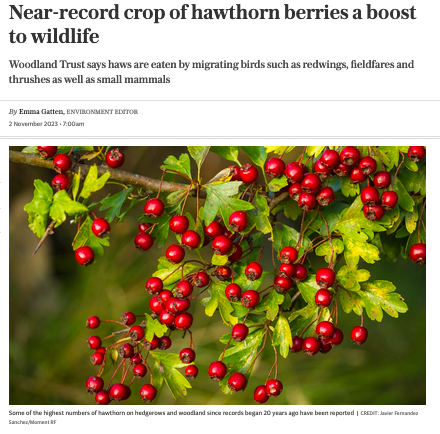
One of the largest crops of hawthorn berries has been recorded by nature watchers this year in a boost to wildlife.
The Woodland Trust has said its volunteers have reported some of the highest numbers of hawthorn on hedgerows and woodland since records began 20 years ago, equal only to 2014.
It has put the exceptional crop down to the mild temperatures this spring, which were above average.
This is the time white hawthorn flowers bloom and if pollinated, go on to produce the red fruits.
“This is really good autumn news for wildlife,” said Dr Judith Garforth, the Woodland Trust’s citizen science officer.
Thanks for reading our news round-up! If you enjoyed it and want to amplify these stories, why not give this blog a share on your social media, and help us celebrate and commiserate the good, the bad and the ugly from this week! See you next week!
