

1. Experts predict UK forests could suffer ‘catastrophic collapse’ in next 50 years – Innovation News Network, 9th November 2023
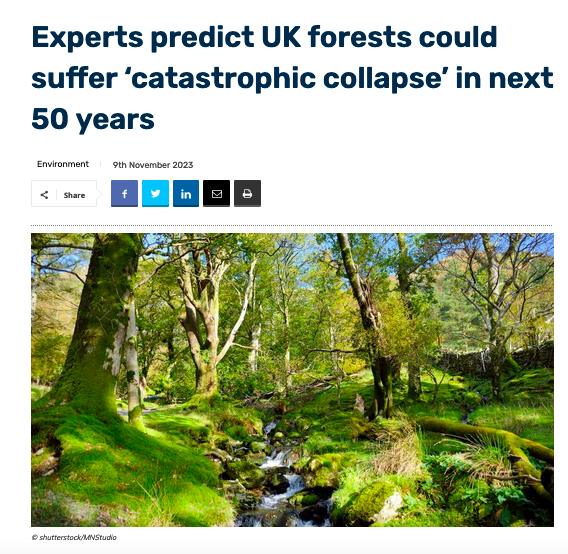
A team of experts from across Europe has produced a list of 15 overlooked and emerging issues that are likely to have a significant impact on UK forests over the next 50 years if action is not taken now.
Current threats to UK forests include competition with society for water, viral diseases, and extreme weather affecting forest management.
This is the first ‘horizon scanning’ exercise – a technique to identify relatively unknown threats, opportunities, and new trends in these forests.
The aim is to help researchers, practitioners, policymakers, and society in general, better prepare for the future and address threats before they become critical.
Dr Eleanor Tew, first author, visiting researcher at Cambridge’s Department of Zoology, and Head of Forest Planning at Forestry England, said: “The next 50 years will bring huge changes to our forests: the threats they face, the way that we manage them, and the benefits they deliver to society.”
2. Work begins to save rare Devon butterflies – BBC News, 11th November 2023
Work to save four of Devon’s rarest butterfly species is set to start this winter.
The Devon Fritillary Recovery Project is a two-year land management plan by the Devon Wildlife Trust.
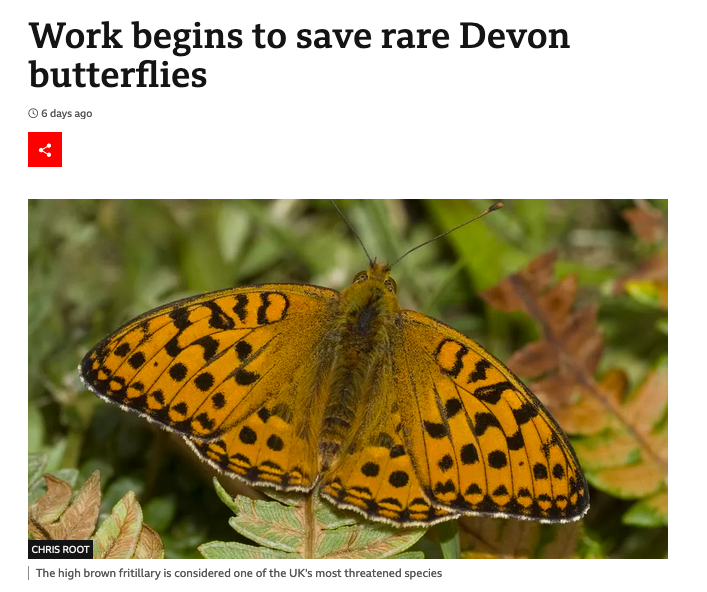
The project aims to help struggling populations of high brown, pearl-bordered, small pearl-bordered and marsh fritillary butterflies. The charity said numbers had declined dramatically due to changes in farming, loss of habitat and climate change.It said the high brown fritillary, in particular, had seen its numbers crash by 96% and was now one of the UK’s “most threatened species”.
Staff and volunteers will now begin work to manage the levels of scrub and gorse at 12 of the trust’s nature reserves to ensure the habitats encourage butterfly population growth. Project officer Jenny Cawson said: “Devon Wildlife Trust’s nature reserves offer some of the last homes to our struggling butterflies so it’s vital that we work hard to keep them in good condition. “The launch of our Devon Fritillary Recovery Project signals the start of a huge effort to not only stabilise the populations of these rare species but to restore their numbers.
3. ‘Shocking and sad’: photographer’s project reveals wildlife lost to pollution in Yorkshire’s River Wharfe – The Guardian, 11th November 2023
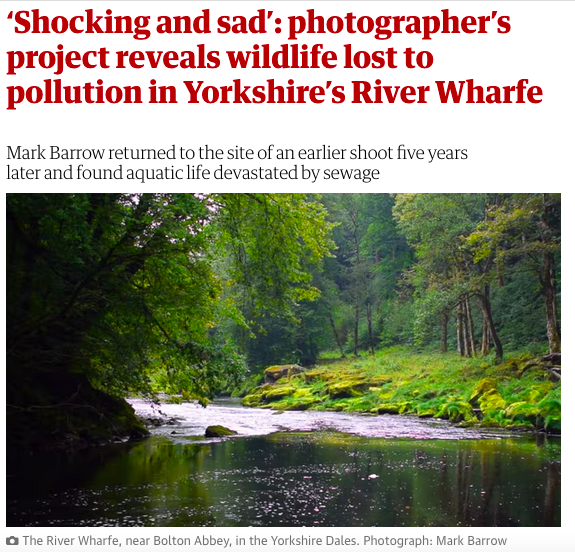
Five years ago, when Mark Barrow started his project to film along the 65-mile River Wharfe in Yorkshire, he captured footage of majestic shoals of grayling, the fish known as “the Lady of the Stream”, some 200 or 300 strong.
Recently, Barrow returned to the same spot, near the historic Harewood House on the outskirts of Leeds, to reshoot some video because he wasn’t happy with the quality of his earlier attempt.
What he found shocked him. The water was cloudy with pollution and the numbers of grayling, with their distinctive red fins and pewter scales, were reduced to pockets of no more than 30 or 40.
“It was a huge difference in five years,” said Barrow, 53, of Wetherby, West Yorkshire. “Grayling, in particular, are susceptible to pollution in the waters. It was very shocking and sad to see.”
4. Warming ends when carbon pollution stops – Frontiers in Science, 14th November 2023.
A recent article in The Hill insisted that “scientists failed for decades to communicate” the threat of climate change. The scientific paper on which the article was reporting did not really say that—it was instead providing a more nuanced discussion of sea level rise “tail risk”. But the irony here is that the opposite of what was asserted by the news article is arguably true. If anything, we scientists have failed to communicate the prospects for averting catastrophic warming.
In the days when I was working on my PhD, in the early 1990s, we were taught that the warming of the planet would persist for decades even if we suddenly stopped burning fossil fuels and emitting carbon into the atmosphere. This is due to what is known as “thermal inertia”—the slow, sluggish response of the oceans. Climate models showed that surface warming would continue for 30 years or more, as the oceans slowly continue to warm, even after carbon pollution ceases. This so-called “committed warming” would seem to render our efforts to avert disaster somewhat futile. Even if we turned off the metaphorical carbon faucet, the water level of warming would continue to rise. Extending the metaphor, that water would soon spill from our kitchen sink onto the kitchen floor. With apologies to Greta Thunberg, rather than burning, our house would instead be flooding.
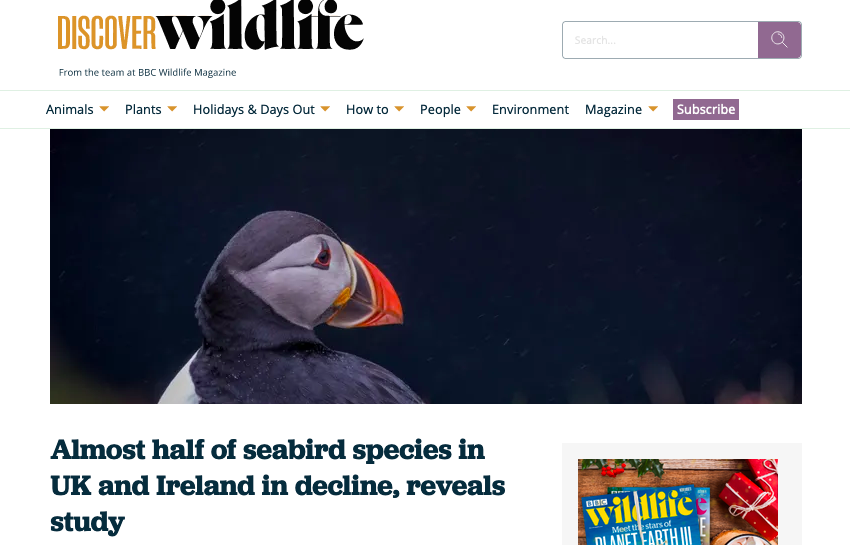
5. Almost half of seabird species in UK and Ireland in decline, reveals study – BBC Wildlife Magazine, 16th November 2023
Britain and Ireland hold most of the world’s nesting Manx shearwaters, northern gannets and great skuas. The islands are also a vital stronghold for other species of seabird, such as lesser black-backed gulls, common guillemots, European storm-petrels and roseate terns. Yet a new study released today found that almost half of the seabird species in Britain, Ireland, Isle of Man and the Channel Isles have declined in the past 20 years.
The Seabirds Count census, led by the Joint Nature Conservation Committee (JNCC), surveyed over 10,000 sites between 2015 and 2021. Experts suggest that the causes of decline are linked to adverse weather conditions (which may be a result of climate change), a lack of food as a result of both climate change and fisheries, and predation.
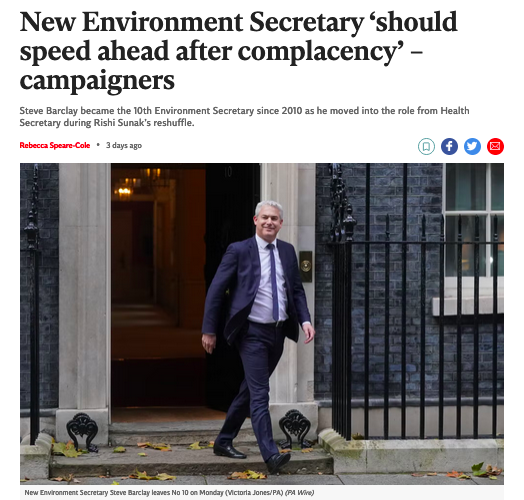
6. New Environment Secretary ‘should speed ahead after complacency’ – campaigners – The Independent, 14th November 2023
The new Environment Secretary Steve Barclay “should speed ahead with quick wins” as his predecessor leaves a legacy of “complacency”, campaigners have said.
Mr Barclay became the 10th Environment Secretary since 2010 as he moved into the role from Health Secretary during Rishi Sunak’s reshuffle on Monday.
He replaces Therese Coffey, who resigned from Government during the reshuffle after holding several ministerial jobs including health minister and work and pensions minister, and also served as deputy prime minister under Liz Truss.
Campaigners are now calling on Mr Barclay to act quickly as they criticised the Government and Ms Coffey over the recent response to environmental challenges facing the UK.
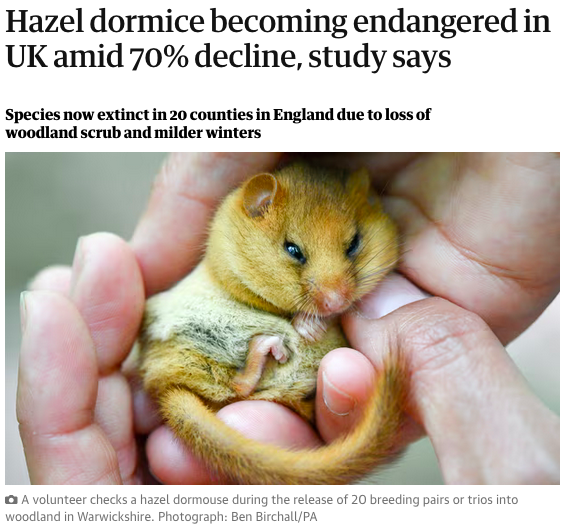
7. Hazel dormice becoming endangered in UK amid 70% decline, study says – The Guardian, 10th November 2023
Populations of the hazel dormouse, perhaps the most elusive native British mammal, have plummeted by 70% this century.
The nocturnal, tree-dwelling animals are now extinct in 20 counties in England and the species must be reclassified as “endangered” on the International Union for Conservation of Nature red list, according to a study by the People’s Trust for Endangered Species (PTES).
Since the previous State of Britain’s Dormice report was published in 2019, they have vanished from Hertfordshire, Staffordshire and Northumberland.
The key factor in their decline is the loss of the scrubby under-storey in woodlands where the arboreal dormice live and feed in spring and summer, but the problem has been compounded by climate change, according to conservation scientists.
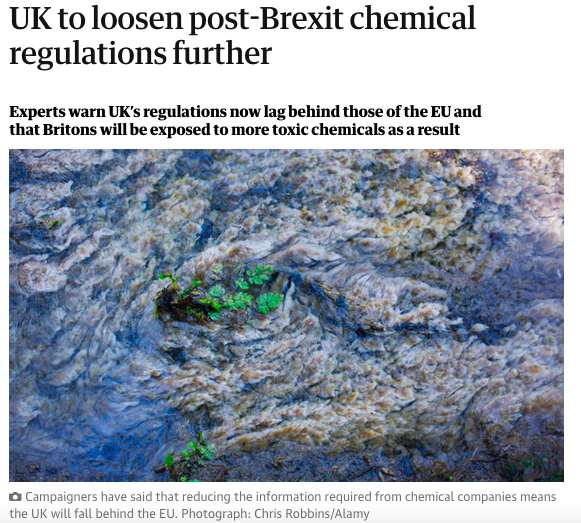
8. UK to loosen post-Brexit chemical regulations further – The Guardian, 14th November 2023
The government is to loosen EU-derived laws on chemicals in a move experts say will increase the likelihood of toxic substances entering the environment.
Under new plans the government will reduce the “hazard” information that chemical companies must provide to register substances in the UK. The safety information provided about chemicals will be reduced to an “irreducible minimum”, which campaigners say will leave the UK “lagging far behind the EU”.
The UK’s scheme, called UK Reach, is falling behind the EU’s as it is. The UK has not been part of the bloc’s chemicals regulations scheme, EU Reach, since 2021. Eight rules restricting the use of hazardous chemicals have been adopted by the EU since Brexit, and 16 more are in the pipeline. The UK has not banned any substances in that time and is considering just two restrictions, on lead ammunition and harmful substances in tattoo ink.
If you’re concerned about chemical pollution in our freshwater ecosystems, check out our #NotsoFreshwater campaign.
Thanks for reading our news round-up! If you enjoyed it and want to amplify these stories, why not give this blog a share on your social media, and help us celebrate and commiserate the good, the bad and the ugly from this week! See you next week!
