

elcome to the Urban Nature Day Festival – an exciting event celebrating the beauty of urban wildlife! We’re thrilled to have you join us for this epic day. Explore our festival schedule, discover the venue layout, and understand the significance of our urban nature campaign. Thank you for sharing this day with us and discovering the incredible wildlife that coexists with us in our cities.
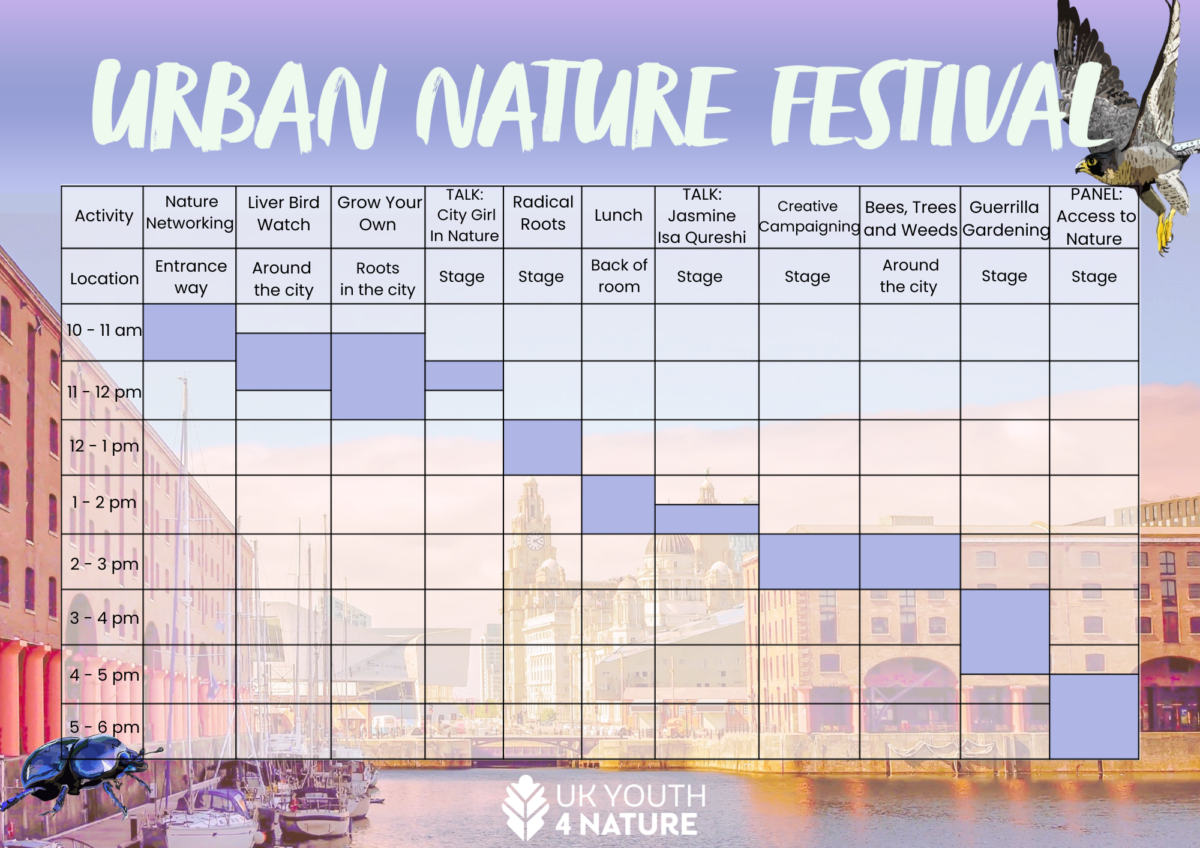
Programme
Venue layout – Bierkeller, Liverpool

What is our urban nature campaign and why is it needed?
Over the next few years, our urban nature campaign is calling on governments and local authorities to increase the quantity, quality, and accessibility of nature in urban spaces.
What are we asking for?
- Increase Nature in Urban Spaces
- Increase Access, particularly for young people from marginalised communities.
What do we mean ‘urban’?
The word ‘urban’ will have different meanings for different people. For our Urban Nature Campaign, we are keeping our definition loose to include any built-up areas, ranging from villages and small towns through to the largest cities and conurbations in the UK. So wherever you live, you can get involved with our campaign and make a difference right on your doorstep!
Urban nature facts
State of urban nature
- The proportion of England’s urban areas made up of green space has declined – just 35% of households with annual incomes below £10k are within a 10-minute walk of a publicly accessible natural green space (1).
- Domestic gardens have been estimated to make up 30% of the urban area in England. Not all of the land covered by domestic gardens is green, as a proportion of this comprises paved areas and buildings (1).
- It is estimated that the proportion of England’s urban areas made up of green space declined from 62% in 2001 to 55% in 2018 (1).
- Urban sites can have higher diversity of bee species in comparison to surrounding agricultural areas. However, emerging evidence suggests that urbanisation increases the risk of mistiming between plants and their pollinators as heat and local climate effects move flowering times forward (1).
- In 2020, about 18% of water bodies in England were identified as being damaged by pollution from towns, cities and transport. This figure does not include pollution from waste water treatment, much of which originates from urban sources (1). See our Not So Freshwater campaign for more information on this.
- Urban areas are expanding. The proportion of the UK’s population living in urban areas rose by 8% between 1970 and 2018. This is having a big impact on nature. The abundance of key urban species has dropped significantly: of 529 urban species assessed in the UK, 37 are considered at risk of extinction (2).
- In the UK, the abundance of key urban species fell by 10% between 2002 and 2013 (2).
Access to nature
- In the UK, 59% of households with incomes of £60k or more (roughly the top 10% by income) are within a 10-minute walk of a publicly accessible natural green space, compared with just 35% of those with incomes below £10k. The Covid-19 pandemic has exacerbated inequalities in accessing green spaces. People on lower incomes, with lower levels of education or who live in deprived areas visited natural spaces less often than usual, whereas other groups visited more often (1).
- City communities with 40% or more residents from people of colour have access to 11 times fewer green spaces locally than those comprising mainly white residents (1).
- People of colour are also less likely to have access to a private garden than people from white backgrounds. Of survey participants from black backgrounds, 44% did not have access to a garden or private outdoor space of any kind, compared with 24% of participants from Asian backgrounds and 11% from white British or Irish backgrounds. Statistical analysis of this data has shown that these trends are significant even when other factors including geographical location, social grade and age are taken into consideration (1).
- The huge surge in people’s use of green spaces during the coronavirus pandemic reveals an inequality of access to nature in many neighbourhoods, towns and cities. Nationally, there are 295 deprived neighbourhoods of 440,000 people that are grey deserts, with no trees or accessible green space. People of colour people visit natural settings 60% less than white people (3).
- Visits to urban parks account for over a third of all visits to the natural environment (4).
- One in eight households has no access to a private or shared garden. 21% of Londoners do not have a garden (4).
- A survey conducted in April-June 2020 revealed that socio-economic status affects access to natural spaces – you are less likely to visit natural spaces if you live in an area of high deprivation, have a low income, have a low level of education, or are not working. Older people, people from minority ethnic groups, those with a long-term illness or condition, and those without children were also less likely to have visited a natural space (5).
- In a survey conducted in July 2020, 46% said they were spending more time outside than before Covid-19. 42% of adults reported that ‘nature and wildlife is more important than ever to my wellbeing’ (5).
- 1,108 neighbourhoods in the UK (home to 9.6 million people) are deprived of green space. That’s roughly 1 in 5 of us (6).
- Black and brown people are twice as likely to live in a neighbourhood with minimal access to green space. Almost 40% of people of colour live in the most green-space deprived areas, compared to 14% of white people (6).
- Around 1 in 3 of us don’t have access to accessible nature-rich spaces near our homes (7).
- In England alone, it has been calculated that the NHS could save an estimated £2.1 billion every year in treatment costs if everyone had access to good quality green space (8).
- 40% of people from ethnic minority backgrounds live in the most green-space deprived areas, compared to 14% of white people (9).
- 6.1 million people have no park or green space within a ten-minute walk from home (10).
Access to nature panel resources
Jasmine Isa (عِيسَى) Qureshi Jenny Griggs Mahnoor Kamran Meg Watts Kwesia
Chaired by Şeniz Mustafa
Blogs and Articles:
Being Inclusive: Ways to Promote Diversity in Nature
Equality in access to natural spaces is essential for a more eco-friendly future
The intersectionality of culture and nature and well-being of minoritized groups in the UK
We Need More Colour in Wildlife
Why access to nature is a social justice issue
Reports:
Videos:
How biodiversity and cultural diversity are inexorably linked
How improving disability access can benefit everyone
Rights of persons with disabilities to access public natural resources
Organisations
All The Elements: A community for everyone working on diversity in the UK outdoors.
Birding for all: A voluntary organisation that seeks to improve accessibility for those with disabilities to access birding.
Black Girl Hike: An organisation that provides a safe space for Black women to explore the outdoors.
Due East: A Hiking and outdoors group for those of East/Southeast Asian heritage.
Flock Together: A birdwatching collective for people of colour.
Gay Birders’ Club: A club that works to make people from the LGBTIQA+ community feel safe and welcome in the birding community.
Muslim Hikers: A community for Muslims interested in the outdoors.
Race 4 Nature: An organisation that helps young people from diverse backgrounds to get connected to various environmental organisations.
Wanderers of Colour: An organisation committed to social justice through improving access to travel and the outdoors.
Wonderful Wild Women: A community aimed at inspiring women to get active and enjoy nature.
What’s next?
We’ll be doing a range of follow-up actions after our Urban Nature Day and we want you to get involved!
- Continue the conversation around access to nature. We’ll be doing some post-Urban Nature Day events to carry forward the messages and feelings of the day. Follow us on social media to stay engaged!
- Join the “Your Wild Street” action taking place later this year to put pressure on your local authority to change the way it manages our local environment. Want to get more involved? Join our team and help us shape this action now!
- We’re supporting the Nature2030 campaign coordinated by Wildlife and Countryside Link and will be exploring what the “right to a healthy environment” means to us personally. Have something to share? Let us know!
Get involved!
If you’ve enjoyed today and want to join us – whatever you have to bring to the table will be welcomed with open arms. Please check out our Get Involved page or talk to one of our team at the event today to find out more.
If you’re not currently subscribed to our newsletter or following us on Instagram, Facebook, X, TikTok, Threads, or LinkedIn, they’re all great places to stay in touch with us and hear all about what we’re up to!