

Welcome to our nature news round-up for the week ending Friday 20th of October.
1. Welsh Water admits spilling untreated sewage near dolphin habitat for decade
Welsh Water has admitted to spilling untreated sewage near a rare dolphin habitat for at least a decade.
A BBC investigation found the water company had been illegally discharging untreated wastewater at dozens of sewage plants, often for years at a time.
The organisation has promised to tackle the problems after viewing the analysis, which it did not dispute.
Water companies across England and Wales frequently discharge sewage into rivers and seas. In England, sewage was spilled via storm overflows more than 300,000 times last year.

2. Aged 16-24? Get your nature hit – for free!
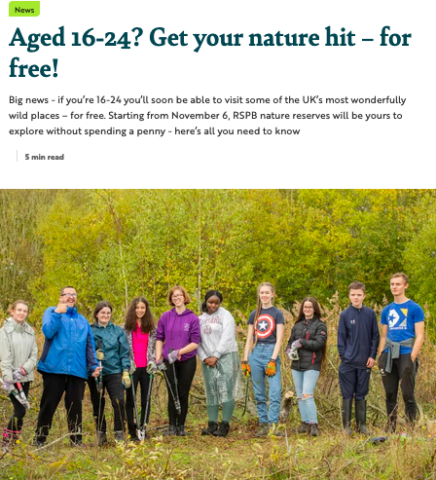
Big news – if you’re 16-24 you’ll soon be able to visit some of the UK’s most wonderfully wild places – for free. Starting from November 6, RSPB nature reserves will be yours to explore without spending a penny – here’s all you need to know.
Nature is for everyone. It’s our ambition to encourage more and more people of all ages and backgrounds to engage with wildlife and wild places and make our natural world as accessible as possible.
At the moment we know we need to do more to engage and connect with 16-24 year olds. Young people are less likely to visit our nature reserves than other age groups and we know that cost is one of the main barriers. By removing entry charges, we hope more young people will come to explore these wonderfully wild places and connect with the great outdoors in new ways.
From November 6, all you need to do is show a valid photo ID with your age on it when you arrive at the nature reserve. This could be a driving license, a proof of age card or your passport.
3. New project aims to get urban communities involved in nature
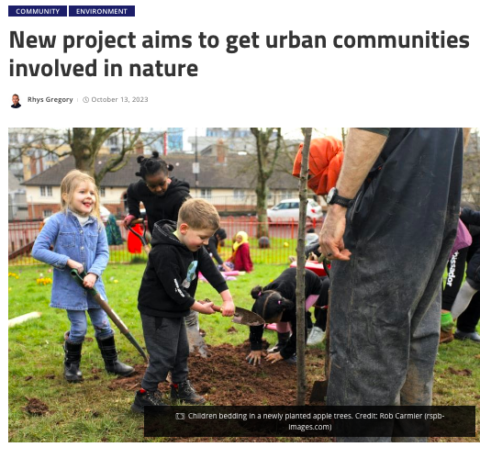
Newport’s Maindee area, Pwllheli in Gwynedd, and Neyland in Pembrokeshire are part of a new UK-wide initiative announced today, seeking to help local, mostly urban, communities stand up for nature in their neighbourhoods, tackling the global climate and nature crises at a local level.
Three-quarters of people in the UK are worried about the state of nature, yet we are in the bottom 10% of countries globally for protecting it. In March 2023, the People’s Plan for Nature set out recommendations to reverse the UK’s shocking declines in nature, including calls for greater investment in ways to help communities take action to protect and renew nature at a neighbourhood level. The Nature Neighbourhoods project is a direct response to those calls.
4. Greta Thunberg detained at Fossil Free London protest
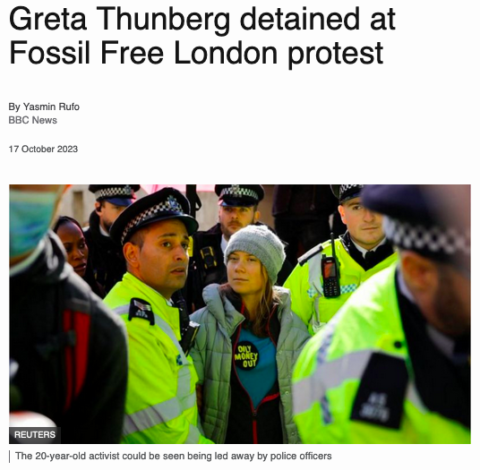
Greta Thunberg has been detained during a Fossil Free London protest.
The Swedish climate campaigner had joined other activists outside the InterContinental Hotel on Park Lane where oil executives were meeting.
The protesters attempted to block access to the hotel by occupying the area by the entrance.
Fossil Free London posted on X, formerly known as Twitter: “Breaking – Greta Thunberg has just been arrested.”
Images on social media showed the 20-year-old activist being led away by police officers and placed in the back of a marked van.
In a statement, the Met Police said it had imposed conditions on the activists under Section 14 of the Public Order Act, to “prevent serious disruption to the community, hotel and guests”, and had asked them to move from the road and on to the pavement.
5. Number of nesting seabirds on Lundy island at nine-decade high
Tiny island in Bristol Channel has 25,000 Manx shearwaters – 95% of England’s breeding population – and 1,335 puffins.
There are more seabirds nesting on the island of Lundy than at any time since the 1930s, conservationists have revealed.
The tiny island in the Bristol Channel, a globally famed location for Britain’s seabirds, is now home to 25,000 Manx shearwaters – 95% of England’s breeding population – as well as 1,335 puffins and more than 150 pairs of storm petrels, a species that only arrived on the island in 2014.
Despite the recent threat of avian flu, which has decimated wild bird populations in some of the world’s most sensitive locations, and the problematic decline in wild sources of food such as sand eels, the total number of seabirds on Lundy stood at 40,000 this summer.
This is a massive turnaround after just 7,351 remained in 2000. Puffins were close to extinction, with just 13 counted on the windswept 450-hectare island in 2001.

6. UK’s biggest nature charities publish shared Nature Markets Principles to help combat corporate greenwashing
The Wildlife Trusts, RSPB, Woodland Trust and National Trust have today published a set of principles for ensuring ‘nature markets’ truly deliver for nature, climate and people.
With an estimated £6 billion annual funding gap for UK nature recovery across land and sea, the UK Government has set an ambitious target to grow annual private investment in nature by at least £500 million by 2027, rising to over £1 billion by 2030. It published its Nature Markets Framework in May and is working with the British Standards Institute to develop robust standards for green financing.
7. Hull set to allow ‘right to grow’ on unused council land in UK first
City councillors pass motion to let community groups, charities and neighbours cultivate fruit and veg
Hull is set to become the first city in Britain to give people a “right to grow” on unused council land.
Community groups, charities and even small groups of neighbours would be able to cultivate fruit and vegetables on suitable council land in what campaigners say will provide healthy local food, boost mental health and revive neglected spaces.
Hull councillors unanimously passed the “right to grow” motion that means the council will produce a map of suitable land it owns and help those who want to grow food on it overcome practical obstacles such as insurance or provision of water for the plants.

8. Storm Babet: ‘It’s the price of climate change’, says expert
A CLIMATE change expert has said Scotland can likely expect even more intense storms than Babet due to global warming.
Storm Babet has wreaked havoc on the north east of Scotland. Parts of Angus are accessible only by boat after heavy flooding on Thursday night, including the entire village of Brechin – with First Minister Humza Yousaf saying he “cannot stress how dangerous” conditions are for residents.
Angus Council said the flooding was a “very serious emergency” and “completely unprecedented”.
Heavy rain and strong winds are also causing major transport disruption across Scotland and northern England on Friday.
Simon Tett, a professor at the University of Edinburgh, told The National that he’s sorry for those impacted by this extreme weather.
He warned, however, that not only is the likelihood of extreme weather events like Storm Babet higher, they already have and will also likely become more intense.

Thanks for reading our news round-up! If you enjoyed it and want to amplify these stories, why not give this blog a share on your social media, and help us celebrate and commiserate the good, the bad and the ugly from this week! See you next week!
