

Welcome to our nature news round-up for the week ending Friday 13th of October.
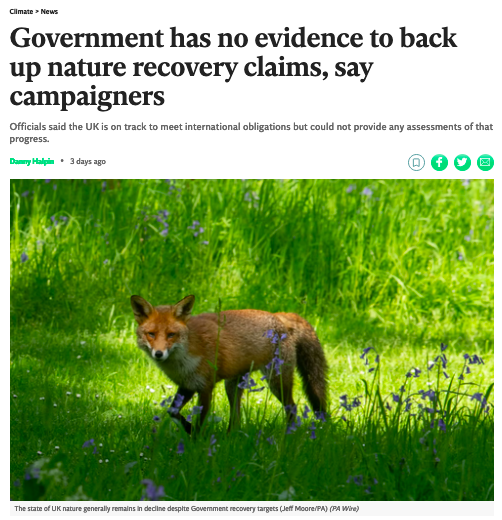
1. ‘Government has no evidence to back up nature recovery claims, say campaigners’ – The Independent, 10th October
The Government has no evidence to back up a recent claim it made saying the UK is on track to meet its internationally-agreed targets on improving nature, campaigners have said.
After the Wildlife and Countryside Link (WCL) found there to be just over 3% of land and up to 8% of sea protected for nature – when the target is 30% – the campaign group accused the Government of failing to make headway.
2. ‘Formidable coalition’ of policymakers and NGOs rap Rishi Sunak for biodiversity rollbacks – edie, 9th October
The accusation forms part of an open letter published in The Independent on Friday (6 October) as part of the Nature 2030 campaign, which implores all major political parties to set out meaningful and credible plans to halt and reverse nature loss in the UK.
It was revealed recently that one in six of the UK’s plant and animal species are now at risk of extinction. Even for those species not at risk, there has been an average decline in abundance of 19% since 1970. Worryingly, that decline rises to 54% for flowering plants and 43% for birds.
These are all findings from the State of Nature Report. This includes data from 60 organisations including the National Trust and Natural History Museum.

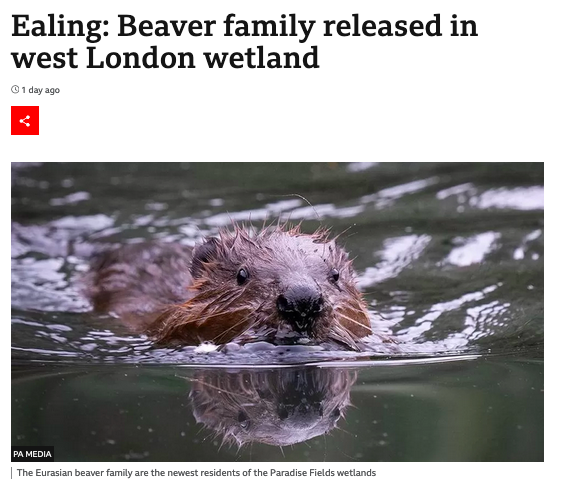
3. Ealing: Beaver family released in west London wetland – BBC News, 12th October
Beavers have been reintroduced to west London for the first time in about 400 years in a bid to improve biodiversity and help mitigate the impact of climate change.
The family of five Eurasian beavers were released at Paradise Fields, an area of wetlands in Ealing.
They were relocated from a wild beaver population in Scotland by a coalition of wildlife groups. It is hoped they will improve the local habitat and reduce flood risks. The project is being paid for as part of the mayor’s Rewild London Fund.
Elliot Newton, co-founder of Citizen Zoo, told BBC London: “Beavers became extinct in the UK 400 years ago so this is part of bringing them back into the landscape where they deserve to be.”
4. Wildlife Photographer of the Year Award winners and highly commended images announced – Natural History Museum, 11th October
Selected from 49,957 entries from 95 countries, the winners of the Natural History Museum’s prestigious wildlife photographer of the year competition were revealed at an awards ceremony in South Kensington on Tuesday. The flagship wildlife photographer of the year exhibition featuring the awarded images will open on Friday 13 October 2023 at the Natural History Museum in London [from The Guardian online].

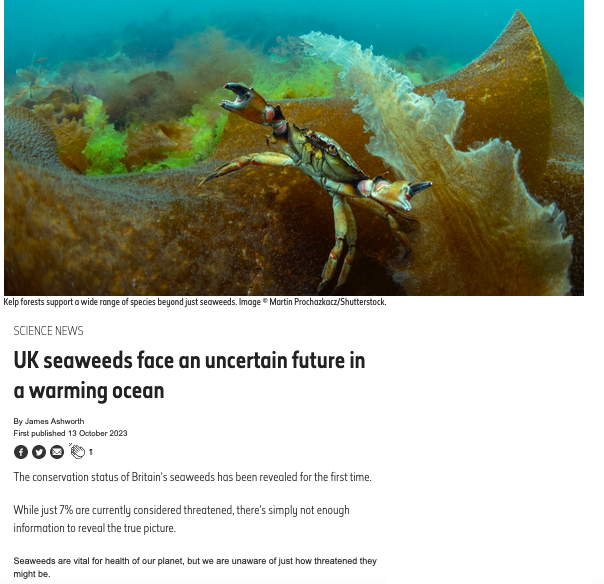
5. UK seaweeds face an uncertain future in a warming ocean – Natural History Museum, 13th October
The conservation status of Britain’s seaweeds has been revealed for the first time.
While just 7% are currently considered threatened, there’s simply not enough information to reveal the true picture.
Seaweeds are vital for health of our planet, but we are unaware of just how threatened they might be.
While we know that climate change, invasive species and pollution are having an impact on the marine macroalgae, the difficulty of studying them due to their wide range of lifestyles and shapes makes it hard to know the exact impacts on individual species.
6. Key UK nature report highlights Little Terns project – News from Wales, 11th October
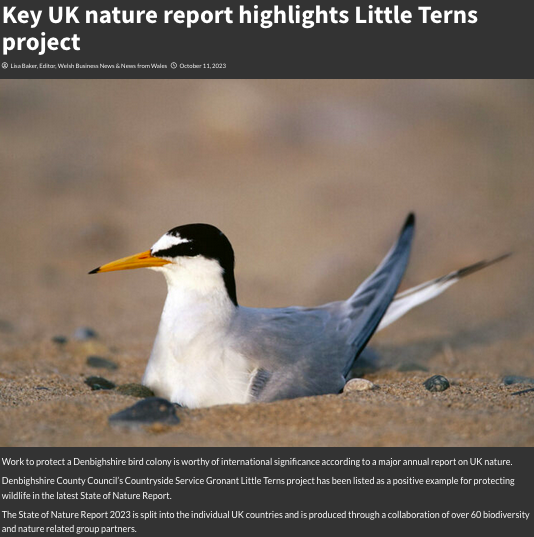
Work to protect a Denbighshire bird colony is worthy of international significance according to a major annual report on UK nature.
Denbighshire County Council’s Countryside Service Gronant Little Terns project has been listed as a positive example for protecting wildlife in the latest State of Nature Report.
The State of Nature Report 2023 is split into the individual UK countries and is produced through a collaboration of over 60 biodiversity and nature related group partners.
Species studied by the collaboration have on average declined by 19 percent since monitoring started in 1970. The declines are much higher for some groups including birds which stands at a 43 percent loss.
However, the State of Nature Report highlights the Little Terns Project as a positive piece of conservation work of ‘international significance’.
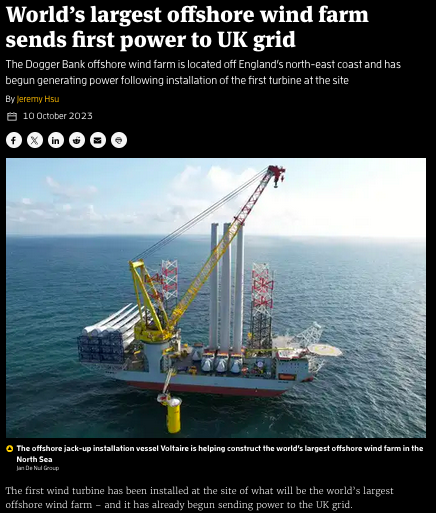
7. World’s largest offshore wind farm sends first power to UK grid – New Scientist, 10th October
The first wind turbine has been installed at the site of what will be the world’s largest offshore wind farm – and it has already begun sending power to the UK grid.
The plan is to install a total of 277 wind turbines at the Dogger Bank Wind Farm, located about 130 kilometres off the north-east coast of England. Once fully operational in 2026, the wind farm is expected to power more than six million UK homes.
The first turbine at the site is a GE Haliade-X turbine with spinning blade tips reaching 260 metres above sea level – about the same height as New York City’s Rockefeller Center. The power it generates flows through an array of high-voltage direct current cables that connects to the coast of north-eastern England.
8. Giant living artwork unfurled at Westminster as waiting lists for allotments double in a decade – Greenpeace UK, 11th October
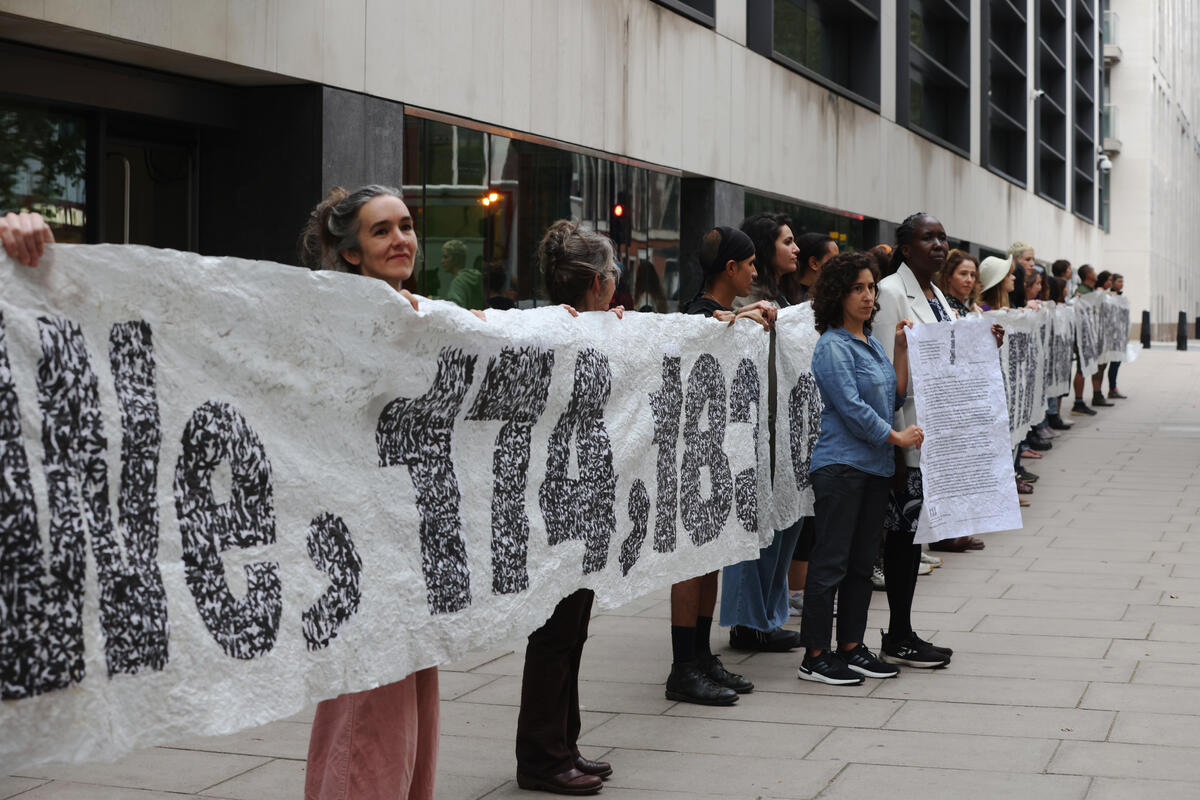
A 30-metre-long living artwork made of seed paper was unfurled and displayed at Westminster this morning by artists and allotmenteers. They are urging the government to enable people to exercise their rights to allotments as part of the solution to food insecurity, the cost of living crisis and the climate and nature emergency.
The artwork, which was taken to the Department of Levelling Up, Housing and Communities, is embedded with clusters of seeds as well as ash from burned Amazon forests, spelling out the message “We the 174,183 demand allotments”. It is a visual representation of new data collected by Greenpeace UK and the artists via Freedom of Information requests to all councils in England, Wales and Scotland.
The data shows there are now at least 174,183 applications sitting on local authority allotment waiting lists across Great Britain – with England figures almost double what they were in 2011. Waiting times average at 3 years and the longest average waiting time recorded was 15 years. The local authority with the longest waiting list is Bristol at 7,630 applications, followed by Sunderland, Portsmouth, Southampton, Edinburgh and Manchester.
Thanks for reading our news round-up! If you enjoyed it and want to amplify these stories, why not give this blog a share on your social media, and help us celebrate and commiserate the good, the bad and the ugly from this week! See you next week!
