The power of Awe: How nature changed my outlook on my place in the world

By Ella Gregory

Nature has an almost hidden power to elicit grand emotions from us. This concept, in literature, is called the sublime and is defined by the Tate as ‘a quality of greatness or grandeur that inspires awe and wonder…a source of inspiration for artists and writers, particularly in relation to the natural landscape.‘

This feeling of reverence, one that is so consuming it is almost indescribable, has featured in many great works of art and literature, including The Prelude by William Wordsworth and Romantic art, like that of Joseph Mallord William Turner. Works of art that capture the sublime have the power to produce overwhelmingly strong reactions from the observer, usually accompanied by a recognition of how small we as individuals are. 

The truly magical thing is that nature inherently has this power, without needing to be sculpted or created nature can remind us simultaneously of how small and how important we are. This reaction is characterised by a feeling of awe, sometimes including both a fearful feeling and one of great amazement.

Awe surpasses the traditional dichotomy of ‘good’ and ‘bad’ emotions and offers a unique experience. A lot of research has been done into the importance of feeling awe, the effects it can have on our life and outlook. “Awe walks” are an activity that we can all take part in and have shown to “reduce self-focus, promote social connection, and foster prosocial actions by encouraging a ‘small self‘.” Awe is an emotion, that one we open ourselves up fully, can be felt in most areas of life, but it is most easily felt when we are in nature.

A truly incredible example of an awe-inspiring experience is described by ‘The Overview Effect’. It is an experience had by astronauts viewing the Earth from space, that promotes greater clarity and interconnectedness. Some of these astronauts went on to experience profound shifts in their worldview that stayed throughout their lives. Edgar Mitchell, an astronaut on Apollo 14, described the effects of seeing the Earth from space: “You develop an instant global consciousness, a people orientation, an intense dissatisfaction with the state of the world, and a compulsion to do something about it. From out there on the moon, international politics look so petty. You want to grab a politician by the scruff of the neck and drag him a quarter of a million miles out and say, ‘Look at that, you son of a bitch.” He spoke about it being an ‘epiphany’ and that the feeling of being in a ‘larger reality’ inspired him to change his life back on Earth. Most importantly Allen felt that his ‘role in the universe completely shifted. I saw myself as part of a bigger cosmic picture.’ This inspired him to think about our global lack of sustainability, which should worry us all, and realise that what could combat this is a ‘love of nature’ and ‘love of each other’.

The feeling of awe for many has a direct spiritual connection. It is a key feature of mystical experiences, and the feeling of vastness and oneness is one typically embraced by those following a spiritual path. However, this new research into awe is showing us that it needn’t be reserved for those who believe in some sort of higher power, and that awe has the ability to help us shape a kinder society for all. It has also been suggested that awe-inspiring experiences can open us up to further personal growth.

I have experienced this myself through meditating and walking in nature. The ‘vastness’ that often accompanies these experiences is both terrifying and humbling and I have walked away with a renewed sense of my place in the world and a determination to do good.

These benefits of awe show us another reason why greater access for nature is needed. We should all have the chance to improve ourselves and to feel such beneficial emotions. This is why our campaign ‘Nature Nearby’ is so important, we are calling on the UK government for better access to nature so that people across the UK have access to nature’s benefits, of which awe is one of many.

The Power of parks

By Monica Bhatia

Some people may question, “What’s so special about a park?”. Even though the idea of stretches of green grass and stoney paths may be seen as boring to some, these places are the ones we can always rely on; they are always free, often accessible, and have been one of the safest and only places we have been able to turn to for the past year or so. Not to be stereotypical and discuss the revelations I have had during this lockdown, but many months after not leaving my home, I stumbled across a park that is a one minute drive from my home – I have lived in the same house all of my life and I never knew this place existed – and since then, going for a quick lap around this park has been the highlight of my days and weeks. It provided me with a place to exercise, a place to think and breathe, and a place to get away. Parks feed the nation with so many rich benefits, and in this post I am going to discuss a mere few of the beautiful gifts that parks provide us with. 

Physical health – run, walk, cycle or jog, these parks provide paths that allow us to get our steps in in an environment that is peaceful and calm. Different routes allow for different amounts of exercise, and in addition to this, many parks are fitted with gym equipment! You can easily argue that one could simply walk down the street for their daily walk, buy some home exercise equipment or head to the gym for a work out, yet there is something about parks that makes the often daunting idea of working out more comfortable. Walking down the street is great, but the thing about streets is it is often just houses after houses – this almost mundane surrounding can lead to demotivation when it comes to exercise, yet in a park, there is always the option to try something new! You can take a new path each time, or even if you choose to take the same one, I guarantee there will always be something new there that wasn’t there the day before – this could be as simple as a new bug or bird sound, or something drastic and beautiful like the colours of the leaves on trees changing – either way, this ever changing environment can be the factor that motivates people to visit and therefore exercise in parks every day. In regards to working out in the gym or in your homes, I understand that a lot of people almost feel embarrassed about working out in front of regular gym goers or family, but in parks there is a certain comfort in knowing that everyone is here to do the same thing – just go for an easy walk! In addition to this, if you’re lucky you will have a dog run up to you, and I can’t think of anything more motivational than that. 

My go to walk route in my local park!

Mental health. This is what I have gained the most from these parks. The quiet, the fresh air, and the open space combined provides an environment perfect for organising your thoughts, or given that parks create a world separate to the crowded urban streets, the option to leave your worries at the gate and get back to them when you’re ready. Whenever I find myself stressed, I often get so frustrated that I can’t make myself feel better where I am in the house – I ask myself “why do I need to go somewhere to clear my head?” – but that’s precisely the issue. You cannot make yourself feel better in the environment that is stressing you out, from the mound of homework laying on your desk to the loud hustle and bustle going on in your kitchen, to feel better, you need to get away from the source of worry. I can fully admit that now, sitting at my laptop with a huge to do list of tasks ahead of me, that a simple 10 minutes outside would make me feel miles better.

I remember exactly how I felt when I took this one! I’d been sitting at home for 3 days straight, and felt so demotivated. I went to the park to get a break and saw the blossoms and remembered it was the beginning of spring! And while I was still stressed, simply seeing the blossoms provided me with a mental boost.

Hobbies and education. The fact that something as simple as a space full of grass and trees could open up so many doors and interests is mind boggling! While these links may not seem direct, the sheer beauty of a park can stimulate something in us creatives, this thing being inspiration! The colours, sounds, and feelings you can gain while in your park can fuel you with ideas to put in a vast array of things you do, whether it’s the things you do for fun such as music or art, or the things you have to do such as school assignments or projects – I’m an A Level student, and I can find myself in a biology lesson learning about anything from photosynthesis to the food web and I can actually think to myself “wait – I’ve seen this happen!” even if it was simple observing a leaf or seeing a bird gobble up a worm. I think a huge, direct hobby that I have gained from my parks is photography – not even anything special; I strolled into the park with nothing but my phone camera, and I left with a gallery full of pictures that were fairly decent, and since then whenever I go somewhere where there is a chance of coming across a spot of nature, a camera is always at the ready – this may seem simple, or uninteresting to some, but having this simple hobby to fall back on that has no commitments, pressure, and is free of charge provides me with so much joy. 

Finding moss in the park gives me an example of a component of a woodland area when studying ecosystems!

Community – this links to my last point. Let’s just say, if you’re a nature lover, that instantly makes you part of a pretty cool community – as I started to post the pictures mentioned above on my social media, I found myself being embraced into a community of wildlife photographers that I didn’t even know existed – the ability to talk, text and share with talented photographers all across the globe was a blessing in a time where I couldn’t even leave the house to see friends, and none of this would have happened had I not ventured into a park and took some simple photographs.  

One of my favourite bits of nature photography.

To conclude, I want to acknowledge how lucky I am to have a park on my doorstep – I understand that this is a privilege that not many have (if you’d like to help us ensure that this isn’t the case, keep up with our Nature Nearby campaign, we are all over the idea of equal access to nature like a rash!), yet if you are one of the lucky ones, all I can say is go. No commitments or anything, but just go for a little bit of your day, and I promise you that there will be something incredible to gain.

International Women’s Day 2021

Compiled by Danielle Shaw

Today, people from around the globe are coming together to celebrate International Women’s Day. It brings an opportunity to celebrate women’s achievements and marks a call to action for accelerating gender equality. UK Youth for Nature would like to take this opportunity to amplify the voices of some of the conservationists and campaigners in our network, celebrate the people who inspire them, and share some tips for getting involved in the environmental sector.

Morgan Guthrie

Who inspires you?

Mya-Rose Craig inspires me because she set up her own organisation, Black2Nature, to increase engagement of VME communities in the UK with nature. She works incredibly hard to ensure her work is accessible through education and that it intersects with social justice and health and wellbeing. Also, Mikaela Loach and her work as a social justice and environmental activist is inspiring as she campaigns for intersectional action and justice in the climate sphere.

Do you have any advice for working in the environmental sector?

The environmental sector can seem extremely daunting at first, with so many different elements to the sector. A good way to enter the sector is to decide what you are most interested in and then research organisations and groups, local or national, that work in this area that you can join. Volunteering is a great way to start and can lead to lots of new opportunities, contacts, experiences and skills. If you don’t find the kind of organisation you want to join, then start it! You will find so many people who share your passion. Also following people on social media who work in these fields or are environmental activists is beneficial as they may share resources, opportunities and tips that could help you!


Monica Kaur Bhatia

What motivated you to volunteer in conservation?

A lifelong admiration for the outdoors – as simple as it sounds, the beautiful colours paired with the feeling of fresh clean air was enough to convince me of how sacred nature was, and since then all I have wanted to do is protect it. My current environmental position includes blog/journal writing about nature on land and in the oceans, paired with some photography and social media advocacy – and also studying to hopefully take zoology at university!

Who inspires you?

Marine biologist Asha De Vos; her recent appearance as a key voice on David Attenborough’s A Perfect Planet was my first time seeing a South Asian woman like myself on TV doing exactly what I aim to do in my future, and therefore made me believe that I could succeed in this field.

Do you have any advice for working in the environmental sector?

If I could give any advice to young women wanting to work with the environment, I’d have to say put yourself out there; email every youth group you can find, DM all of the conservationists you look up to and establish relationships with people who can support you, and see how many doors open up!


Talia Goldman

Tell us about your current environmental position.

By day I’m the Sustainability Officer for a food packaging company, and by night (and most days) I’m the Co-Director for UK Youth for Nature. Joining UKY4N was my way of taking ownership of my deep, deep desire to move into the more wildlife-centred world of nature protection. Volunteering with UKY4N became a platform from which I could work out where my skills were best valued and an incredible moment to work with people who care just as much as I do, from a complete mix of academic and personal backgrounds. It has also shown me how far persistence can get you. After pouring my heart, soul, and rigorous Excel organisational skills into the movement, I became Co-Director after about 6 months. Taking the plunge into volunteering continues to motivate me in my professional career – it’s definitely not a question of one or the other.

Do you have any advice for working in the environmental sector?

You don’t have to be a scientist to pursue a career in nature protection and wildlife conservation. This is a myth that I long assumed to be true, as I tried to change field after graduating from my BA in French and Russian in 2017. It sometimes still feels a bit silly to write that down, or to say it out loud, but it’s a reminder that I still need. The environmental field is so huge and it’s one that needs a whole range of skills and expertise, if we’re going to have any long-term, positive impact on the planet and people’s attitudes towards nature. There is absolutely space for everyone, from any background and with any interest – it’s just about taking that first step, keeping your love of nature and desire to work in the field at the heart of everything you do, and slowly and surely finding out where you can best contribute.


Danielle Shaw

Who inspires you?

Caroline Lucas. Having supportive and proactive politicians is so important if we are to make a difference for people and the planet. Caroline may be the only Green MP, but her voice on matters of the environment and social justice is strong and effective. She is an inspiration to me as she is a shining example of working hard and standing up for what you believe in.

Do you have any advice for working in the environmental sector?

In the past I was made to feel that to be considered a ‘conservationist’, I had to be working towards a PhD or be out in the field doing research. This is untrue, and I am much happier since pursuing a role in communications that I actually enjoy and am good at. Research is obviously a vital part of conservation and should be celebrated, but if we are to make a real difference, we need people in lots of other roles, such as photographers, lawyers, politicians, artists, campaigners, and journalists, just to name a few! So follow your passion and use your unique talent, not only will you enjoy it more but you’re more likely to work harder and make a difference too.

Why we must protect our vanishing species

By Monica K Bhatia

We as humans can often get so caught up in our hectic urban lives, spending all day seeing only other people. It can be easy then, to forget that we cohabit our spaces with many other species.

Can you guess how many we share the UK with?

70,000. That is 70,000 species of animal, plant, fungi, grass in the UK alone! To be fair, we don’t exactly see them every day – if you’re a wildlife fanatic you probably have seen some through your screens in the form of documentaries. However, so many go unnoticed from the humble Silphidae (beetles that feed on decaying matter, often dead animals) to the mighty fox, which can live a lot closer to city centres than you may think. We can be dismissive of these species and this tends to continue to keep them out of the conversation, when it comes to what we love about nature.

But as our Vanishing campaign makes clear, 41% of these species (or the ones that were studied for the State of Nature report) are declining. The UK is 189th in the world for biodiversity and has missed most of its major targets for preventing the loss of biodiversity in the last decade. Making targets is all well and good but if we don’t then follow up on creating successful plans and holding the government to account when they fail, they are pointless.

If you asked somebody “what is the population of the world”, you’d probably get an answer of around 7.5 to 8 billion, but this is in fact wrong. There are around 8.7 million species of wildlife in the whole world, and imagine how many individuals there are in each species, we actually have no idea of how many organisms this earth holds!


Our human-centric focus tends to keep us from moving forward and clouds are judgement regarding policy change. Something that must be reworked.

If you look back at some of our previous blogs at UK Youth for Nature (you can find the link below!), you will see that we have discussed ecosystem services; the benefits they can give are vast and varied but none of these would occur without the support of a diverse set of species that fill all the niches (Little quirks) of a habitat. I truly believe that if you picked out any species – yes any out of the 8.7 million – it is more than likely indirectly part of your life

whether it be pollination from wild honey bees (creating fruits and seeds), the little bit of joy you gain when you see a heron standing in a pond, the brush of some moss instead of scraping your hand on stone or even just being able to breath slightly healthier air thanks to a few trees lining the street.

While I would love to type for pages and pages about how great the earth’s species are for all that it does, there are some harsh statistics surrounding what is happening to them. Wildlife experts calculate that a low-ball estimate between 0.01-0.1% of all species are lost every year. Looking at the number 0.01 seems pretty minute, right?
At this rate, we are still losing 8,700 per year; it’s far too much to lose globally. Especially when you take into account some of these are from small changes we have made, like neonicotinoids, fisher trawling, etc.

There’s a lot of things the government could do in this regard, without stating the obvious that they should have stuck to the targets they set and aggressively pushed to achieve them by 2020. They could always make more aggressive action for 2025 and fund this area significantly to get back on track of their own plan. But, we know that’s unlikely to bear any fruit and so what they could do instead is turn protected areas already created, into havens for wildlife. Often they’re miss-managed, under funded and generally disregarded by the wider public. Make these areas beautiful retreats for nature, pillars of the community and beacons of hope to show that the UK should not be a 189th best for biodiversity country (https://www.britishwildlife.com/article/volume-30-number-2-page-87-95).

In addition they need to fund and provide enough legal enforcement to environmental enforcement agencies (Natural England and Environment Agency to name two), so that they can spend the time needed to continuously educate and reinforce the importance of biodiversity across the UK. That funding should then filter down into nature itself, simply comparing it to road infrastructure funding makes it look miniscule. £3 billion is a laughable amount when we’re already so far behind the promises the government made 10 years ago. Why isn’t it our priority to save the biodiversity on our little island?

Local authorities should take a tougher stance on planning proposals and utilise the knowledge of experts when required. Wider government should create nationwide nature plans to reduce the distance needed to find a local site, corridors for nature should be created and specific ‘stop off’ points supported to help migrating birds find shelter. We should be investing in saving the most vulnerable species, those endemic to our island and those that are part of our national identity. Reintroduce species where possible to help resolve centuries old issues due to extinction (Deer populations are too high). Then filter through that passion and desperation to every species we can save, we used to care so much about nature, from the books we wrote, to the interest we gave to other countries. Yes, it’s a huge issue rolling down the hill and it’s hard to stop. We can fix this though, there’s still a small amount of time, it just requires some effort. There’s so many things we can do but the biggest thing we can do is try

As always, I will never write an article about how change needs to happen without offering advice on how to step in, so if you’re thoughtful enough to make personal changes to keep these species living and thriving, read on! One way is through ethical consumerism, which is exactly what it sounds like – purchasing ethically, and we can take orangutans as an example. Sumatran orangutans are classified as critically endangered. These great apes live in the rainforests of the Southeast Asian islands of Borneo and Sumatra, and while it makes for a great home for these animals, for us humans, it is a rich source of palm oil, an edible vegetable oil that comes from the fruit of oil palm trees which is found in everything from our chocolate bars to our shampoos. So how can we counteract this? Always check your products before putting them in the basket, and if you don’t want to sit and read the tiny writing on the back of your products, head over to the nifty app linked below that’ll do all of the research for you. (Once you start looking you’ll find a lot of surprising food items contain palm oil, even ones not supposed to!!)

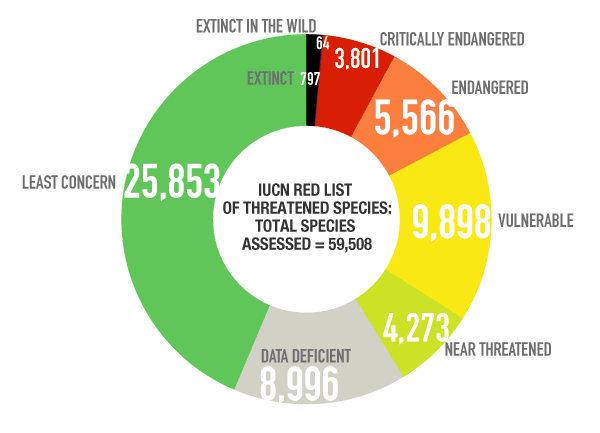
When seeking to help out a pressing cause, it all starts with education. Head over to the IUCN Red List linked below to do some research into your favourite animals and their stance in population numbers, or if you want to see the most endangered straight away, take a look at the WWF website to look at their list of most endangered species (which you 

could then consider sponsoring!). 

Thank you very much for taking the time to read, remember to stay safe, and stay educated on the vanishing species you know and love! And always keep in mind, while being aware of the species we have lost, don’t forget to look at all of the great success stories when it comes to reappearing (we’re looking at you, dodo bird).

Ecosystem services and nature based solutions blog: https://youthfornature.uk/2020/12/15/ecosystem-services-and-nature-based-solutions/

Ethical shopping resource:

giki.earth/

IUCN Red list:
https://www.iucnredlist.org/

WWF endangered list

https://www.wwf.org.uk/learn/wildlife?ds_rl=1263317&pc=ATB001001

WWF success stories! 

https://www.wwf.org.uk/success-stories

Monica’s Instagram: HERE

We’re recruiting for our Advisory Committee!

We know that there are a  number of areas where we know we can improve our performance, knowledge and outcomes. An Advisory Committee would help us to ensure that our actions as an organisation and a movement are as impactful as they can be and are embedded in evidence, accuracy, and expertise. 

We are currently seeking advisors with the following expertise:

List of positions:

  1. Diversity & inclusion 
  2. Social media 
  3. Campaign strategy  
  4. Political strategy  
  5. Mental health & education 

Our initial proposal would be for an average of 1 day/month. However, the structure of the advisor’s position would be tailored according to their skills, expertise, availability, and own ideas, investment, and requirements. This time would be used mainly by the core Organising Team and would perhaps include: 

  • Review of strategy documents, according to area of expertise, and suggestions for improvement 
  • Review of campaign materials, according to area of expertise, and suggestions for improvement 
  • Open discussions and general training and advice 
  • Targeted sessions for wider members of the team 
  • Specific questions that would be addressed to advisors only once we had undertaken research and attempted to come up with solutions ourselves.

If you’re interested or want to find out more, please email: ukyouthfornature@gmail.com 

Thank you! 

Burned into their memory: the fate of Englands’ peatlands

Peatlands remember. They remember the way the climate has changed over thousands of years by the shifting pollen grains they hold. They remember brutal sacrifices from the Iron Age by their careful swaddling of perfect human corpses. They remember pollution 800 years ago with increased lead deposits. They remember us testing nuclear weapons by the radioactive isotopes that sprinkled down on them. They remember ancient fires with thin layers of buried ash. And they remember today’s fires too.

Upland moors in places like the Peak District are burned every year to remove the cover of heather. The heather, whose roots are still intact, will grow back over the next couple of years. Grouse, rusty brown birds with white feet and a red streak on their heads, eat these fresh shoots. This food, the protective shelter of older heather patches, and the reduced predation risk by birds of prey (because of their illegal destruction by gamekeepers) the grouse population grows. This thriving does not last, however. Instead of being hunted to feed hungry golden eagles and hen harriers, it is humans who pay around £7000 a day for the luxury of shooting them. Roughly 500’000 grouse are shot every year like this.

Peatlands remember. They are made of memory. 

Peat is layers of partially decomposed plant matter, accumulated over thousands and thousands of years. In the blanket bogs where grouse hunting happens, the plant community is dominated by Sphagnum moss. They begin their lives as an explosion of spores, which then germinate and extend their tendrilous branches across and under the surface of the peatland. Deeper than a centimetre or two, light cannot penetrate. Sphagnum beneath this point, buried by its cousins above, dies. But it is not forgotten. The watery grave protects it. Whereas in other ecosystems microorganisms and fungi break down dead bodies, in peatlands they are much less able to do so.  This is because the oxygen decomposers require to stay alive cannot penetrate through the water. As well as this, Sphagnum is made out of cells that are inherently resistant to decomposition and it produces chemicals which acidify the water, effectively pickling itself. 

The peatland remembers everyone who ever lived there, building itself from them and in doing so becoming the largest terrestrial carbon store. New plants germinate and grow on top of their ancestors and the bog climbs upwards, growing around a centimetre each year, and each year sequestering around 0.37 gigatons globally of CO2.0.37 Gt, one centimetre ago, Zac Goldsmith pledged to ban the burning of peatlands for grouse shooting. Yet today still the practice continues, with the environment minister George Eustice accused of blocking efforts at legislation. When these areas are burned, the top layer of Sphagnum is destroyed and the level of organic matter in the upper layers of peat is diluted by the incoming ash from the burning. It is this upper layer of organic matter which holds on to

the scarce nutrients which come to the bog through the rain, so without it Sphagnum cannot get the fuel it needs to grow. As the researchers from Leeds University put it: “In this sense, the peat retains a ‘memory’ of past burning”.

Even worse than this, burning lowers the water table, exposing peat to the air and allowing it to decompose and release its carbon. Burning peatlands for grouse shooting releases 260’000 tonnes of CO­2 every year in England. 

Looking globally, as well as burning, extracted peat is imported for use in compost and peatlands are drained so the land can be used for agriculture. The combined total of all of these is that degraded peatlands release 6% of annual anthropogenic greenhouse gas emissions. The peatland’s memories are destroyed at our expense.

Contemplating peatlands gives a deep perspective on time and land. Many lament that we would lose an essential English tradition if we were to ban burning. The thousands-of-years-old peat mocks the idea of a 250-year-old ‘tradition’. Many cite the economic benefits that grouse-shooting brings, but these dwindle when they are put in proportion to the size of the land used. And they vanish when we look with the peatland’s eyes wider and deeper in time. The short-term benefits are outweighed by the costs of the climate and ecological crisis. Costs which are already hitting those worse off the hardest, and which my generation and my generation’s children will have to deal with. 

Having said this, policies for peatlands in England must not leave the communities who have benefitted from historic poor practices without alternative means of supporting themselves – for example through regenerative payments for peatland’s many ecosystem services. Effective engagement with these local stakeholders is required for a collective movement into the positive vision of a future where peatlands and humans can thrive.

Peatlands will remember the decisions this government makes long after its term has ended. Next year the assembled countries of the world will remember the decisions this government makes when they congregate here for COP26. Therefore let them be the right decisions. Ensuring a just transition for local communities, we must ban burning on peatlands; ban the import of extracted peat from other countries; and rewet, restore and protect our degraded peatlands. If we do not, the peatlands will remember. 

By Jamie Walker, with Bethany Copsey and Frankie Turk, members of Re-Peat. If you run into any problems accessing the cited resources, contact Jamie Walker for more information.

Letter to the UK Government on peat burning

We have today (15th October 2020), along with A Focus on Nature and Re-Peat, written to the Government calling on them to ban peat burning. Here’s the full text of our letter.

To: Rt Hon Alok Sharma MP, Secretary of State, Department for Business, Energy and Industrial Strategy and Rt Hon George Eustice MP, Secretary of State, Department for Environment, Food and Rural Affairs.

15th October 2020

Re: Young nature conservationists urge the government to ban the burning of peatlands

Dear Secretaries of State

We are writing to you as a network of young people passionate and alarmed about the decline of our natural world. We urge you to take the necessary steps to bring an end to the burning of peatlands in England.

Peatlands are one of the most precious habitats in our country, and we are home to an important proportion of Europe’s peatland habitat, and of the world’s blanket bog. Peatlands have formed over thousands of years and hold 20 years’ worth of the UK’s annual emissions. But, at present these greenhouse gas storage machines have been put into reverse gear and are pumping out carbon into the atmosphere. The UK’s peatlands currently release the equivalent of 6% of our annual emissions.

One of the main causes of this, releasing 260,000 tonnes of CO2 per year in England, is the practice of burning peatlands, which also destroys their ability to store water and their status as a home to rare biodiversity too.

As the UK prepares to host the world’s climate conference in 2021, banning this practice is one of the most basic steps that could be taken to bolster our reputation on climate change. We cannot lecture other countries on their practices (such as Brazil’s burning of the Amazon – in 2019 the Prime Minister said he was “deeply concerned” by the fires) while we continue to intentionally set fire to our own vast carbon stores. 

Our international diplomatic leverage and credibility will be undermined if we do not tackle this issue.

Your Government must do three things:

  • Ban the burning of peatlands. This practice is unnecessary and environmentally destructive. Your Government wants to be the first to hand on the environment in a better state – if you do not ban peat burning then this alone will mean you have failed your own test.
  • Include peat emissions in the UK’s greenhouse gas inventory (at present they account for 6% of annual UK emissions but are not included in our accounts, removing any real incentive to get to grips with them).
  • Ban the use of peat compost, so as we stop using peat dug up from the rare peatlands of other countries.

On behalf of young people across the UK passionate about nature and wildlife, we urge you to take these steps. If these measures can be put in place, they will be the cornerstone of a flourishing, healthy future for our peatlands. We dream of that future and hope to be the generation that ushers it into existence.

We would be grateful for the opportunity to discuss this issue with you or your departments.

Matt Williams, Director, UK Youth for Nature (www.youthfornature.uk)

Lauren Cox, Policy and Campaigns Officer, A Focus on Nature (www.afocusonnature.org)

Jamie Walker, Re-Peat (www.re-peat.earth)