Welcome to our nature news round-up for the week ending Friday 17th of November.

1. Experts predict UK forests could suffer ‘catastrophic collapse’ in next 50 years – Innovation News Network, 9th November 2023

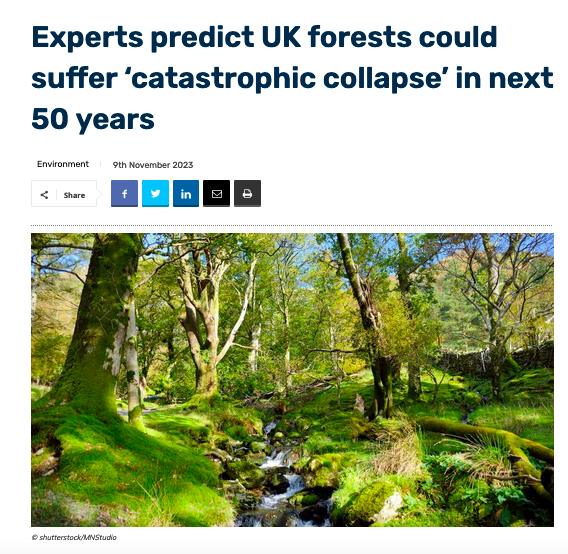
A team of experts from across Europe has produced a list of 15 overlooked and emerging issues that are likely to have a significant impact on UK forests over the next 50 years if action is not taken now.

Current threats to UK forests include competition with society for water, viral diseases, and extreme weather affecting forest management.

This is the first ‘horizon scanning’ exercise – a technique to identify relatively unknown threats, opportunities, and new trends in these forests.

The aim is to help researchers, practitioners, policymakers, and society in general, better prepare for the future and address threats before they become critical.

Dr Eleanor Tew, first author, visiting researcher at Cambridge’s Department of Zoology, and Head of Forest Planning at Forestry England, said: “The next 50 years will bring huge changes to our forests: the threats they face, the way that we manage them, and the benefits they deliver to society.”
2. Work begins to save rare Devon butterflies – BBC News, 11th November 2023

Work to save four of Devon’s rarest butterfly species is set to start this winter.

The Devon Fritillary Recovery Project is a two-year land management plan by the Devon Wildlife Trust.

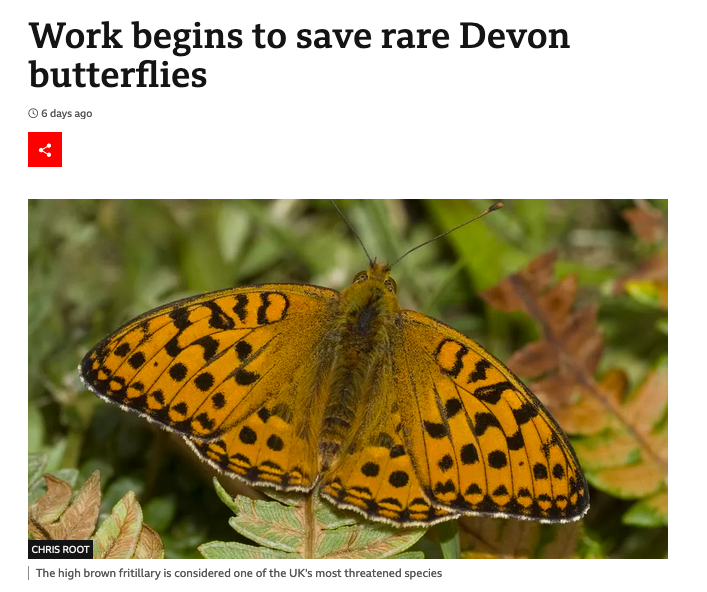
The project aims to help struggling populations of high brown, pearl-bordered, small pearl-bordered and marsh fritillary butterflies. The charity said numbers had declined dramatically due to changes in farming, loss of habitat and climate change.It said the high brown fritillary, in particular, had seen its numbers crash by 96% and was now one of the UK’s “most threatened species”.

Staff and volunteers will now begin work to manage the levels of scrub and gorse at 12 of the trust’s nature reserves to ensure the habitats encourage butterfly population growth. Project officer Jenny Cawson said: “Devon Wildlife Trust’s nature reserves offer some of the last homes to our struggling butterflies so it’s vital that we work hard to keep them in good condition. “The launch of our Devon Fritillary Recovery Project signals the start of a huge effort to not only stabilise the populations of these rare species but to restore their numbers.
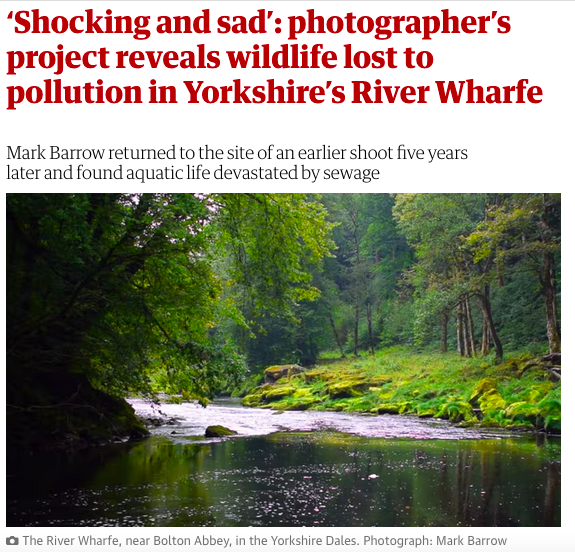
3. ‘Shocking and sad’: photographer’s project reveals wildlife lost to pollution in Yorkshire’s River Wharfe – The Guardian, 11th November 2023

Five years ago, when Mark Barrow started his project to film along the 65-mile River Wharfe in Yorkshire, he captured footage of majestic shoals of grayling, the fish known as “the Lady of the Stream”, some 200 or 300 strong.

Recently, Barrow returned to the same spot, near the historic Harewood House on the outskirts of Leeds, to reshoot some video because he wasn’t happy with the quality of his earlier attempt.

What he found shocked him. The water was cloudy with pollution and the numbers of grayling, with their distinctive red fins and pewter scales, were reduced to pockets of no more than 30 or 40.

“It was a huge difference in five years,” said Barrow, 53, of Wetherby, West Yorkshire. “Grayling, in particular, are susceptible to pollution in the waters. It was very shocking and sad to see.”
4. Warming ends when carbon pollution stops – Frontiers in Science, 14th November 2023.

A recent article in The Hill insisted that “scientists failed for decades to communicate” the threat of climate change. The scientific paper on which the article was reporting did not really say that—it was instead providing a more nuanced discussion of sea level rise “tail risk”. But the irony here is that the opposite of what was asserted by the news article is arguably true. If anything, we scientists have failed to communicate the prospects for averting catastrophic warming.

In the days when I was working on my PhD, in the early 1990s, we were taught that the warming of the planet would persist for decades even if we suddenly stopped burning fossil fuels and emitting carbon into the atmosphere. This is due to what is known as “thermal inertia”—the slow, sluggish response of the oceans. Climate models showed that surface warming would continue for 30 years or more, as the oceans slowly continue to warm, even after carbon pollution ceases. This so-called “committed warming” would seem to render our efforts to avert disaster somewhat futile. Even if we turned off the metaphorical carbon faucet, the water level of warming would continue to rise. Extending the metaphor, that water would soon spill from our kitchen sink onto the kitchen floor. With apologies to Greta Thunberg, rather than burning, our house would instead be flooding.
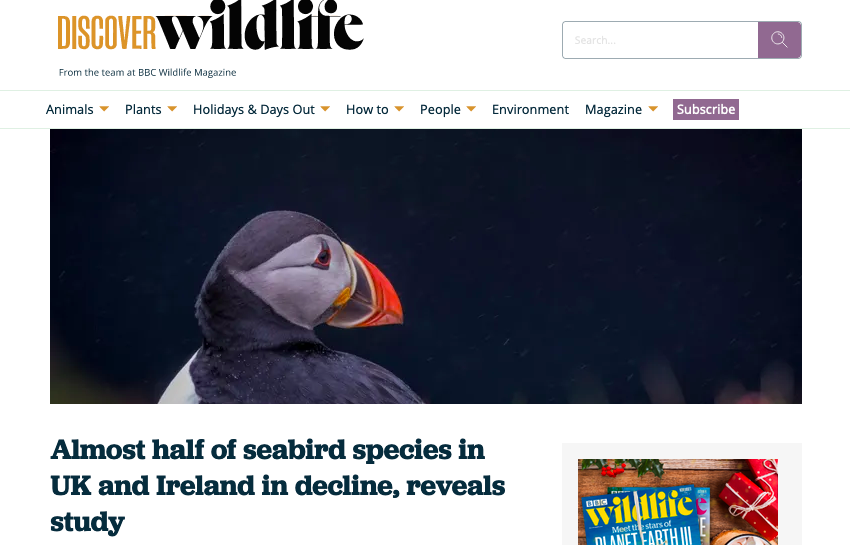
5. Almost half of seabird species in UK and Ireland in decline, reveals study – BBC Wildlife Magazine, 16th November 2023

Britain and Ireland hold most of the world’s nesting Manx shearwaters, northern gannets and great skuas. The islands are also a vital stronghold for other species of seabird, such as lesser black-backed gulls, common guillemots, European storm-petrels and roseate terns. Yet a new study released today found that almost half of the seabird species in Britain, Ireland, Isle of Man and the Channel Isles have declined in the past 20 years.

The Seabirds Count census, led by the Joint Nature Conservation Committee (JNCC), surveyed over 10,000 sites between 2015 and 2021. Experts suggest that the causes of decline are linked to adverse weather conditions (which may be a result of climate change), a lack of food as a result of both climate change and fisheries, and predation.
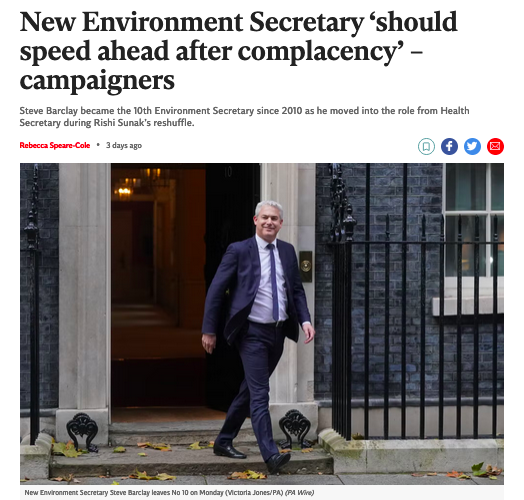
6. New Environment Secretary ‘should speed ahead after complacency’ – campaigners – The Independent, 14th November 2023

The new Environment Secretary Steve Barclay “should speed ahead with quick wins” as his predecessor leaves a legacy of “complacency”, campaigners have said.

Mr Barclay became the 10th Environment Secretary since 2010 as he moved into the role from Health Secretary during Rishi Sunak’s reshuffle on Monday.

He replaces Therese Coffey, who resigned from Government during the reshuffle after holding several ministerial jobs including health minister and work and pensions minister, and also served as deputy prime minister under Liz Truss.

Campaigners are now calling on Mr Barclay to act quickly as they criticised the Government and Ms Coffey over the recent response to environmental challenges facing the UK.
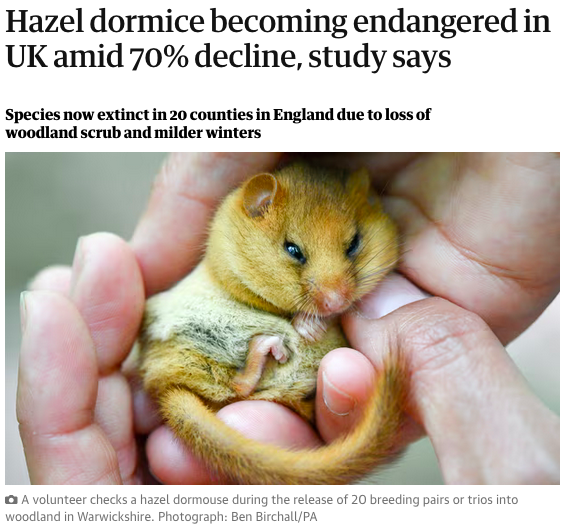
7. Hazel dormice becoming endangered in UK amid 70% decline, study says – The Guardian, 10th November 2023

Populations of the hazel dormouse, perhaps the most elusive native British mammal, have plummeted by 70% this century.

The nocturnal, tree-dwelling animals are now extinct in 20 counties in England and the species must be reclassified as “endangered” on the International Union for Conservation of Nature red list, according to a study by the People’s Trust for Endangered Species (PTES).

Since the previous State of Britain’s Dormice report was published in 2019, they have vanished from Hertfordshire, Staffordshire and Northumberland.

The key factor in their decline is the loss of the scrubby under-storey in woodlands where the arboreal dormice live and feed in spring and summer, but the problem has been compounded by climate change, according to conservation scientists.
8. UK to loosen post-Brexit chemical regulations further – The Guardian, 14th November 2023

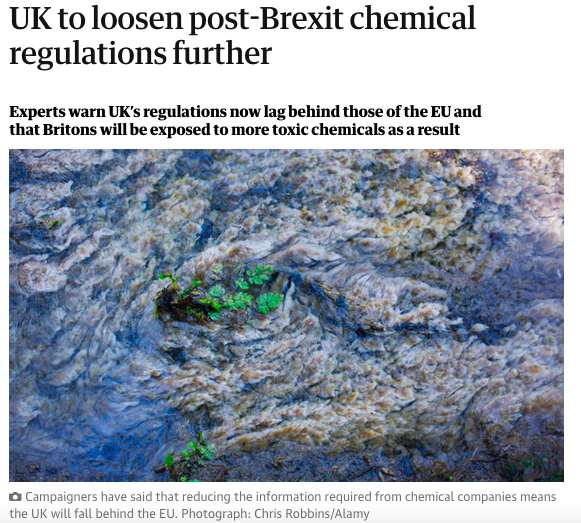
The government is to loosen EU-derived laws on chemicals in a move experts say will increase the likelihood of toxic substances entering the environment.

Under new plans the government will reduce the “hazard” information that chemical companies must provide to register substances in the UK. The safety information provided about chemicals will be reduced to an “irreducible minimum”, which campaigners say will leave the UK “lagging far behind the EU”.

The UK’s scheme, called UK Reach, is falling behind the EU’s as it is. The UK has not been part of the bloc’s chemicals regulations scheme, EU Reach, since 2021. Eight rules restricting the use of hazardous chemicals have been adopted by the EU since Brexit, and 16 more are in the pipeline. The UK has not banned any substances in that time and is considering just two restrictions, on lead ammunition and harmful substances in tattoo ink.
If you’re concerned about chemical pollution in our freshwater ecosystems, check out our #NotsoFreshwater campaign.

Thanks for reading our news round-up! If you enjoyed it and want to amplify these stories, why not give this blog a share on your social media, and help us celebrate and commiserate the good, the bad and the ugly from this week! See you next week!

Community member spotlight – Ramandeep Nijjar

Who are you?

I always find this such a hard question to answer so I will try my best – I love getting involved with various things. Firstly, I am a zoology student in my second year at the University of Reading. I am co-president of the university’s hedgehog society which we started last year and diversity officer for the hiking society.

I feel I have discovered my voice while at university so I am passionate about representing student views. I am one of two senior representatives for the School of Biological Sciences this year, part of senate and a mentor for new students. I also want to use my energy to help make a difference for nature and wildlife. I love being part of UK Youth for Nature and a BTO Youth Rep. In my free time, I like being active, reading and exploring new places.


What is your favourite nature place in the UK?

We have a static caravan in the countryside, it has no Wi-Fi, but I love it when we get to go as it is true bliss. All the surrounding countryside is beautiful, I love that you can walk for miles and I can just take my binoculars and take in all the incredible wildlife. I often live quite a fast-paced life, so it’s sometimes nice to just take things slow and enjoy nature.

If you were voted President of the Planet, what would be the first three things you’d change?

This is such a challenging question as I would love to change a multitude of things but I would choose:

  1. I would make it mandatory for everyone to put their phones down for 30 minutes every day and spend time outside. As it is so good for people’s well-being and physical health, words cannot truly express how much nature helps me.
  2. Everyone has to do one kind act each day, as this would help spread positivity. I often find helping others is one of the most fulfilling things you can do.
  3. Once a month, every person has to do one thing that is outside of their comfort zone. This would encourage people to push themselves and try new things.


Would you rather be a tree or a coral?


This is a hard question! I would love to be a tree to be able to look above some amazing landscapes, but I am also very curious about marine life, so being a coral could be a good too. I think at the moment as I am becoming a keen birder it would be a tree. Plus, I am quite small, so it would be nice to feel tall for once!

If you could only drink one drink for the rest of your life, what would it be?

This would definitely be green tea, I am such a big tea fan but green tea is superior for me. I naturally have a lot of energy so I haven’t had much coffee yet, that may change who knows? However, if you ever see me with a mug throughout the day it is highly likely I am drinking green tea. I am not sure why I adore it so much, it just helps me stay calm and focused throughout the day.

What are your favourite things to see, hear and smell?

See: Sunrises and sunsets, every single time I watch them it takes my breath away.
Hear: I love listening to rushing water from a river or waves by the sea.
Smell: Grass in the morning with dew.

If you’re aged between 16 and 35 and are looking for a community of like-minded nature-lovers, stop your search! Our growing community is open to everyone within this age range, and you can be as involved as you want. There’s no minimum time requirement. Our community is made up of people from every background imaginable – we’re not all scientists or outspoken activists…we’re just a big ol’ group of nature fans who want to do our bit to give wildlife a future on our planet (and us humans too). Find out more about joining us here.

Welcome to our nature news round-up for the week ending Friday 10th of November.

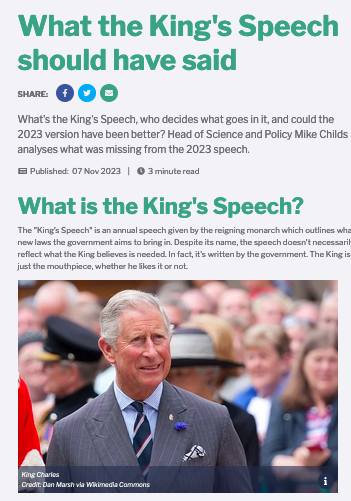
1. What the King’s Speech Should Have Said – Friends of the Earth, 7th November 2023

The “King’s Speech” is an annual speech given by the reigning monarch which outlines what new laws the government aims to bring in. Despite its name, the speech doesn’t necessarily reflect what the King believes is needed. In fact, it’s written by the government. The King is just the mouthpiece, whether he likes it or not.

On 7 November 2023, we witnessed a speech motivated by culture wars and an attempt to drive a wedge between the Conservative Party and Labour on issues such the environment. What should have been an opportunity to address the climate and nature emergencies that scientists keep warning us about, was instead a cynical move by the Conservatives to backtrack even further on environmental measures.

For example, an annual granting of licenses for offshore oil and gas licences was announced, despite the government admitted this will not reduce energy bills. The King also had to read out a promise to scrap minimum energy efficiency standards in the private rented sector, a move that has been estimated to cost renters up to £1.4 billion a year.

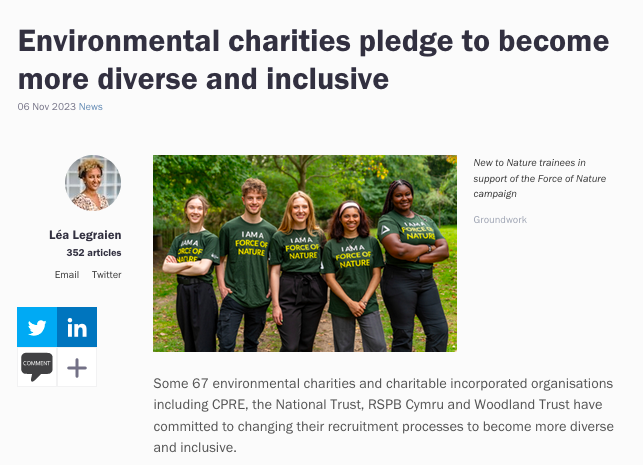
2. Environmental charities pledge to become more diverse and inclusive – Civil Society, 6th November 2023

Some 67 environmental charities and charitable incorporated organisations including CPRE, the National Trust, RSPB Cymru and Woodland Trust have committed to changing their recruitment processes to become more diverse and inclusive.

Today, Groundwork, a federation of charities, launched the Force of Nature campaign, which aims to encourage environmental organisations to do more to diversify the green jobs workforce.  

Last year, a report by the RACE Report campaign showed that 7% of those working in the environmental charity sector are from Black, Asian and minority backgrounds, compared with a 14% national average across all people in employment and 9.5% of the civil society workforce.

3. The Wildlife Trusts publish list of the UK’s Government’s broken promises to nature – Wildlife Trusts, 3rd November 2023

Today, Friday 3rd November, The Wildlife Trusts publish a list of 10 broken promises by the UK Government on the environment. Despite the UK Government’s assurances of leaving nature in a better state by the end of its tenure, there are increasing concerns that its nature-negative agenda is undermining its manifesto commitment. This includes repeated attempts to water-down environmental protections through ditching nutrient neutrality rules, the recent announcement not to prioritise species reintroduction, and the passing of the Retained EU Law Act which allows the UK Government to revoke or weaken environmental legislation without parliamentary scrutiny.

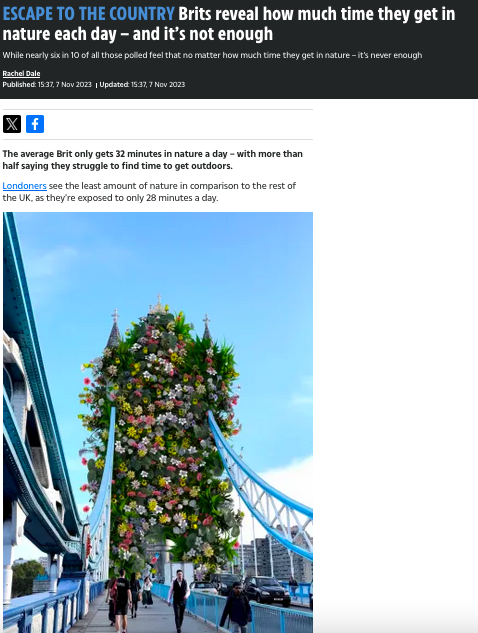
4. Brits reveal how much time they get in nature each day – and it’s not enough – The Sun, 7th November 2023

The average Brit only gets 32 minutes in nature a day – with more than half saying they struggle to find time to get outdoors. 

Londoners see the least amount of nature in comparison to the rest of the UK, as they’re exposed to only 28 minutes a day.

The study of 2,000 adults found more than a quarter (26 per cent) find it harder to connect with nature now than they did 10 years ago.

And 46 per cent of those blame this on living in cities and built-up areas with less greenery.

While nearly six in 10 of all those polled feel that no matter how much time they get in nature – it’s never enough. 

Walks in the park (58 per cent), enjoying a coffee in the garden (39 per cent), and taking off shoes and going barefoot (10 per cent) are among the ways we connect with the Earth.

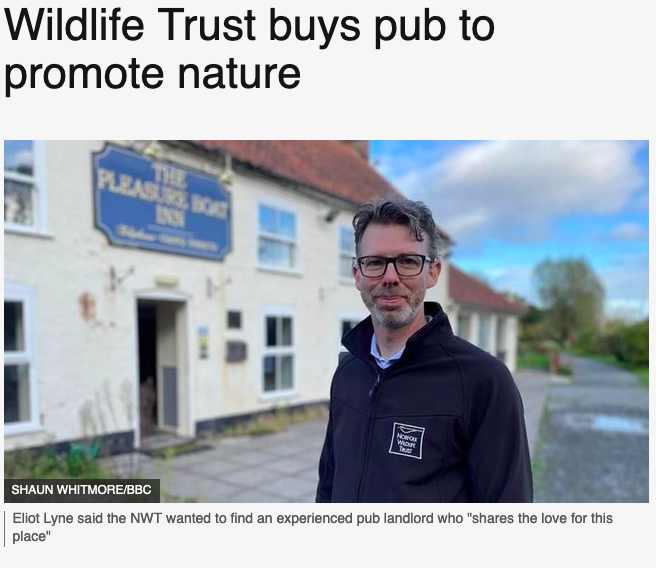
5. Wildlife Trust buys pub to promote nature – BBC News, 8th November 2023

A wildlife charity has bought an empty pub to try to help more people connect with nature in The Broads national park.

Norfolk Wildlife Trust paid “the market rate” for the Pleasure Boat Inn in Hickling, which has been closed for about three years.

It hoped the purchase would attract people who “might not normally go to a nature reserve” to get connected with the outdoors.

The charity plans to hire experienced pub managers to run the inn and extensive refurbishment will be carried out before it opens in 2024.

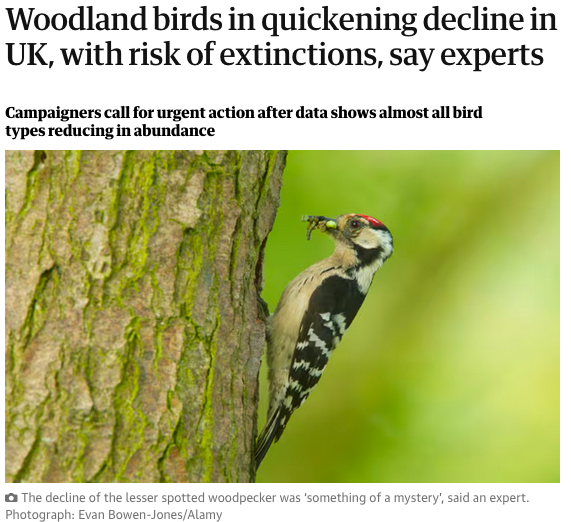
6. Woodland birds in quickening decline in UK, with risk of extinctions, say experts – The Guardian, 8th November 2023

Woodland birds are facing an accelerating decline in the UK, with species at risk of extinction if the government does not act, experts have said.

Data released by the Department for Environment, Food and Rural Affairs (Defra) has revealed that almost all bird types are reducing in abundance, despite years of warnings from nature bodies that action needs to be taken to protect habitats and save species.

Bird campaigners have warned that urgent measures must be taken to “bend the curve” of nature loss.

Faring the worst are woodland birds. Their indicator of abundance has fallen by 37% since 1970, and by 15% in just the past five years, which suggests an accelerating decline. In general, bird indicators have fallen by 6% in the past five years and 15% since 1970. In the last five years just three species in the woodland bird group have increased – blackcap, nightingale and nuthatch – but 23 have declined.

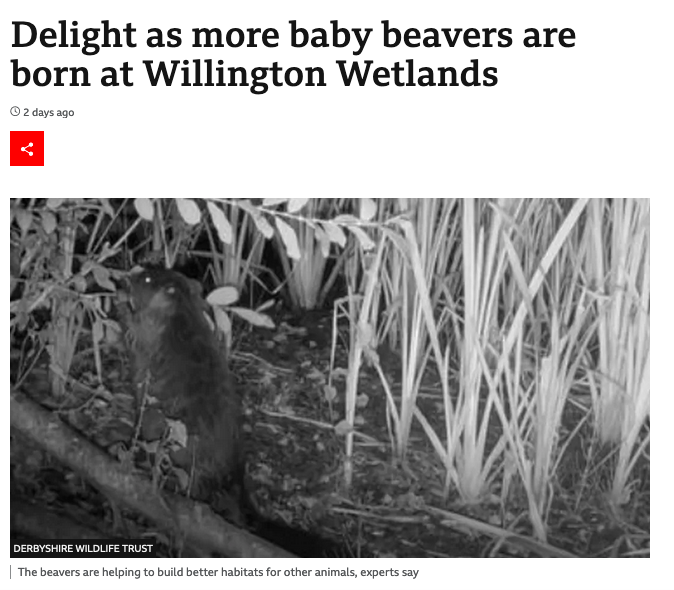
7. Delight as more baby beavers are born at Willington Wetlands – BBC, 8th November 2023

Conservationists say the first family of beavers to breed in Derbyshire for 800 years has grown again.

The aquatic animals were reintroduced at Willington Wetlands, near Repton, in 2021, leading to the birth of two babies in the county for the first time since the 13th Century.

Now two more babies, called kits, have expanded the family.

The Derbyshire Wildlife Trust said it was thrilled to see more of the dam-building creatures.

This one isn’t UK specific, but we thought it deserved a highlight anyway…

8. These haunting underwater photos portray climate change in a new way – CNN, 4th November 2023

Akessa stares straight ahead with a look of fierce indignation.

The 15-year-old is sitting in a rickety chair. Her hands are clasped in her lap. Her white skirt is billowing ever so slightly in what, at first glance, you might assume is the wind.

The scene seems nearly normal until more details come into focus: The background is an eerie shade of blue you wouldn’t see on land. Thousands of broken shards of coral cover the ground. And a reef looms behind her.

There is no breeze blowing here.

This girl and her searing gaze are underwater.

Thanks for reading our news round-up! If you enjoyed it and want to amplify these stories, why not give this blog a share on your social media, and help us celebrate and commiserate the good, the bad and the ugly from this week! See you next week!
Welcome to our nature news round-up for the week ending Friday 3rd of November.

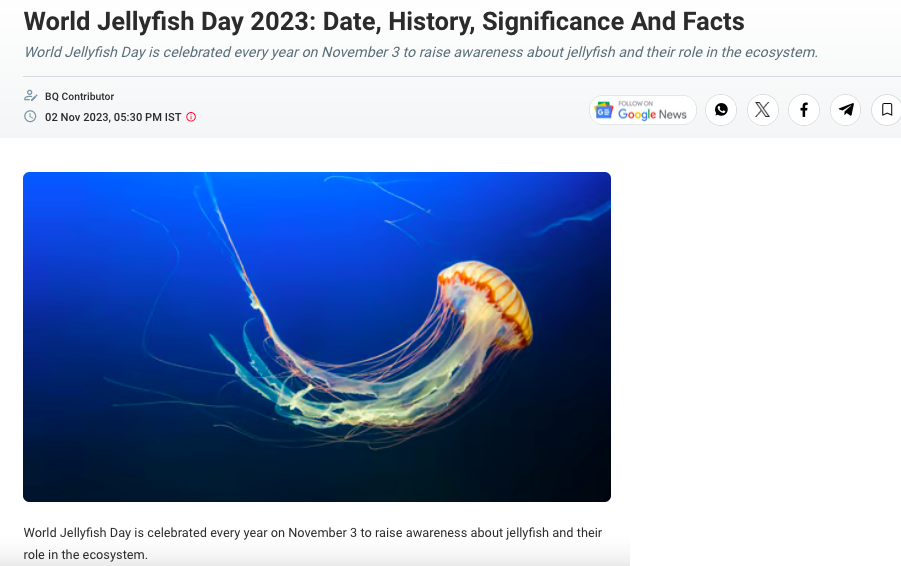
1. Today is World Jellyfish Day! BQ Prime, 2nd November

World Jellyfish Day stemmed from enthusiastic marine biologists to put a spotlight on these creatures. Jellyfish have been swimming in our oceans for over 500 million years, making them one of the oldest living creatures on Earth. Despite this, their understanding among the general populace remained superficial for a long time, often confined to their stinging nature or their beauty. World Jellyfish Day was introduced reportedly in the year 2014 to shed light on the more profound aspects of these creatures.

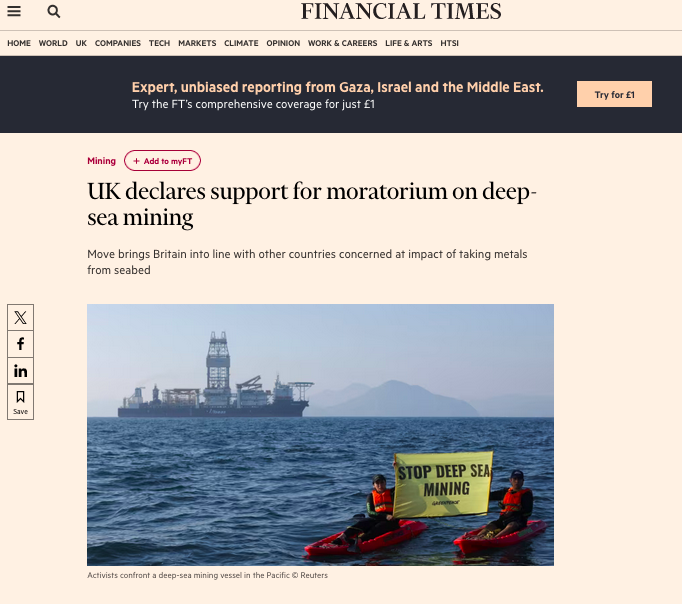
2. UK declares support for moratorium on deep-sea mining – Financial Times, 30th October

The UK has said publicly for the first time that it will back a moratorium on deep-sea mining, after its previously supportive stance for the controversial practice came under fire from scientists and parliamentarians. The government on Monday announced its support for a temporary suspension of sponsoring or supporting licences for projects to exploit metals from the seabed until enough scientific evidence was available to assess its impact. The move brings the UK in line with Brazil, France and Germany, which are among more than 20 countries to have called for a pause in deep-sea mining, at least until the environmental effects are better understood.

3. Claimants take UK government to court over inadequate climate adaptation – Guardian, 1st November

When Kevin Jordan bought his seaside home in Hemsby, Norfolk, he was told it would be safe for a century. In the decade since, 17 of his neighbours’ homes have had to be demolished, or have been swept away into the waters of the North Sea. His is now just 5 metres from the fast-crumbling cliff, isolated and unreachable by car after part of the road collapsed into the North Sea.

The people of Hemsby would seem to be natural beneficiaries of official policies to adapt to the climate crisis. Under the Climate Change Act 2008, the government is required to produce a national adaptation programme every five years, setting out plans protect communities in the UK from the extreme heat, flooding and coastal erosion expected as the climate breaks down.

But critics, including the government’s own advisers, the Climate Change Committee (CCC), have said it is not doing enough. And now, in a case believed to be the first of its kind, Jordan is taking the government to court, alleging its failure to set out lawful “adaptation objectives” in its latest plan is a breach of his human rights.

4. Climate breakdown – a matter of time – Ecologist, 31st October (by UK Y4N community member Ione Howells!)

We need a radical reimagining of the relationship between society, time, and nature In this era of global scorching.

The natural world is collapsing. The IPCC currently reports that our window of opportunity to preserve a liveable world is ‘rapidly closing’. 

Averting climate breakdown is increasingly high on the global political agenda – but our current market-based solutions aren’t working.

The commodification of everything in the neoliberal era – especially our own time – has isolated us from the natural world around us. 

Reconstruct

Our tenuous relationship with the living planet revolves around profit, loss, extraction and exploitation. It’s unsurprising, then, that our attempts to ‘fix’ it are failing. 

We live in a culture of consumerism and commodity, where economic calculations of profit and loss take precedence over traditional systems of care. 

Where does this leave us? We are abstracted from our very means of existence, the planet we live on and with. 

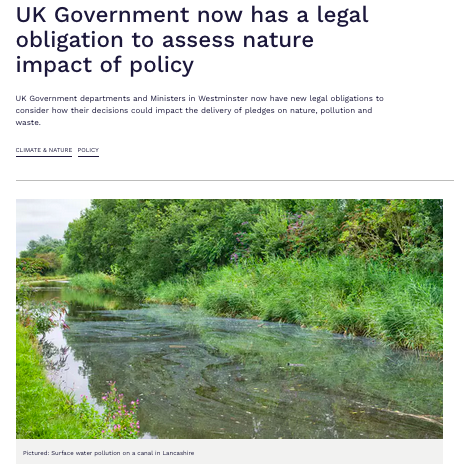
5. UK Government now has a legal obligation to assess nature impact of policy – Edie, 1st November

UK Government departments and Ministers in Westminster now have new legal obligations to consider how their decisions could impact the delivery of pledges on nature, pollution and waste.

This is because the Environmental Principles Policy Statement has been implemented today (1 November).

The Statement was first promised under the Environment Act, which received Royal Assent in November 2021. Then, the Statement in its current form was laid before Parliament this January by the Department for Food, the Environment and Rural Affairs (Defra).

Five environmental principles are covered in the Statement, the first being ‘the integration principle’. This stipulates that the consideration of environmental protection must be integrated into the process of designing policies. Policies are defined in the statement as not only formal Bills and Acts, but also statements, proposals and strategies that intend to inform legislation in the future. Documents prepared by public bodies which ministers are required to approve also count.

The Statement will apply to new policies plus those currently in development and not yet finalised. The UK Government has a long-term vision, under the 25-Year Environment Plan, to leave nature in a better state for the next generation. It has repeatedly been warned that it is failing to deliver on this vision by green groups and academic specialists in the environment.

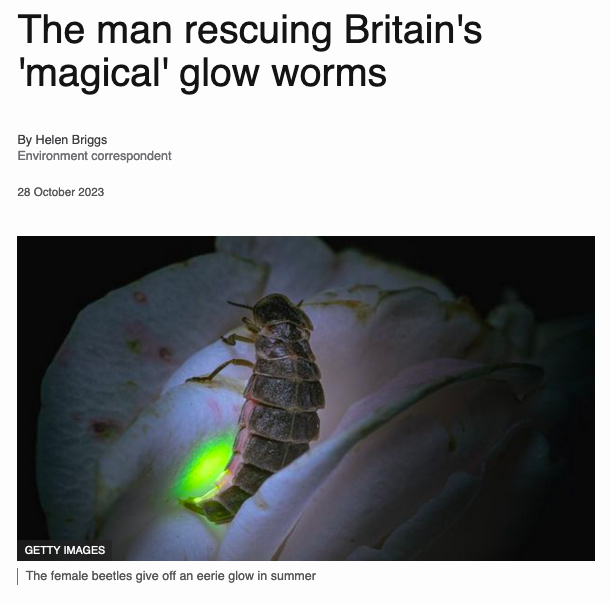
6. The man rescuing Britain’s ‘magical’ glow worms – BBC News, 28th October

“The fascination of glow worms for me is that they are in effect magic,” says ecologist Pete Cooper, as he tramples through thistles and nettles.

“The glow worm has been the symbol of the other world, of love, of hope, of rebirth, of simply the great mysteries of nature.”

The insect is declining in many parts of the UK due to a host of factors, from habitat loss to light pollution. Experts believe artificial lighting is distracting the males so they miss out on a chance to mate.

The young conservationist has a passion for glow worms that’s second to none. He has gone to extreme lengths to breed and release them in the south of England, such as here in Hampshire.

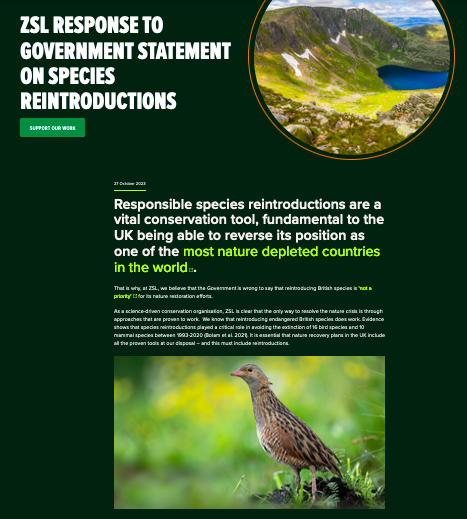
7. ZSL Response to Government Statement on Species Reintroductions – ZSL, 27th October

Responsible species reintroductions are a vital conservation tool, fundamental to the UK being able to reverse its position as one of the most nature depleted countries in the world

That is why, at ZSL, we believe that the Government is wrong to say that reintroducing British species is ‘not a priority’ for its nature restoration efforts.  

As a science-driven conservation organisation, ZSL is clear that the only way to resolve the nature crisis is through approaches that are proven to work.  We know that reintroducing endangered British species does work. Evidence shows that species reintroductions played a critical role in avoiding the extinction of 16 bird species and 10 mammal species between 1993-2020 (Bolam et al. 2021). It is essential that nature recovery plans in the UK include all the proven tools at our disposal – and this must include reintroductions. 

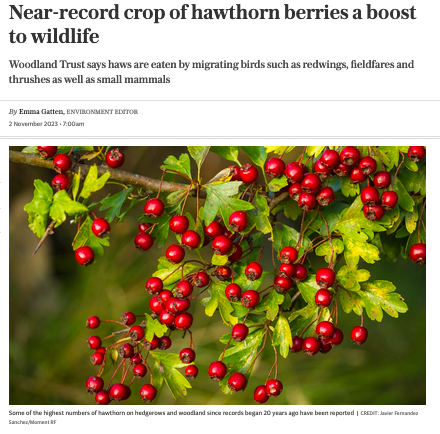
8. Near-record crop of hawthorn berries a boost to wildlife – The Telegraph, 2nd November

Woodland Trust says haws are eaten by migrating birds such as redwings, fieldfares and thrushes as well as small mammals

One of the largest crops of hawthorn berries has been recorded by nature watchers this year in a boost to wildlife.

The Woodland Trust has said its volunteers have reported some of the highest numbers of hawthorn on hedgerows and woodland since records began 20 years ago, equal only to 2014.

It has put the exceptional crop down to the mild temperatures this spring, which were above average.

This is the time white hawthorn flowers bloom and if pollinated, go on to produce the red fruits.

“This is really good autumn news for wildlife,” said Dr Judith Garforth, the Woodland Trust’s citizen science officer.

Thanks for reading our news round-up! If you enjoyed it and want to amplify these stories, why not give this blog a share on your social media, and help us celebrate and commiserate the good, the bad and the ugly from this week! See you next week!
Youth urban nature creative showcase: exploring the beauty of nature in the city

As part of our Urban Nature campaign, we’re hoping to spread awareness and appreciation of the wildlife, plants, fungi, lichens, slime moulds and whatever other living organisms we share our urban landscapes with. Each quarter, we’ll change the theme, and you can submit a creation using whatever artistic medium your heart desires – photography, illustrations, crochet, poems, songs, whatever your creative medium of choice!

The theme until Monday 22nd of January is…WATER!

Overview

We want to celebrate urban nature and share our experiences of it between urban areas across the UK – each urban environment is unique and will support an array of different wildlife and plants. We hope this project will help people recognise that nature is present in urban spaces, and to help them enjoy it, seek it out, and have experiences that connect them with it, inspiring them to act and support our government policy asks (coming soon!).

Theme

The theme for the first quarter (Thursday 2nd November – Monday 22nd January) is water in urban environments. Think ponds, puddles, gutters or water droplets – there’s probably a lot of rain coming our way, so there should be plenty of inspiration! Some of the UK’s nature thrives during wet weather – mosses, fungi, slime moulds – so their presence is a sign that nature is benefitting from all the extra moisture!

Submission guidelines

Submissions should be sent via direct message to our Instagram or Facebook inboxes, along with the name of the piece (even if it’s just the name of the place or animal featured in a photograph, as well as the name of the place it was created). All submissions will be shared to our stories, and you’ll be tagged in them (unless you don’t want to be – specify in your submission), and we’ll showcase some of the entries at the end of each month on our social media, and share them all on the website when the theme ends and changes..

If you don’t use social media, submissions can be sent to ukyouthfornature@gmail.com with the subject line ‘urban nature photography submission’, along with your name (if you want to be credited), location of the photo and the name of the piece. Please send the highest resolution copy of the photograph that you have, and it can be in portrait or landscape format – it may be cropped to fit in an social media carousel or website gallery.

Sample entry: Hannah Mulvany, Banff, Scotland

Submission Deadline

The ‘water’ theme will change on Monday 15th of January and the new theme will be announced the week prior.

Eligibility

This is a youth project for those who are eligible to join our community (16-35 year olds).

Intellectual property

Both parties (the creator) and UK Youth for Nature retain the right to use the images for all non-commercial purposes after the showcase is over.

Contact Information

Email ukyouthfornature@gmail.com for clarification on any of the above.