FRESHWATER SPOTLIGHT:  Cultural Impact of Salmon

Article by Medha Vasisht
Illustrations by Kirsty Lloyd
Cultural Impact

Wisdom, strength, endurance – all these characteristics associated with salmon mean the fish run through mythology as they do up the rivers of England, Wales, Scotland and Ireland each year during the Atlantic salmon’s migration. 

In North European Folk Tales

One such tale from Ireland has it that Fionn mac Cumhaill, the legendary Irish hero, gains all the world’s knowledge by tasting the Salmon of Knowledge which had eaten hazelnuts from the sacred trees surrounding the Segais Well.

In the Welsh tale of Culhwch and Olwen, a series of impossible tasks is set before Culhwch by his potential father-in-law – all to earn his beloved Olwen’s hand. In one such mission, it is only the Salmon of Llyn Llyw – the wisest and oldest living creature – who can help Culhwch and the other knights of King Arthur to find an imprisoned comrade, and even graciously offers them a ride on his back!

You’ve probably heard of Loki, the conniving god of Norse mythology. After tricking a blind god into killing Baldor, the most beloved of the gods, he is said to have turned into a salmon to escape the wrath of the other gods. Even in slippery fish form, he was no match for Thor, who traps Loki so tightly that he gives salmon its iconic taper. Such shape-shifting stories illustrate salmon’s association with transformation and adaptability in these northern European traditions.

Salmon as Food

For generations, Norway, Sweden, and Finland have been major exporters of this fish – the frigid rivers, fjords, and streams of Scandinavia swarm with Atlantic salmon. They were once shipped in barrels where the fish were brined, cured or smoked to travel great distances. These processes gave birth to gravlax, a popular Norwegian delicacy; it is lox that has been spice-cured, thinly sliced, and served with sauce. Sounds delicious!

Salmon has been a vital food source for the Scottish since the Mesolithic period, with salmon festivals in the UK today celebrating this culinary icon while raising awareness about the importance of salmon’s conservation. Across the world, from Scotland to the Pacific Northwest, smoking techniques have been perfected for the famous smoked salmon, beloved for its succulent texture and smoky aroma.

Salmon has been consumed for millennia, and some archeological sites date back more than 11,000 years. The Ainu people of Japan were salmon-dependent, much like the indigenous peoples of the American Northwest. Salmon were considered a spiritual blessing; each fish’s spirit would only return if they were treated with the proper respect. Through handling corpses with care and holding welcoming ceremonies, the people made sure there would be an abundance of salmon for years to come.

Reflections

Across the globe, salmon has historically connected people to the land and to each other. While we can’t all have a taste of the Salmon of Knowledge, there’s a lot to learn from the salmon and its relentless journey. The word ‘salmon’ derives from the Latin for leap – ‘salire’. Leaping up waterfalls, being battered by rocks and still having the strength to keep going – no wonder this fish has endured as a symbol of cultural identity, prosperity and wisdom for so many.

After years at sea, salmon return to their birth river and swim resolutely upstream to their spawning grounds. Perhaps we can learn from their dramatic life cycles of perseverance, adaptation and connection, to protect salmon and all the cultures that it sustains.

Not So Freshwater

Our Not so Freshwater campaign is calling on the UK Government to:

  1. Reduce pesticide use by 50% (volume and toxicity) by 2030
  2. Create ambitious targets to restore field margins and riverside ecosystems to reduce field run-off and boost our waters for wildlife and people

If you want to support our campaign, head to our campaign page and write a letter to your MP or subscribe to our newsletter to get regular updates directly to your inbox.

If you’d like to help this iconic species continue to thrive in the UK and across the world, check out our Not So Freshwater campaign page and subscribe to our newsletter to get regular updates directly to your inbox.

Freshwater Spotlight: Atlantic Salmon Ecology

Article by Ashvi Daia

Illustrations by Kirsty Lloyd

Salmon Life Cycle

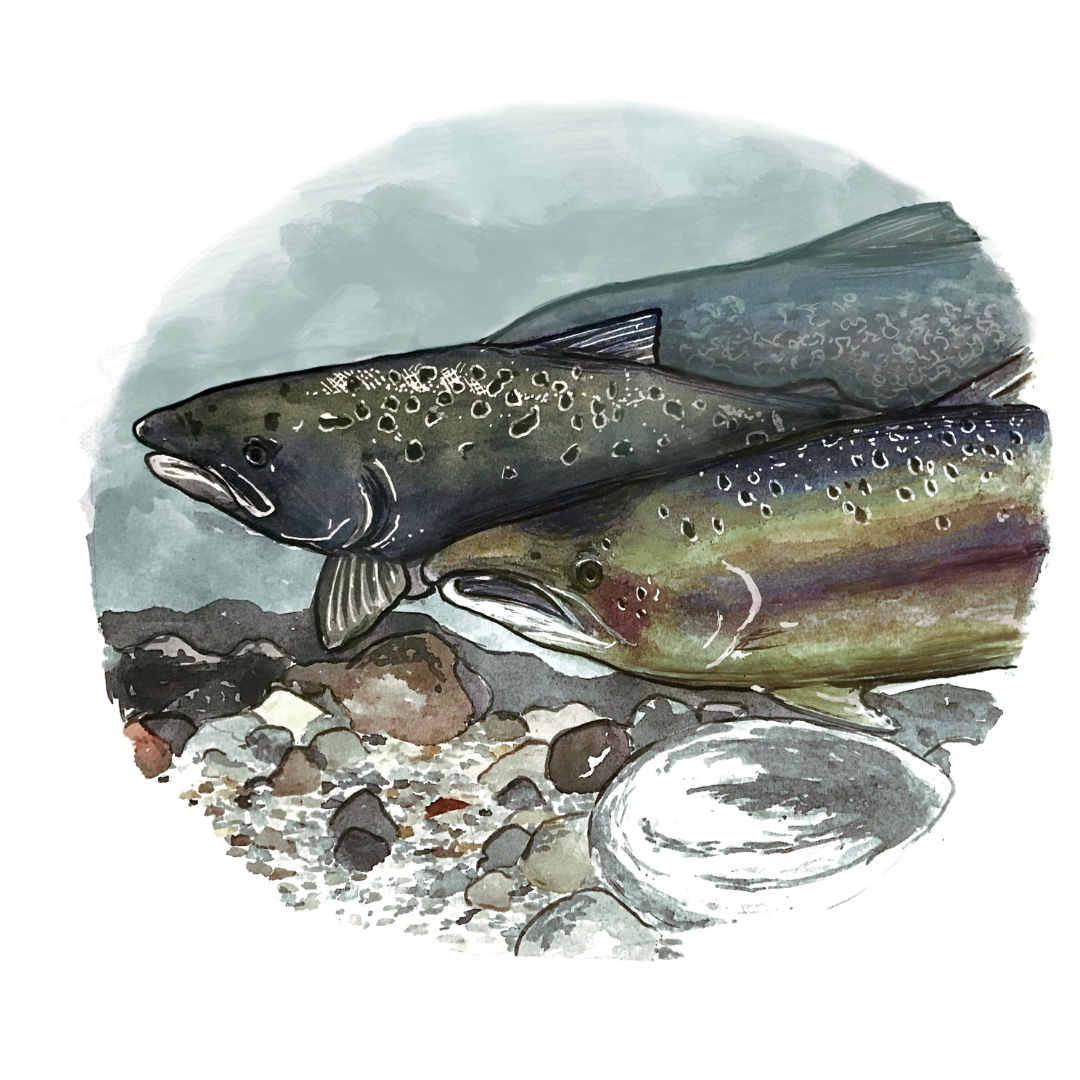
Salmon begin their lives as pea-sized eggs hidden in loose, gravelly riverbed nests in freshwater rivers. When they hatch, they are known as ‘alevins’, ready to embark on their journey through the gravel. First, they must rise to the water’s surface and gulp air to achieve neutral buoyancy, allowing them to swim in fast-flowing streams. Once they can swim freely, they are referred to as ‘fry’.

The fry have eight fins that help them maneuver through the water. As they mature, they undergo a physiological change called ‘smolting’, preparing them for migration to their feeding grounds in the North Atlantic. During this process, their body shape, colour, and behaviour adapt to life in the ocean.

Having reached deep-sea waters, they feed on a diet of crustaceans, sand eels and small fish. However, only about 10% of smolts will survive the numerous predators, sharks, seals, dolphins and humans, and return to the freshwater river they were born in to lay their eggs.

Upon reaching their spawning grounds, the female salmon uses her tail to create a depression in the riverbed, known as a redd, where she lays her eggs. After a male fertilises the eggs, she covers the redd with gravel before moving on to create a new one. During the spawning period, a single female may construct up to seven separate redds and lay between 2,500 and 7,000 eggs!

The spawning process can be so exhausting that over 90% of adults die once the eggs have been laid and fertilised. However, the few that do survive, called kelts, can return to sea and redo this epic journey.

And so, the life cycle begins anew, ensuring the survival of the species for the next generation.

Decline

In Britain, Atlantic salmon are classified as ‘endangered’ by the IUCN Red List, while globally, they are ‘near threatened’ due to significant population declines. These declines are due to a combination of factors, including habitat destruction, pollution, overfishing, climate change, and barriers to migration like dams.

For instance, salmon possess an extraordinary ‘homing instinct’- they can locate the river they were born in using the earth’s magnetic field, the chemical smell of their river, and pheromones. However, water pollution can reduce their ability to locate their river of origin that they need to return to as spawning adults, leading to reduced spawning success and population decline.

It underscores that much more work is needed to improve our natural environment. By reducing our impact on the environment and water, we may be able to reverse the decline of this species.

Not So Freshwater

Our Not so Freshwater campaign is calling on the UK Government to:

  1. Reduce pesticide use by 50% (volume and toxicity) by 2030
  2. Create ambitious targets to restore field margins and riverside ecosystems to reduce field run-off and boost our waters for wildlife and people

If you want to support our campaign, head to our campaign page and write a letter to your MP or subscribe to our newsletter to get regular updates directly to your inbox.

If you’d like to help this iconic species continue to thrive in the UK and across the world, check out our Not So Freshwater campaign page and subscribe to our newsletter to get regular updates directly to your inbox.

Sources

https://atlanticsalmontrust.org/why-wild-salmon-matter/

https://ifm.org.uk/wp-content/uploads/2023/02/IFM-statement-on-salmon-conservation-February-2023-1.pdf

https://www.discoverwildlife.com/animal-facts/fish/where-and-when-to-see-leaping-salmon-in-the-uk

https://www.cefas.co.uk/iys/salmon-life-cycle/#:~:text=We%20are%20thus%20aware%20that,before%20returning%20home%20to%20spawn.

https://onlinelibrary.wiley.com/doi/full/10.1002/aqc.3624

https://nasco.int/atlantic-salmon/pressures

Review of ‘Rathlin, A Wild Life’

Emily Seccombe reviews Ruby Free’s account of living on a windswept isle off the County Antrim coast, ahead of March’s UKY4N Book Club.

I loved reading Rathlin A Wild Life as it allowed me to vividly recall my own time on the
island’s seabird reserve last summer. I’ve rarely found a book that so perfectly captured the
spirit of a place.


Like Ruby, I found Rathlin to be an incredibly inspiring nature haven, and the RSPB seabird
centre is perhaps the most incredible single nature spot I’ve ever been to. I stayed on the
island as a residential volunteer for the RSPB in 2024 and it was a joy to relive my own
memories of the Rue Lighthouse, Craigmacagan Trail and of course the RSPB West
Lighthouse Seabird Centre through this book. Ruby’s illustrated ‘big 5’ tick sheet – clearly
photocopied many times over – was still in use when I visited and being appreciated by the
younger visitors.

I appreciated how open and intimate Ruby’s writing was about her family, neurodiversity,
grief, guilt and the feelings that come with being young and passionate about the natural
world.


As well as providing factual details on nature’s decline, I liked that Ruby had a keen
emphasis on her emotional connection to individual animals, especially the puffins. Some
nature writers avoid anthropomorphising and naming wild animals, but Ruby’s approach
resonated with my own experiences and aligns with her view (and mine) of seeing animals
as equal individuals with their own personalities and life stories to tell.

I’m looking forward to discussing the book with the rest of the UKY4N book club on Sunday
30th March and to chatting with Ruby herself about the book on Instagram live on Monday
7th April.

For more details about our book club, click here.