The Climate and Nature Bill – a campaign for new UK legislation – by Zero Hour

By Amanda Bishop & Amy McDonnell

In the month that has been confirmed as the world’s warmest March on record, it has never been clearer that we need to act with every lever we have to turn things around. At Zero Hour, we’re ramping up activities as we veer ever closer to the next UK Westminster General Election. We want to make sure that your next MP is ready to take environmental action as soon as they hit Westminster (more on this below!).


What is the Climate and Nature Bill?

The Climate and Nature Bill (CAN Bill) will make sure the UK does its bit to keep global warming down to 1.5°C, which gives us a chance to avoid the worst impacts of climate change. This means cutting down greenhouse gas emissions really fast. It’s a plan for a new UK law that addresses the full extent of the climate and nature crisis in line with the most up-to-date science. The Bill is the only proposed legislation before the UK Parliament that ensures a comprehensive and joined-up approach to the climate emergency and nature crisis.

While the existing Environment Act only offers to halt the decline of nature by 2030, the Climate and Nature Bill commits to reversing biodiversity loss by 2030. Weaning ourselves off fossil fuels means big changes. So it’s important that everyone is on board with them. That’s why the Bill also calls for a climate and nature assembly to help Government and Parliament develop an emergency strategy on the way forward.

The Bill, which was written by scientists, experts and campaigners, was first introduced in Parliament by Caroline Lucas MP in September 2020 and now has the backing of over 150 parliamentarians representing all major political parties.

Allow us to (re)introduce ourselves

As we gear up for the General Election, Zero Hour (the campaign for the Climate and Nature Bill) are making sure that the Bill is back on the books in parliament! This means we can sign up as many election candidates as soon as possible over the coming months.

We are proud that Labour/Co-op MP Alex Sobel is now leading the charge and reintroduced the Climate and Ecology Bill in the House of Commons in March—with cross-party backing from all major UK political parties—under a new name: the Climate and Nature Bill (or “CAN Bill”). The content of the CAN Bill is the same as the Climate & Ecology Bill—so that we are still holding the UK’s environmental ambition in line with science.


The Labour Party currently backs the “ambition and objectives” of the CAN Bill and with Alex Sobel taking the reins, we hope that we can get even closer to securing the party’s full backing. In 2019, Sobel set up the Net Zero All-Party Parliamentary Group to help secure a low carbon and clean industrial and economic future for the UK, and between 2021 and 2023 he was Shadow Minister for Nature Recovery and the Domestic Environment in the Opposition Party’s DEFRA team—so he is very well placed to help move the campaign forward.

Alex Sobel MP said:

‘I’m proud to have introduced the Climate and Nature Bill with cross-party support from MPs of all main parties. This joined-up climate and nature plan is continuing the legacy of the Climate Change Act 2008. This CAN Bill is needed if we want to reclaim our environmental leadership; and finally get serious about reducing energy bills, protecting our wildlife, creating green jobs, and bolstering our energy and food security.’

‘When made law, the CAN Bill will set the UK on a path where we can properly tackle the interconnected climate and nature crises—whilst making sure that no one is left behind in the long-overdue just transition we need. Global emissions are rising. Nature is in peril. So in this pivotal election year, let’s align our climate and nature laws in line with the science—and our international agreements—and deliver the climate and environmental action the public are crying out for.’


Chris Packham, Deborah Meaden and Tori Tsui launch ZH’s election campaign

This is the last Westminster general election, which will usher in the last Government able to turn the tide on climate change and nature loss—another five years will be just too late. This is why we’ve launched The Nation Needs You! Zero Hour’s election campaign calling on all candidates who will stand in the next General Election to back the Climate and Nature Bill. The launch (12 March) was packed and we were grateful to Chris Packham, entrepreneur Deborah Meaden, climate justice activist Tori Tsui, vice chair of Peers for the Planet Baroness Rosie Boycott and Zoological Society London scientist Prof. Nathalie Pettorelli for joining us.
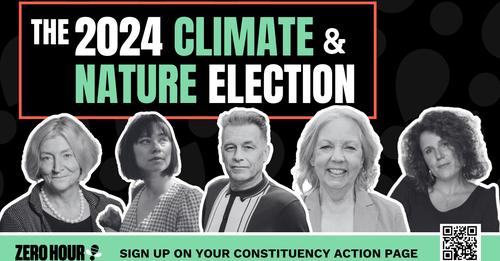
 

Within twenty four hours of the campaign’s official launch, over 800 candidates (10% of the total number standing for election) had agreed to back the Bill. CE Bill supporters include both incumbent MPs and Westminster challengers from all main parties across the UK, including Conservatives, Labour, Labour/Co-op, SNP, Greens, Lib Dems, DUP, Plaid Cymru, Scottish Greens, SDLP and Alliance.

Tori Tsui said: “It’s not a surprise that this upcoming election is absolutely vital for ensuring rapid climate and nature action. We absolutely need candidates to stand by a commitment to the CAN Bill. As voters, we have a responsibility and duty to hold our candidates to account. We can’t delay action any longer. It is up to us to make our voices heard.”


What you can do

Will you help us make sure that your next MP backs the Bill and is ready to take serious action? Find out more at zerohour.uk to sign up and get involved! Your local area has it’s own Constituency Action Page, which you can help build to demonstrate the power of collective action in your local community!
 

Together we can give politicians the mandate to take the action we need to protect climate and restore nature. Yes we CAN!

Check out our resources page to find more ways you can take action for nature.
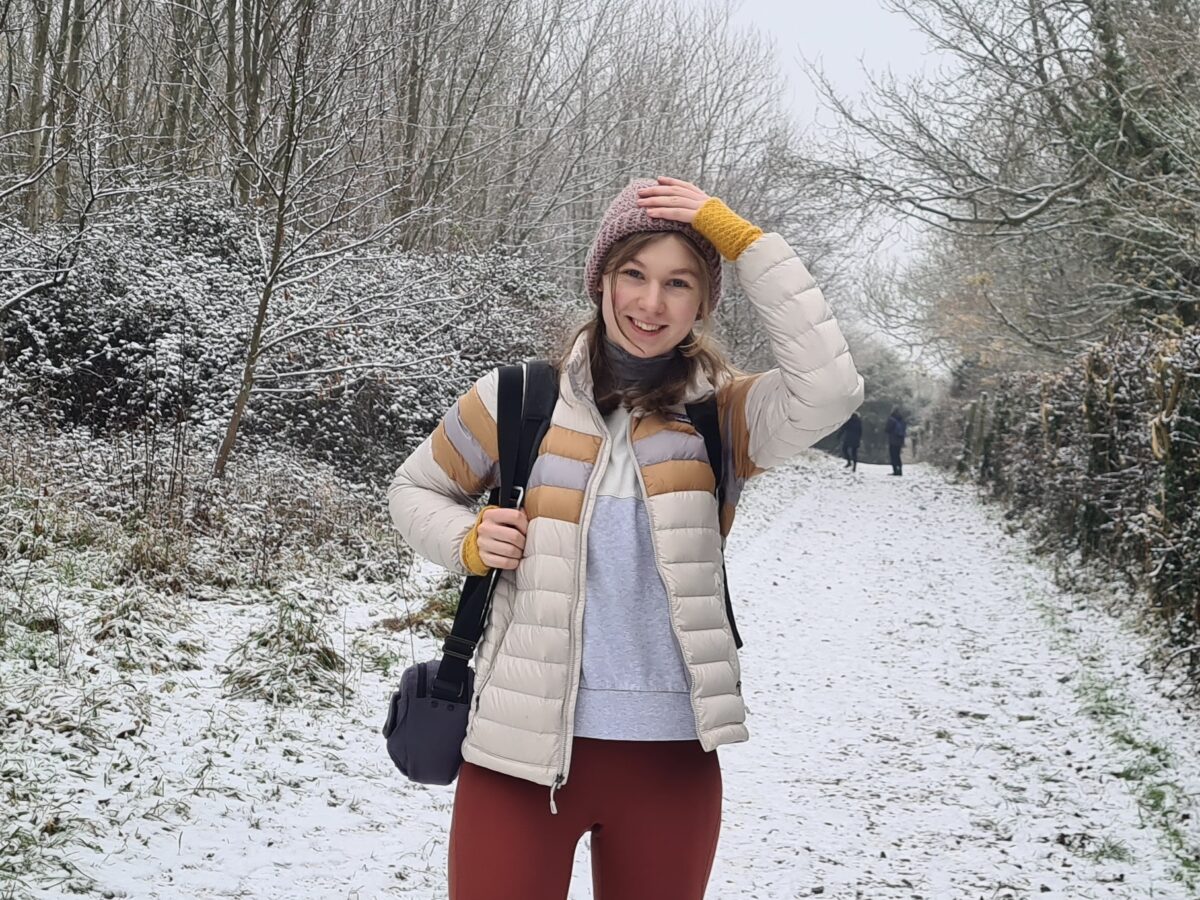
 

Community member spotlight – Ione Howells

Who are you?

I’m Ione! I’m a postgraduate student in Environmental Policy at the University of Bristol and I currently live in Bath.

I’m a self-professed policy and nature nerd and I’m currently working on a research project exploring the social context of the new Biodiversity Net Gain policy in England – it’s one of the most stringent biodiversity policies in the UK, but it still has a lot of limitations to explore.

In my free time I (predictably) love spending time outdoors – hiking, cycling, camping, birdwatching… anything! I’m hypermobile and had major surgery a few years ago, so now I never take the ability to move my body the ways I want to for granted; reaching the top of a mountain (British or Alpine) is now especially sweet. But I also enjoy nothing more than curling up with a creative project or a good book. I’ve always been indecisive like that – but I prefer ‘multi-talented’!

Your work focuses on environmental policy – why did you focus on that?

I ended up in policy in quite a roundabout way! I always loved nature when I was growing up – I spent a lot of weekends visiting my grandparents in Suffolk and generally making a muddy nuisance of myself. For most of my childhood, I would have told you I wanted to be either a marine biologist or a vet!
For my undergraduate degree, I studied Politics and International Relations. I’ve always been passionate about political issues (hello, family arguments!), but as I progressed through my degree, I found myself rediscovering my love of nature and the environment and engaging more and more with environmental politics and theory.

I love getting philosophical about the relationship we have with nature (and often write on the topic for the Ecologist!), but wanted a way to make a more concrete impact in the nature space. Reading up on policy and leveraging my political background to understand all the jargon was a great opportunity to get involved in creating positive change, and allowed me to keep learning more about the things I’m interested in.

However much we might hate to admit it, policy and legislation are fundamental to the way the United Kingdom works. It can seem dense, technical, and opaque – and, frankly, it’s all of those things, and very dull at times – but it has really important consequences. Policy plays a key role in both preventing environmental destruction and influencing policy outcomes – is one of the major ways we can try and influence change outside of electoral cycles, and it’s a big part of the campaigning we do here at UKY4N.

If you could change one piece of legislation right now, what would it be and why?

It’s not existing legislation, so it doesn’t strictly answer the question – but I would pass the upcoming Climate and Nature Bill.

This bill is really significant – it’s the first time there has been a comprehensive legislative response to the climate and nature crises, one that aims to consider all of the issues at play. It’s been drafted with the support of scientists, ecological economists, and campaigners, and calls for not only a reversal of biodiversity loss by 2030 and a just transition to green energy, but for far more citizen involvement in deciding what our shared future might be. For me, this citizen engagement is crucial! It would be a significant step forward if it were to pass and become law.

Current legislation is often piecemeal, and that makes it difficult to understand what is going on and how it can be enforced. Having one ambitious and progressive piece of legislation could change the outcome of these crises in the UK. The Climate and Nature Bill is supported by 150 cross-party MPs and many charities and businesses too – Deborah Meaden even spoke at the launch event! If you’d like to learn more about it, go to Zero Hour. They’re the organisation running the campaign.

…but, if I had to change some existing legislation at the moment, it would be to regulate water companies a lot more. I don’t think I need to explain that one!

If you could be a koala, a tiger or a buffalo which one would you be?

That’s a tough one! I love the idea of the freedom I’d feel as a tiger or buffalo, running across wide open plains as fast as possible. But I have to admit that the idea of being a prey animal like a buffalo scares me – and as a decade-long vegetarian, I think I’d make a pretty terrible tiger!

So, I think on those grounds I’d have to choose a koala. I’ll be the first to admit I might love sleeping a little bit too much and just like them, I have a big appetite! Spending all my days up in the trees sounds like a great plan to me…

If heaven is a real place, what would it look, sound and smell like to you?

It seems like an underwhelming answer, but I might have to say my parents’ garden back home in Jersey. My dad has always loved gardening and he’s ploughed (literally!) his life and soul into creating a real paradise. It’s at the bottom of a tiny and very steep river valley and opens out onto the floodplain of a nearby dam, so all you can see are trees, flowers, and meadows.

In the summer, I love nothing better than sitting out there in the sun and listening to the birdsong – we get everything from long-tailed, coal, great, and blue tits to green- and goldfinches, thrushes, larks, very friendly robins and even a pair of buzzards that live in the valley year-round. It helps that my parent’s spaniel, Jack, will always keep me company out there as well!

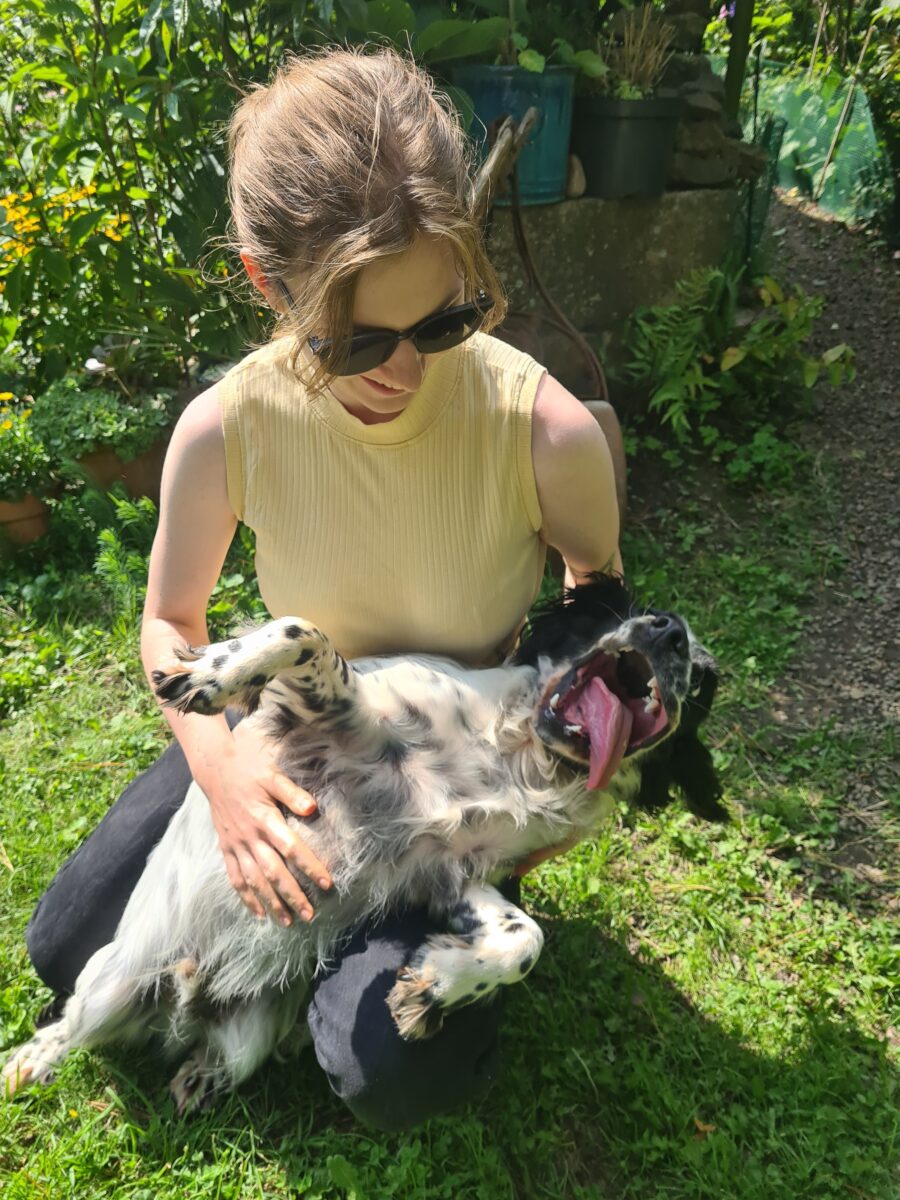
With the dog in the garden in Jersey

It could only be improved on if it had a sea view – since living by the coast when I was younger, I can never spend too long away from the ocean. Saying that, though – my parents’ garden is only 10 minutes away from the beach!

If you could move to anywhere in the world and cost was not an issue, where would you move?

I went to Stockholm a few years ago for work experience and I haven’t been able to stop thinking about it since, so I think I’d have to pick there. I even wrote two essays on Swedish politics during my undergraduate degree!

A much younger Ione making friends with an Arctic pony in Sweden

I love the friendliness and culture in Scandinavia, the simplicity of life – and Stockholm is full of fascinating museums and gardens. It lies on an archipelago, so it’s easy to get out into nature – and the Arctic Circle is only a train ride away! Being in Europe also means the possibilities for flight-free travel are endless. Copenhagen, anyone? Or even Istanbul?

If money was no object, I’d split my time between a summer cottage on an isolated island in the lakes around the city and a small apartment in the city centre. I stayed in a beautiful apartment in 2016 full of character – big sash windows, art everywhere, vintage furniture, and a little balcony over the city.

While I love the idea of being a bit of a hermit in the wilderness, you can’t live in Sweden without having quick access to a bakery for the best baked goods in the world. Keep the croissants, France – it’s all kanelbullar (cinnamon rolls) for me! (Don’t keep them please – I love them too!). 


Feeling inspired to join a bunch of young nature-lovers in their quest to get better nature legislation in the UK?! Join us!

Inclusion in Conservation: a Perspective by Seniz Mustafa

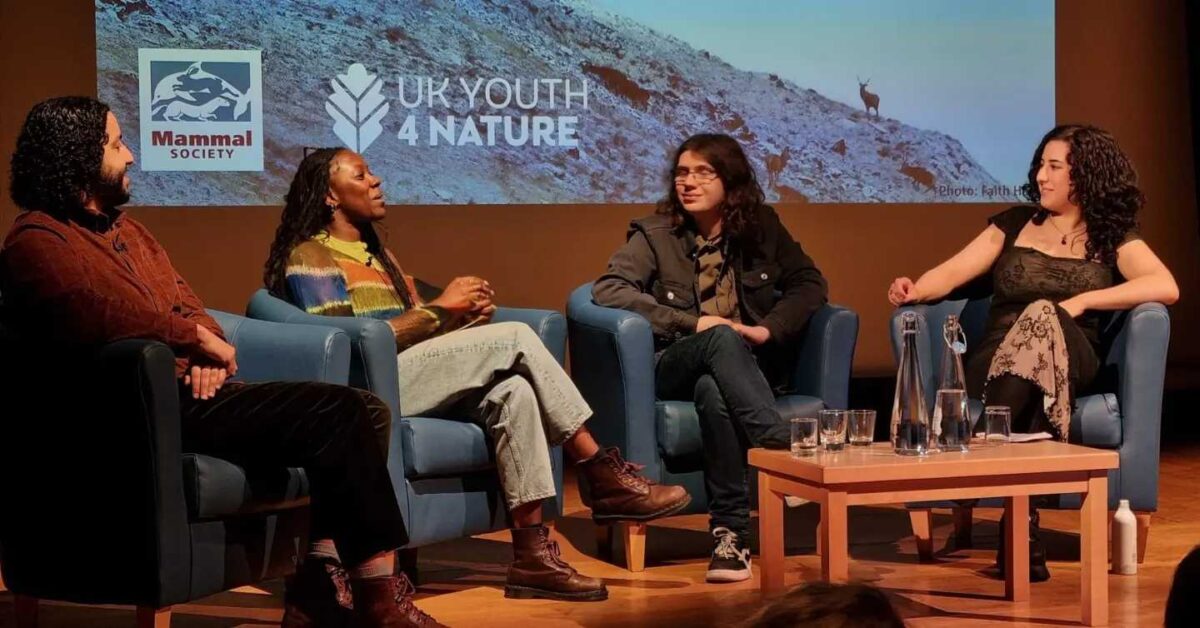
For the Mammal Society’s 70th Annual Conference, our community member Seniz Mustafa chaired a panel for the Friday night lecture ‘Inclusion in Conservation’. Below, Seniz summarises the background to this topic and its importance to the environmental sector and shares her reflections on the event.

A commonality to those within the environmental sector is a dedication to the conservation and protection of our natural landscapes and the species in this country. But too often, the social aspects that are forever intertwined with nature have been less addressed, been sources of conflict, and suffered from a lack of awareness or inaction.


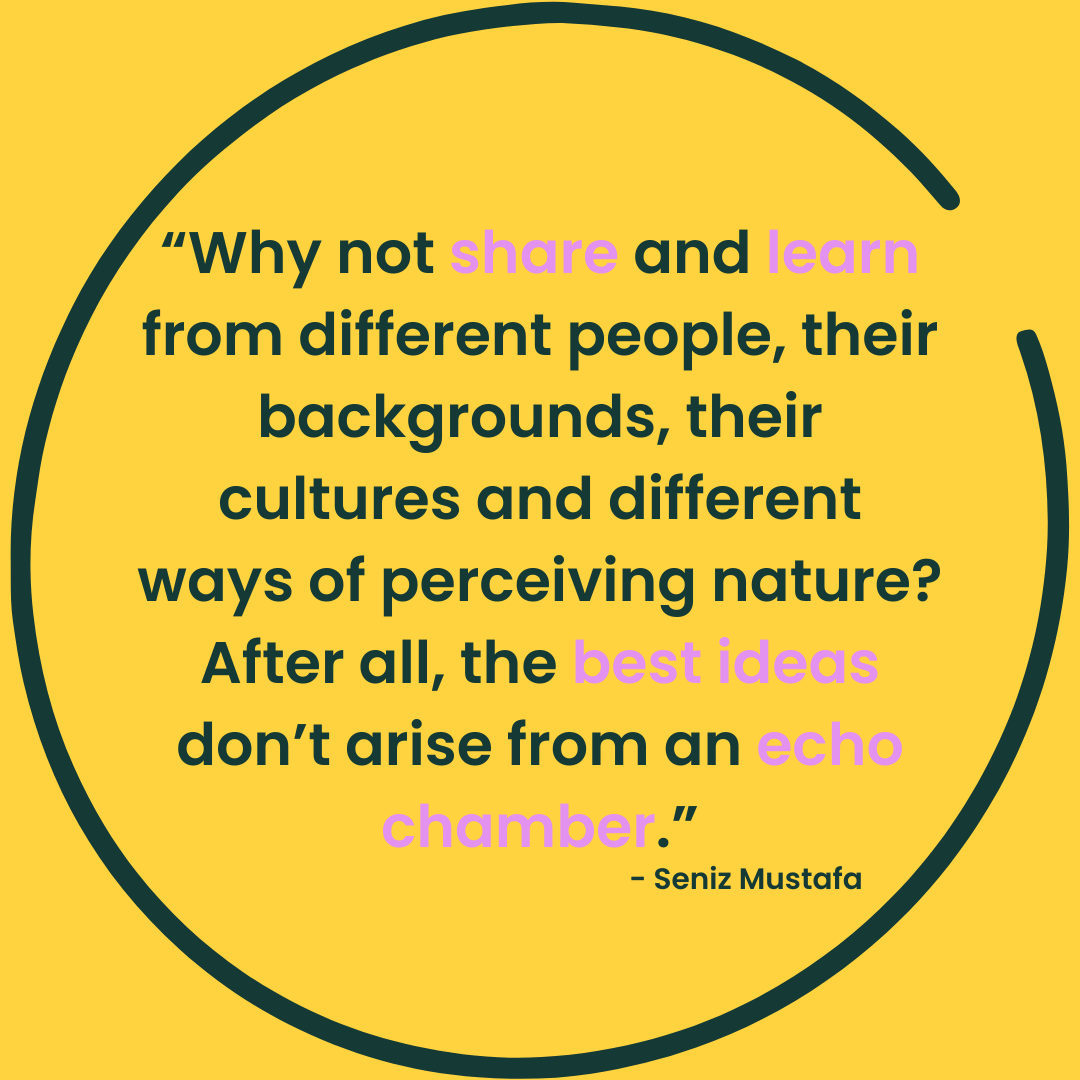
But in this time of biodiversity crisis and nature decline, we know that it impacts all of us. Not just the few, not just those already within the sector, but everyone. So, surely, all people should have the freedom and the choice to take part in conservation?

To unpick and draw up a background on this topic, we need to understand what it means to be inclusive. In the simplest terms, it is the act of including someone or something as part of a group or structure or fostering a sense of inclusion where all identities feel welcome. That is something many people could relate to or understand. Delving deeper, inclusion also means ensuring equal opportunity by bringing opportunities to those with limited access.

What could this look like? It can be socio-economic factors, for example, the cost of transport, not having a car (which is imperative to many jobs in this sector), memberships and outdoor gear…it all adds up. Therefore, leading to a lack of access to training, volunteering or jobs and the ability to network in the sector. Moreover, feeling unsafe or unwelcomed in spaces that are most often dominated by the white middle class, having to work long working hours, or experiencing a lack of educational opportunities.

These are examples of systemic discrimination of identities, such as gender and disability, which overlap and intersect with each other to dissuade and reduce a person’s passion or career in nature. Intersectionality is important to understand because people have many factors that contribute to their identities and experiences. Therefore, when decisions are made, we cannot just look at one factor. We must address them together. For example, if a course for young people to take part in conservation does not address other identities, such as disability and economic status, it could then reinforce inequalities among young people.

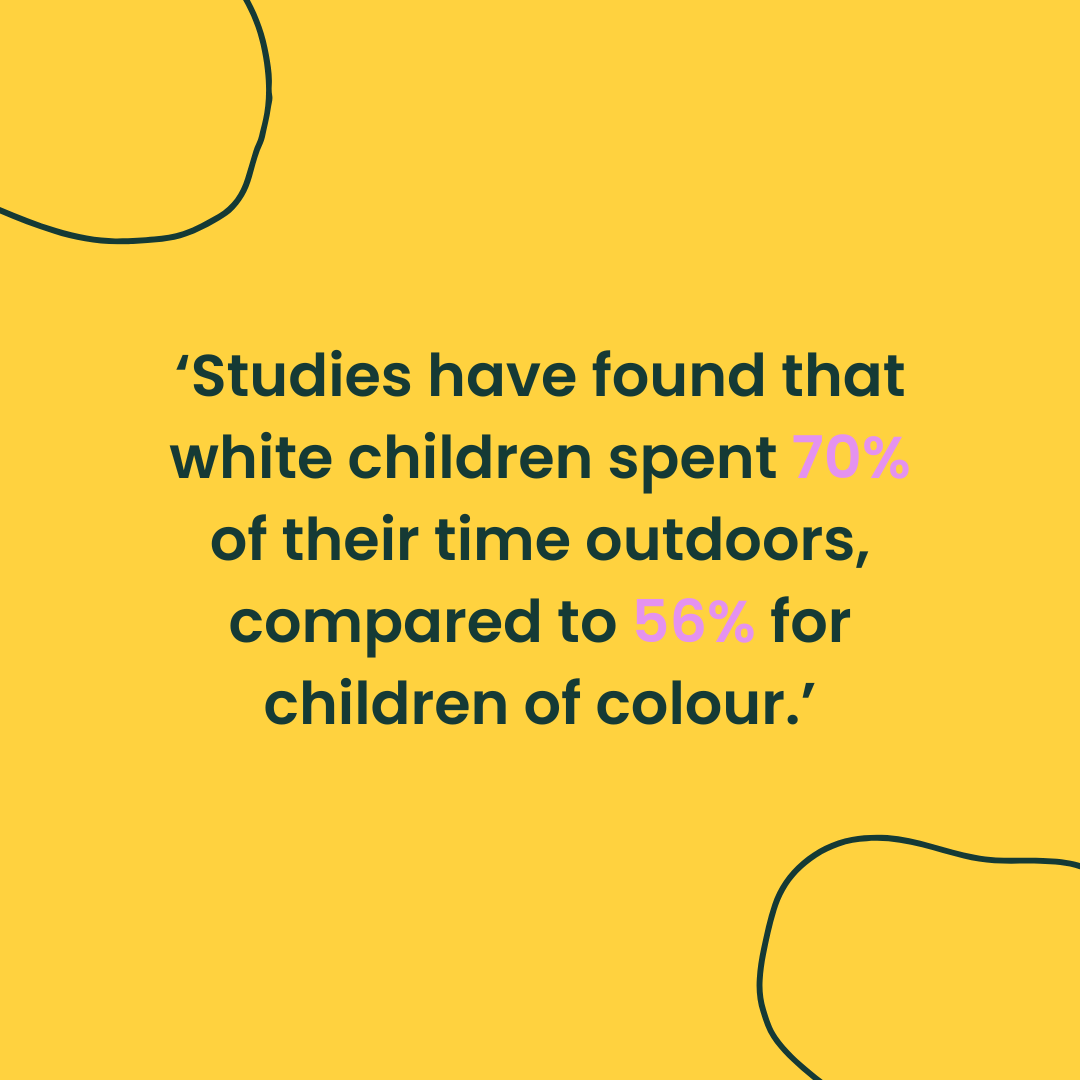
It is possible many readers have heard that conservation is the second least diverse sector after farming regarding people of colour. Moreover, how sites are not accessible to those with physical support needs and for those who are neurodiverse, such as those with autism and ADHD.

The interactions with nature at a young age often spark passions people often reminisce about in later life are so important.

As the amazing journalist and ecologist Jasmine Isa Qureshi said in their Gritty Talent article, passions and skills take time to grow and develop. Time and space to explore the world around them and nurture their curiosity is a “luxury” many minorities do not have.

These inclusions can reap such benefits for us all and the young people who could grow into our next generation of adults with opportunities to engage meaningfully with nature that will turn that into a passion for conservation. Even in terms of health, spending time in nature improves sleep and anxiety and lowers blood pressure and stress. This, again, is another reason working in this sector can be quite so lovely, so why not share those benefits?


If conservation means making collective decisions about how to manage, protect and restore shared natural resources fundamental to both our own survival and the species we share the planet with, then the values and perspectives we bring to that decision-making should encompass all of society and all the beautiful differences it contains.

Post-event reflections

‘I had a wonderful time hosting the panel on inclusion in conservation at the Mammal Society 70th annual conference. Importantly, I felt it to be a safe space where I could be more honest and comfortable to share my thoughts. I was thrilled to see such a great turnout, in person and online, and how engaged the audience was 🙌🏼

It was particularly heartwarming, afterwards, to have several members initiate conversations with me on the topic, asking questions and resonating with what was said. To have an open mind, and continue to talk to others on this topic is vital to continue the movement to make our sector more inclusive.’

Watch the webinar here ↓↓↓↓

Did you know we have a UK Youth for Nature Book Club, where we read the books of young nature authors? Click here to learn more about it and sign up!

If you’ve read this article and feel inspired to join our community of young nature activists, click here to find out more.