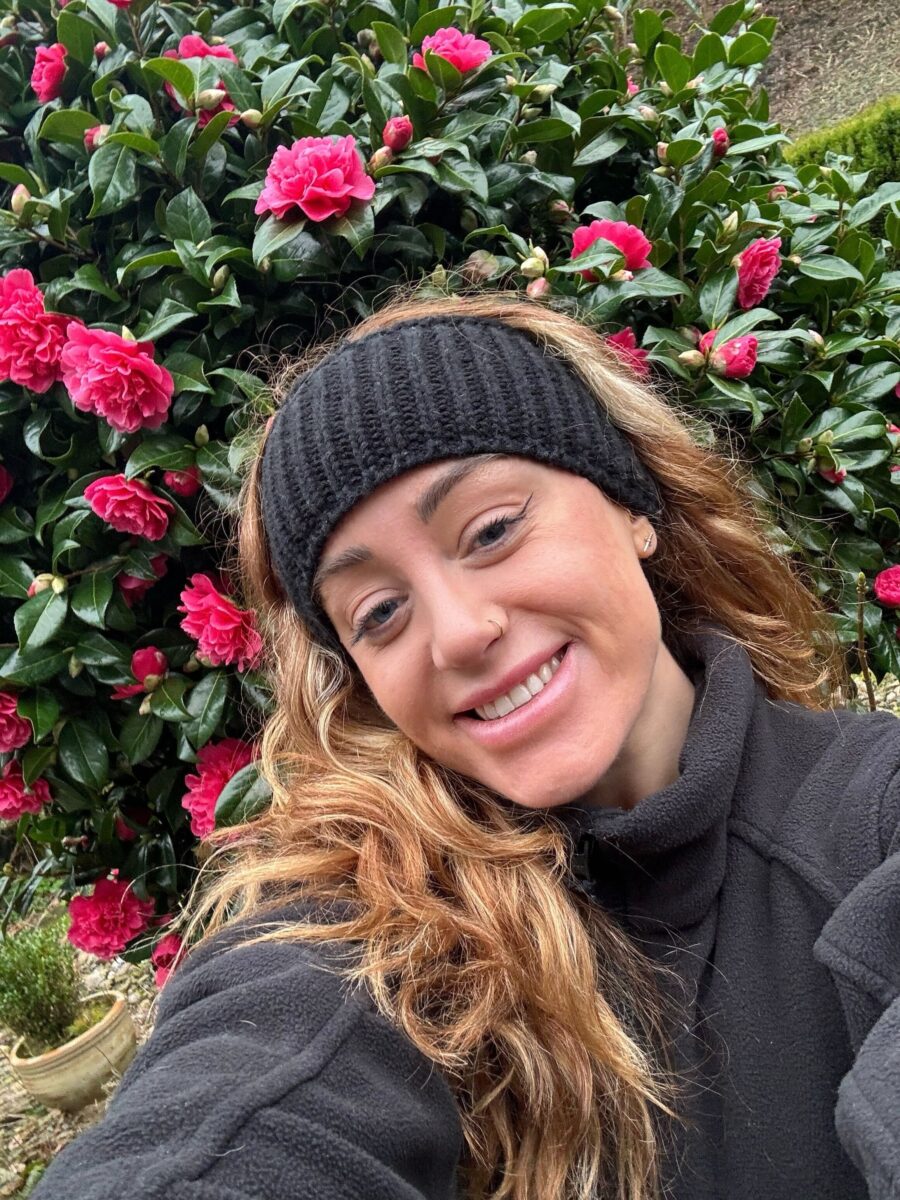
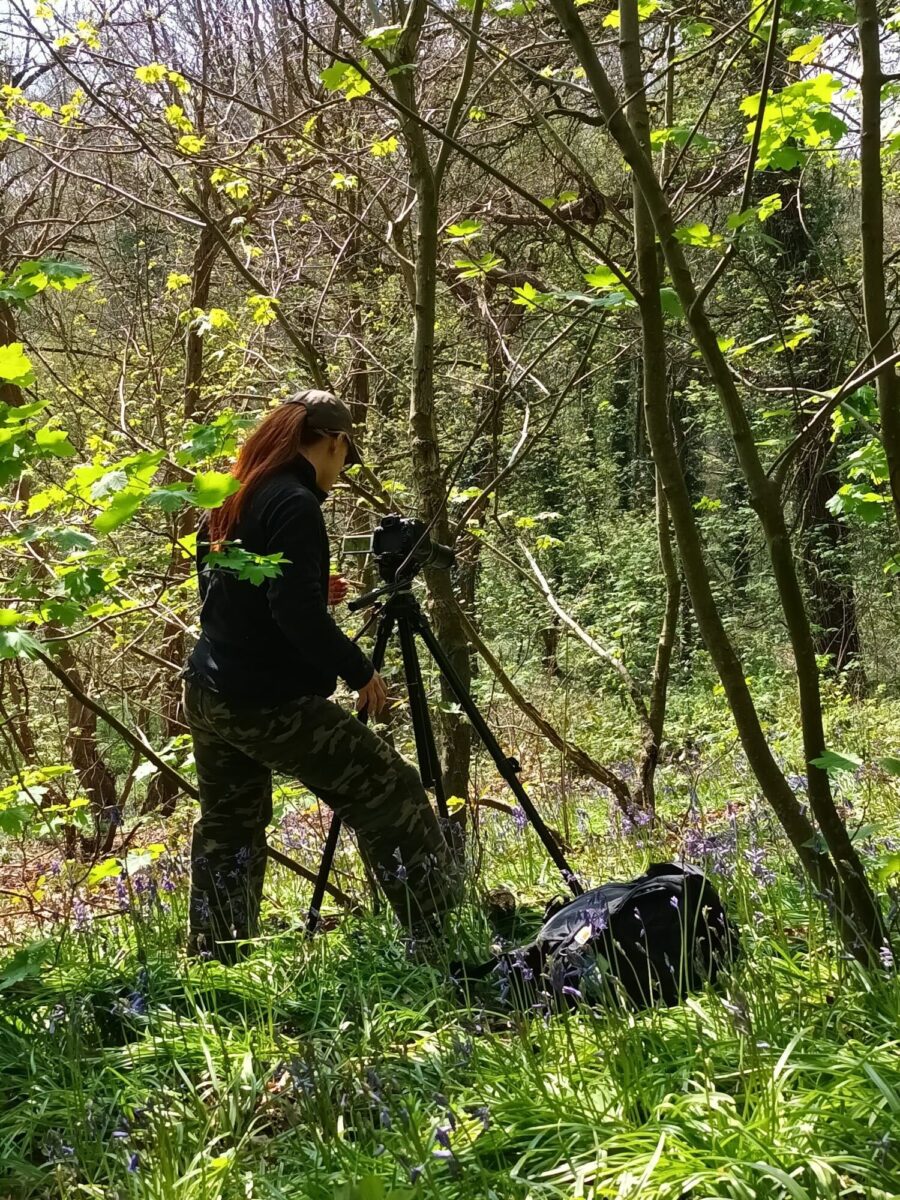
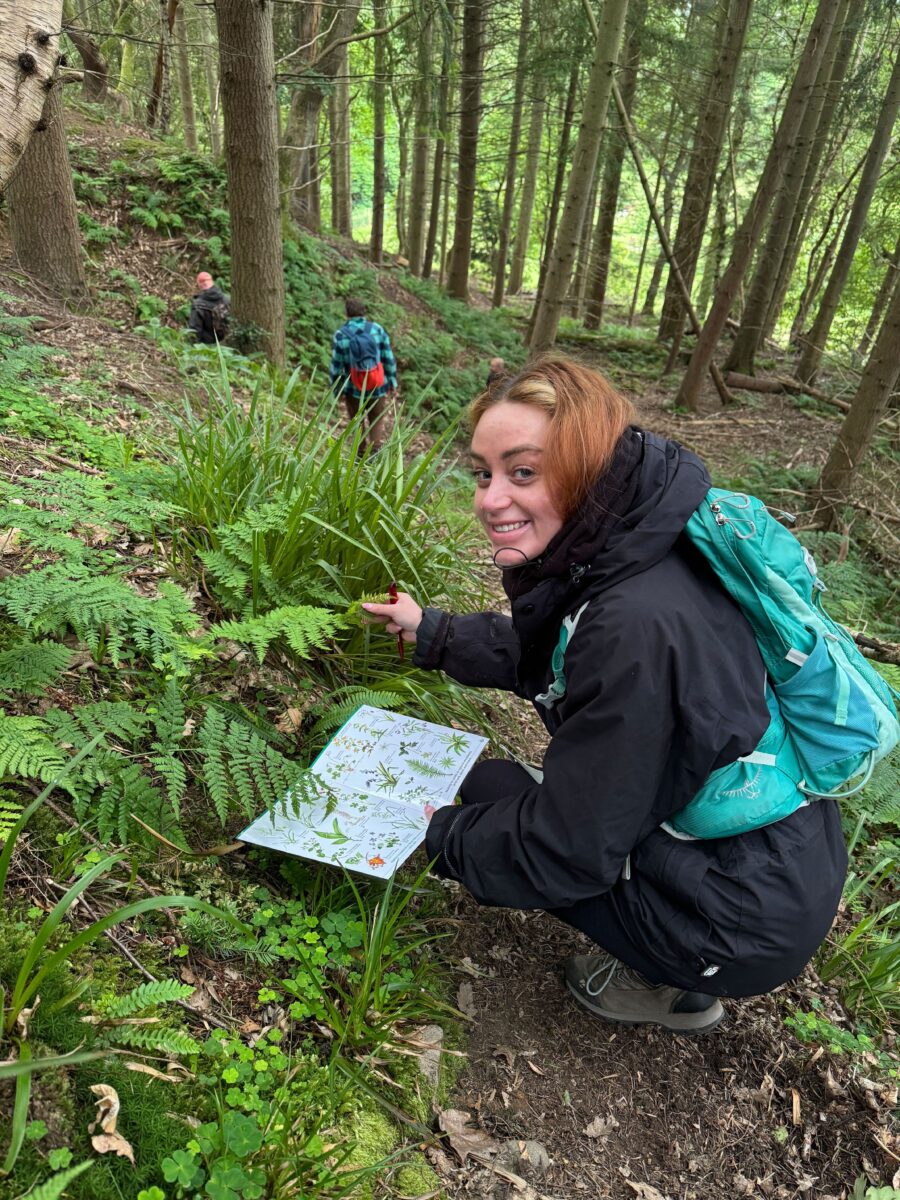
Hey, I’m Katie, I’m a wildlife storyteller and I’m obsessed with animals! I’m part of the UKY4N Webinar team. In my spare time, I love hiking, travelling and skateboarding. I’m also a freelance filmmaker and photographer
Why are you so passionate about engaging young people with nature and the environment?
I believe engaging with young people is key to solving the climate and nature crisis as 70% of young people have climate anxiety, yet 86% believe being outdoors and among nature has a positive effect on their mental wellbeing. We are our future stewards, leaders and stakeholders. We make up a huge percentage of our population and we need to be engaged and share our passion. Plus, younger people are so much fun!! Being around young people, especially children, brings out my inner child and playful side. I’m very lucky that both my current jobs include youth engagement.
Tell us three reasons why we should care about ancient woodlands
They are the UK’s most complex ecosystem, supporting many rare species and communities such as primrose, hazel dormice and specialist lichens. They are our natural heritage and history, housing our ancestors and providing their timber. They have always been woodlands and they have a right to remain so.
With only 2.5% land coverage and a lack of legal protection, we are at risk of completely losing these magical woodlands for good. If policy doesn’t change, ancient woodlands will degrade and be destroyed until nothing is left.
What is your favourite tree and why?
This changes all the time for me! One of my favourites is a very specific ancient hawthorn tree in my local woodlands. I love it as it was the first ancient tree I photographed and I also notice memorial flowers are left there often, which makes me feel connected to the other people who visit and notice the tree too.
Have you ever had an encounter with a famous person?
I met 3 TV celebrities when I entered the Woodland Trust Igniting Innovation challenge -Megan McCubbin, Danny Clarke and Dwayne Fields. They were all really lovely and supportive during my project pitch and, as a filmmaker, I really appreciated their encouragement and it felt surreal to show them my film clips.
Do you have a bucket list? Tell us two things that are on it
Hell yeah! 2 things I am hoping to tick off next year are surfing in Cornwall and visiting the rainforests in Dartmoor (I’m a northern girl so haven’t been to either before).
UK Youth for Nature is a group of like-minded nature lovers who are on a mission to improve the future for wildlife, nature and humans in the UK. If you want to be part of our community, you can find out more here.
The power of changing the landscape has been held in too few hands for too long, the People’s Plan for Nature has given agency back to the people. 100 people from across the UK came together to take part in the People’s Assembly for Nature. They have worked to develop a plan and a set of recommendations for change on behalf of the UK public. This ground-breaking project has been powered by the WWF, RSPB and National Trust and is a unique collaboration with the public to protect and restore nature in the UK.
Across four weekends, two in-person and two online, the Assembly met and heard from experts and practitioners from different sectors to help them understand the state of nature in the UK and what could be done to save it. All talks and resources from the Assembly can be viewed here. UK Youth for Nature was invited to observe some of the sessions:
How we farm and what this means for nature:
This session covered a wide range of topics focused on the impacts of different farming methods on our environment. Sue Pritchard from the Food, Farming and Countryside Commission started by discussing the history of farming, as we’ve moved from subsistence farming to more intense agricultural practices, with the development of technology. Soil scientist Professor Pete Smith then spoke about the implications of farming for our soil quality and the trickle down effects for our biodiversity. To pull it all together, Martin Lines from the Nature Friendly Farming Network spoke about practical solutions farmers can implement to help the wildlife that shares our countryside, while maintaining agricultural productivity.
Diets and supply chains:
This session covered a range of topics around how we source and farm our food, and the impact this has on the environment. One presentation was from a nature-friendly farmer, Mark Lea from Green Acres Farm, on how he is implementing organic methods such as natural fertilisers into his food production. This was followed by Anna Turrell, the Sustainability Director from Tesco, discussing how large supermarkets can reduce their environmental impacts from their position at the other end of the supply chains. These were just a couple of examples of the diverse range of speakers helping to answer key questions surrounding the success of nature-friendly diets in the UK.
Photo by Archie Mathison
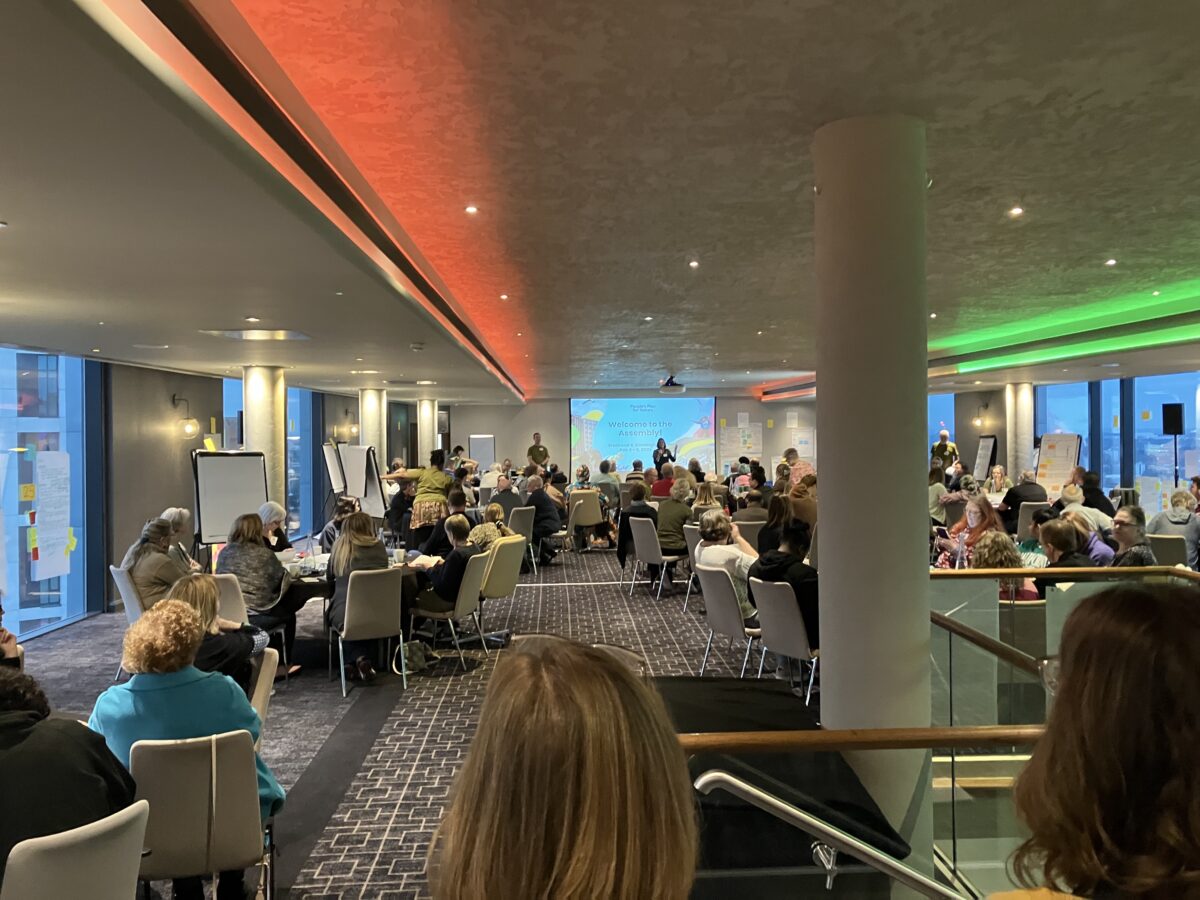
The final weekend took place in the centre of Birmingham on the 4-6th of February. One of our Co-Directors, Ellen, went along to observe and to talk with other environmental NGOs about how we can move into the next stage now that the People’s Plan for Nature has been pulled together.
Final weekend in Birmingham
“It was genuinely one of the most incredible experiences I’ve had in my career. There was a real sense that this was a powerful moment in history that has so much potential to create positive change. Nothing like this has ever been done before and when all the working groups came together at the end of the day to read out the first draft of the People’s Plan there were more than a few people in tears.
During the day I had the opportunity to hear about the process of picking the 100 people who formed the Assembly. A huge amount of thought went into making the group as representative as possible. I’ve been to quite a few environmental conferences and I’ve never seen so much diversity, it was amazing, this is what it should look like. There were people from a range of different socio-economic backgrounds, different races, cultures, 16 year olds working with people in their 90s. What was so special was that everyone wanted to hear other people’s views and opinions, there was no sense that one person was better or more knowledgeable than the next, everyone felt like they were part of something bigger and that their voice mattered.”
“Communicated messages around saving the planet have been done in one way for so long, this is something different.” – Nadeem Perera, founder of Flock Together
“I am so excited about the People’s Plan for Nature, I really feel that this is something different. We’re not going to save nature unless everyone is involved and everyone feels that they have agency to act and speak up. We cannot let this plan become just another report, but from the energy and passion I saw in that room, I’m sure it won’t. This is a really exciting time for UK nature and I’m really looking forward to UK Youth for Nature helping to spread the message and push for change.” – Ellen
UK Youth for Nature will continue to support the People’s Plan for Nature. To find out more about our campaigns visit our campaigns page.
At time of writing, many people around the country are heading to the coast.
Why do we flock to the coast? Is it the open space? The cooling sea breeze? The sounds? I guess everybody has their own reasons for wanting to be beside the sea (we’d love to hear yours – @ukyouthfornature on social media!)
When I started planning this blog, I thought I would know exactly the direction it was going to take. But as I started writing, I realised there were so many topics and issues I wanted to cover. Did I want to focus on my personal love of the sea? Marine biodiversity? Access to the coast and the ocean? The ocean is such an important part of my life that I wanted to be sure that this blog did it justice.
So, I decided to use this blog as a chance to introduce a few different themes and areas of interest and serve a conversation starter for myself and you, the readers.
The State of the Ocean
“How inappropriate to call this planet Earth when it is quite clearly Ocean.”
Arthur C. Clarke
The ocean covers nearly three-quarters of our planet’s surface and was long thought to be too large for human activities to impact. But this is no longer the case (Pink, 2018). We are seeing large-scale changes in ocean chemistry, biology, and dynamics globally (Gattuso et al., 2015). With the threats of sea level rise, ocean warming, and acidification set to impact many countries worldwide, governments worldwide must begin looking to humanities future relationship with the ocean (IUCN, 2017). This will involve creating and implementing policy and management strategies that, firstly, reduce the impact of human activities on the sea and, secondly, reduce the effects of ocean change on coastal socio-ecological systems, particularly those increasingly vulnerable to said change.
But what is actually being done? In a word: nothing.
It’s been nearly two months since World Ocean Day (June 8th), when businesses and world leaders were making big promises to protect the ocean. But shockingly, they haven’t followed through on any of these commitments.
Let’s do a roundup of the last month in ocean conservation:
The High Seas/BBNJ Treaty signing has been delayed.
The United Nations Convention on Biological Diversity COP15 has been delayed to 2022.
The Gulf of Mexico was on FIRE from a ruptured pipeline.
The UK Government is likely to approve the drilling of massive oil field in the North Sea. Seriously? We need to #stopcambo
The MV X-Press Pearl Disaster has caused unknown damage to marine ecosystems in Sri Lanka.
Seas continue to warm.
It’s looking likely that Deep Sea Mining will be entering the exploitation phase in the near future. We still know so little about the deep sea and the impacts of DSM but in my opinion, it’s a disaster waiting to happen.
What needs to be done?
This is question could be answered in a variety of different ways, depending on your area of interest. Here’s some things that spring to my mind straight away, beyond the simple “we need to protect our seas” statement often heard.
Building a love for the sea
Education is an extremely valuable tool in the fight against ocean destruction. Ocean science and conservation can be an incredibly gate-kept sector, even in comparison to other environmental studies and activism. The ocean itself can seem very distant for many people, with them feeling extremely far removed from the ocean.
Governments need to invest in nature- and ocean-based education, with funding for hands-on experiences for children and young people. Speaking from personal experience, these are extremely important to building a love and appreciation of our natural world and in this case the ocean. This is especially true for those in marginalised communities, who may not have the opportunity to otherwise.
“People protect what they love.”
Jacques-Yves Cousteau, Renowned Oceanographer
Allowing people to act on this love
Governments need to be put in place mechanisms that enable people to act upon their values. This is an issue that extends beyond the individual. Mainly this should be targeted at large businesses and corporations who have the audacity to charge extra for ‘sustainable’ options. Create a system where it doesn’t cost extra to be environmentally friendly. We need to hold companies to account and, as our representatives, governments should be acting in our best interests, not those of FTSE100 companies
Realising that technology forms only a part of the solution
This is a recurring problem globally. Many governments, particularly those who prioritise economic growth and business, look for technological development and solutions to allow business to continue to grow, often at the expense of communities and the environment. This solution is further pushed by businesspeople and industrialists globally. The most recent example was billionaire founder of Microsoft, Bill Gates, suggesting that the spraying of chalk dust into the atmosphere could be the solution to climate change (Ramirez, 2021). Another ocean-based example is the pre-eminence of the plastic pollution problem among those facing the oceans and technological ‘clean-up’ solutions (Stanton, Johnson & Kay, 2020). A recent study by Hohn et al. (2020) found that clean-up technology alone will not tackle the issue of plastic pollution, but that behavioural change in our consumption and production patterns are required. Yet, this receives less prominence than ‘tech’ solutions and start-ups.
Many scholars in risk and resilience theory question the ability of technology to solve a problem caused by technology itself. Technology will play a role but there is a greater need for behavioural and systemic change rather than focusing solely on technological solutions.
So, in short, world leaders and policymakers have a long way to go on our journey towards protecting the world’s ocean.
A personal note…
As you may have gathered, I’m extremely passionate about protecting marine environments. The ocean is possibly the most important component of Earth’s life support system, impacting every inhabitant of this planet, even those thousands of miles from the nearest coast.
But on a personal level, I’m happiest when in the sea and that is a big reason I want to see our seas healthy and thriving. The world beneath the waves has always called me (Moana who?)! So, my desire for ocean protection may not be completely altruistic (don’t @ me).
References
Gattuso, J., Magnan, A., Billé, R., Cheung, W. W. L., Howes, E. L., Joos, F., Allemand, D., Bopp, L., Cooley, S. R., Eakin, C. M., Hoegh-Guldberg, O., Kelly, R. P., Pörtner, H. o., Rogers, A. D., Baxter, J. M., Laffoley, D., Osborn, D., Rankovic, A., Rochette, J., Sumaila, U. R., Treyer, S. & Turley, C. (2015) Contrasting Futures for Ocean and Society from Different Anthropogenic CO 2 Emissions Scenarios. Science (American Association for the Advancement of Science). 349 (6243), aac4722. Available from: https://hal.sorbonne-universite.fr/hal-01176217. Available from: doi: 10.1126/science.aac4722.
Pink, J. (2018) 5 ways that climate change affects the ocean. The Conversation.
Natural Kingdom: Wild Walls are a series of wildlife and nature murals in cities and towns across the UK. These murals represent our collective concern about the loss of wildlife and climate change in the UK, and internationally. Working with communities, young people, partners, and artists up and down the country we will be highlighting the importance of nature, especially for fighting climate change. The murals will be created between now and the end of September and will be accompanied by lots of political and community activity in the run up to COP26 .
If you’re lucky enough to be looking out to beautiful Cardigan Bay from Aberystwyth on a peaceful morning, you might just be able to catch a glimpse of a sleek, dark grey, curved dorsal fin. Or hear a faint clicking sound as you see a streamlined body surfing the waves – what could it be? You’re in the presence of a playful and sociable bottlenose dolphin!
Found throughout the world and the UK but frequenting Aberystwyth through Cardigan Bay, common bottlenose dolphins help keep our oceans healthy – which is crucial to having a healthy planet. They do this by eating animals like fish and squid, maintaining the balance in the food chain. Due to anthropogenic factors, the beautiful bottlenose dolphin faces several threats. As a trusting and playful animal, bottlenose dolphins often get caught in fishing gear and our continual exploitation of our waters means commercial fishing for other species is a threat to bottlenose dolphins. While seeing a bottlenose dolphin from a boat might be a wonderful experience for humans, boat traffic and water pollution can disrupt these creatures’ natural habitat and affect their sense of orientation. Unfortunately, our impact on the planet means the bottlenose dolphin has to be on high alert.
So why should we care and what makes these dolphins so special? The bottlenose dolphins found in British waters are the biggest of their kind and from Aberystwyth looking out to Cardigan Bay is one of the best places to see them! Their size helps them cope and thrive in the cold temperature of the waters – they can live up to 50 years! Common bottlenose dolphins are social animals and love to live in groups – you call these groups pods. Another characteristic of these creatures are the different types of vocalisations they use to keep in contact. Just within the population found in Cardigan Bay, we can hear a variation in the type of whistles used to communicate. As well as whistling, bottlenose dolphins make clicking sounds so they can use echolocation to find prey or scope out their surroundings. These animals have extremely complex language systems – what do you think they’d say if we could understand?
And how can you spot a bottlenose dolphin? The name might give you a hint – these dolphins have a short and bottle-shaped beak as well as light/dark grey bodies with a lighter underbelly. Around 60% of the dolphin population in Cardigan Bay has a distinct mark on their fin, making it easier to recognize them! Otherwise look out for these animals taking part in some activities. Bottlenose dolphins love to have fun – they’ve been known to surf on waves, jump out of the water and slap their tails! They’re also speedy swimmers – being able to reach speeds of 18 miles an hour.
After a long day of exerting so much effort, the bottlenose dolphin rests by alternating which side of their body sleeps – a type of sleep called unihemispheric sleep. A true testament to how magnificent these creatures are, they only rest one side of the body at a time so they can maintain consciousness on the other side to carry out activities like breathing or swimming very steadily. Tomorrow their day of play, hunting and communication starts again!
How are we helping, and how you can too:
Common bottlenose dolphins are at risk in our changing climate and through our exploitation of the ocean. To help, you can:
Visit the mural, take a picture, draw it, post it online and celebrate its beauty!
Get in touch with your local MP or councillor, write them a letter, and tell them why protecting and restoring nature is so important! We can help you get started here
Natural Kingdom: Wild Walls are a series of wildlife and nature murals in cities and towns across the UK. These murals represent our collective concern about the loss of wildlife and climate change in the UK, and internationally. Working with communities, young people, partners, and artists up and down the country we will be highlighting the importance of nature, especially for fighting climate change. The murals will be created between now and the end of September and will be accompanied by lots of political and community activity in the run up to COP26 .
Find me here: Grafton Street, Toxteth, Liverpool L8 5XJ
A little introduction
Small and subtle, the northern dune tiger beetle is a hidden gem when it comes to the UK’s ecological build up. These invertebrates are full of surprises and go about their lives in such an exciting way, so I thought what better way to get to know these little legends than by spending a day with these incredible tiger beetles!
Some background
For a little bit of background, northern dune tiger beetles definitely hold some cool titles on the UK wildlife scene; they are actually quite rare found in only a few places across the west coast, and exert so many beautiful intricacies, whether it’s their bright red wings, or their hidden iridescent green underside – do you see what I mean about them quite literally being hidden beauties? Along with these physical features, the beetles hold some serious skills for an insect only 2cm in length – they are thought to be one of the fastest beetles in the whole world, rocketing at speeds of 2.5 metres/second!
To put these nifty skills such as super-speed to good use however, it is fundamental that these insects are given the habitat they need to thrive – they are fussy little things, and so the temperature, along with hiding places, egg laying spots, and hunting areas of these habitats need to be just right! So, where on earth will we get all of the right conditions for these insects? The answer is sand dunes! Sand dunes aren’t just your average sandy beaches either. They have been intricately shaped by natural wonders such as the wind and water to form specific mounded shapes, and without these dunes perfectly managing the conditions for these beetles to go about their daily life, they simply wouldn’t be able to thrive in abundance.
Now that we know a little more about these beetles and where they live, let us get right into how they utilise these superb skills and habitats in their daily life.
Morning time!
The day starts on the barely vegetated, sparse sand dunes of Sefton, Merseyside and Cumbria in the north west of England. For such speedy sprinters, the first call to action for these insects is surprisingly relaxing – they sunbathe! That’s right, they get to start out the day how every human wishes they could; laying on rocks, grass and the ground, basking in the sun rays. Why do they do this? Just to simply get warm – I think we all know that given how chilly it gets each night up north that these little creatures need to warm up before leaping into their active day.
While they like to have a stretch in the sun in the mornings, they can’t laze about all day – this is the fastest beetle in the world we’re talking about, and they have so much to do! These tiger beetles spend a lot of time in their larval form before metamorphosing into adults. In this stage, they nuzzle in sand burrows – these are just holes within the sand – and while sitting down for most of their lives doesn’t make it seem like these beetles are very busy, this is the stage where they must always be on the lookout, as things are about to get interesting.
The way in which nutrients are obtained to sustain an active lifestyle – in the same way as humans – is through diet. Northern dune tiger beetles love to dig into a range of treats, and due to its immense hunting skills, it has its pick of the bunch; they like to eat anything from ants and spiders to moths and flies. So how does this link to the larval position we spoke about; these beetles will sit in their holes, keeping a close eye on what’s happening at the surface of the sand, pouncing on these prey as they move past the burrow. In regards to the moths and flies, the beetle is adept in flight too, and fast at that!
After this long day of hunting, sprinting, and flying, it is safe to say that these beetles need a good night’s sleep in order to do this all again in the morning. Using these same burrows, they dig into them even deeper in the night – up to 20cm, and rest here until the sun rises. These nifty holes are also where any eggs are laid and shielded in the winter time until they are ready to crop up in summer.
Do you remember how before we got stuck into the day, we discussed how sand dunes must be surplus and well maintained in order to sustain the exciting lifestyle of the northern dune tiger beetle? This, sadly, isn’t the case right now. While invasive species such as Rosa rugosa (a non-native species of rose originated in Eastern Asia, introduced to the UK as an ornamental species) are being maintained to limit the rate of which the land reclaims the sand dunes, human activities such as the creation of seaside attractions, holiday paths and homes, along with the natural process of dune degradation (through erosion and transport as a result of high velocity wind) means that this already rare species is at even greater risk due to displacement.
Northern Dune Tiger Beetles and Sand Dunes are at risk in our changing climate and through changes in land use. To help, you can:
Visit the mural, take a picture, draw it, post it online and celebrate its beauty!
Get in touch with your local MP or councillor, write them a letter, and tell them why protecting and restoring nature is so important! We can help you get started here
Support organisations like Buglife and Dynamic Dunescapes – get in touch with them, tell them about the mural, why you care, and let’s fight together!
Learn more about our friend the Northern Dune Tiger Beetle here.
Paint/Draw/Write about your own experiences with the species and @ukyouth4nature on socials
Just as most* rivers eventually flow into the sea, UK Youth for Nature’s Freshwater Campaign is flowing into our Ocean Campaign.
Kicking off today (8th May 2021), our campaign will focus on critical areas of focus for UK politicians such as our coasts, territorial waters, and the High Seas (those beyond national jurisdiction).
Despite covering nearly three-quarters of the planet, the ocean has long been neglected in environmental policy and legislation. This can no longer be allowed to happen! It is not exaggerating to say that life on Earth depends on a healthy, functioning, and resilient ocean. From its control of the weather to its provision of food and other resources to its role in the mitigation of human activities such as fossil fuels, we must protect this most precious of Earth’s habitats.
Before diving into the Ocean, I would like to add that just because we are shifting our focus away from rivers does not mean we forget them altogether. It is not only water that rivers carry to the sea. They take large quantities of waste and pollution from the land into the ocean. With no river in England registering good ecological health, one must wonder about the impacts on our coastal areas such as estuaries, bays and our territorial waters. This reaffirms the need for a systemic and holistic approach to environmental conservation.
Now to fully immerse ourselves in issues facing the ocean.
Have you noticed the UK Governments choose to dodge many of the questions about our territorial waters? But what is the current condition of the UK’s territorial waters? In a word: poor (not my word of choice but this is a public blog). The Government would lead people to believe that large swathes of our territorial waters fall under the protection of Marine Protected Areas (MPAs), but these are little more than paper parks.
I was surprised to discover that only 5% of MPAs have a bottom trawling ban in force. Bottom trawling is one of the most damaging marine activities. It can release vast quantities of stored carbon from the seabed, destroy the local ecosystem and have knock-on consequences on the regional food webs. The combined impacts of bottom trawling, industrial fishing, and pollution can be devastating! The ecosystems in UK territorial waters are under extreme pressures, and we are already beginning to see impacts. Many seabirds, fish, and marine mammals are vanishing from our waters, such as the Puffin which has declined by as much as 42% over the past five years.
How can the governments claim that these areas are protected when bottom trawling and other damaging activities are allowed? The UK Governments have long lectured other countries on the best approaches to sustainable management of their waters, but I think they should be looking in the mirror (or in their reflection in the sea, though it may be polluted) and ask themselves: are we actually protecting our waters? They can no longer continue this “do as I say, not as I do” approach to ocean conservation, and we are calling on them to change now!
With the expected signing of the High Seas Treaty (formally the Biodiversity Beyond National Jurisdiction Treaty) in August, attention should also be on our role in protecting the seas beyond our view. The UK Government (Westminster) has been active in creating a Global Oceans Alliance and using its diplomatic strength to encourage others to sign the treaty, which should be commended. But on its own behaviour, the Government has been suspiciously quiet. Could this be because they are attempting to hide the fact that they in the process of giving deep-sea mining rights to global weapons companies? The High Seas Treaty needs to be strong and protect these vast areas (nearly 50% of the planet’s surface) from damaging human activities.
As an island and maritime nation, the UK is inherently linked to the health of the ocean. But more than this, the world is connected to the health of the ocean. Every one of us. No matter if we live right on the coast or hundreds of miles away from the sea. So my ask to the UK Governments is: get serious about ocean conservation. Empty promises, paper parks, and finger pointing will no longer cut it.
Join us at UK Youth for Nature in making sure that the UK Governments keep to their promises to protect the ocean!
I would like to end my rant blog with this quote from Arthur C. Clarke about the size and importance of the global ocean:
How inappropriate to call this planet Earth when it is quite clearly Ocean.
*Of course, there are some exceptions to this statement. Do check out examples of rivers that end in inland basins, such as the Okavango Delta in Botswana.
Having grown up in a small town since the age of 6, I never realised how important having green space near me was until I moved to a city last year. I had to walk for 25 minutes to reach my nearest green space, which was a shock when I was used to having nature all around me. When I lived in the city, I missed being able to go out and walk in the woods, but more than this, I wanted the freedom you feel when you’re in green spaces, away from buildings and cars. Being in these physical spaces helps to give you mental space, to think and feel without as much noise and as many buildings and distractions. Being able to spend a little part of your day in nature will change your mood instantly, it will help you to feel calm and more relaxed (1).
I now live in the same town in which I grew up and even though I see them every day, there is always something lovely about seeing deer, red squirrels, hares, eagles, rabbits and chaffinches around you when you’re outside. Bird song is also known to help relieve stress and refocus your attention (2). You can’t help but smile when watching a red squirrel challenge itself to see how many peanuts it can fit in its mouth or when they chase each other around the trunk of a tree. There is so much joy to be found in seeing and hearing animals in their natural habitats and without green spaces, this becomes more difficult. There is no reason why these moments of happiness in nature shouldn’t be accessible to everyone.
Having nature on your doorstep is even more vital now, with so many people spending all day staring at computer screens when working from home or doing online university courses. Spending all this time connected means we are taking in much more information than we are used to, and it can be really difficult to process this. Being able to spend some time in nature each day, away from email pings and zoom calls, is essential for our mental health and our ability to process information and the events of the day. I know that for me, being able to spend time with my dog in the park or go for a walk in the local nature reserve after university classes is the perfect way to unwind and let my mind relax.
I am much happier now as I am back in my small town with nature on my doorstep, but it should not take living in a town or the countryside for this to happen. There is no reason why every city can’t have open spaces where residents can experience nature and all its benefits.
We, the youth of today are fed up with the status quo, we’re dissapointed in the UK government for failing us on almost every part of the ambitious targets set for 2020 that were aimed at tackling climate change and saving biodiversity. We’re failing as a nation, as a global leader and as a visionary like we once were. We, as individuals should not have to feel like we’re in quicksand dragging something else down to keep afloat, funding needs to be given to this cause in abundance so that a nationwide approach can be adopted.
Park usage has increased due to COVID-19 and they’re often awfully kept, have a lacking amount of biodiversity, filled with litter and really feel unsafe at night. How is that possible in the 21st Century? This shows a need to increase the quality of those areas as most parks have had funding cut for years.
We are supporting our Letter to the PM – which had over 50+ signatories from NGO’s, organisations and business with this petition for the INDIVIDUALS who want to support this message. Two streams of support will showcase our message isn’t exclusive to those that would benefit from it but also that as a society we mean to change. The Government has released a 10 point plan as of today but we intend to ask for more, this was not enough for us.
A guest blog by Dr Sarah Bell, University of Exeter.
“I think nature has become more important to me in some ways, now that I find it harder to get to it… because it’s unnecessary that it’s harder to get to, so it feels like an unnecessary separation”
This is a pertinent quote from one of the participants in our two-year ‘Sensing Nature’ research project; a project that invites us to question how nature access and inclusion are currently understood and approached in research, policy and practice.
The project was funded by the UK Economic and Social Research Council, from 2016-2018. Using an in-depth, collaborative research approach, it aimed to explore how people with sight impairment describe and experience a sense of wellbeing (or otherwise) with diverse types of nature through the life course.
What ‘nature’ is and what it means to people can vary according to the environments we grow up in, those we experience (or are excluded from) over time, and with the many stories that circulate about nature within different societies and across generations.
Since the 2003 Diversity Review, there has been growing momentum to nurture nature that is ‘accessible’ and ‘relevant’ to everyone. In 2018, the UK Government published its 25 Year Plan to Improve the Environment, ‘A Green Future’. This plan explicitly calls for policies that ‘balance the needs of a growing, vibrant society with the ability to access green space’.
Despite such commitments, there remain stark inequalities – particularly along lines of disability, race, ethnicity and income – in who can shape, access and experience nature in its varied forms. Perhaps more critical attention is needed to whose versions of nature are prioritised in current access initiatives, in the name of what forms of nature connection?
Progress has been made in identifying groups who are typically less likely to engage with nature, for example through nationwide surveys, such as Natural England’s ‘People and Nature’ survey. Yet, these surveys tend to operationalise socio-demographic ‘differences’ as static variables to be ‘controlled’ or ‘adjusted for’, without necessarily exploring why or how inequalities in access have developed over time.
Valuable guidance exists for those keen to enhance nature access amongst varied groups. For example, the fantastic Sensory Trust has developed the widely used ‘Access Chain’ tool. This tool demonstrates opportunities for ensuring nature access plans relate to all parts of a visitor experience; from the moment someone decides to visit, to their journey to a site, their experiences in situ and their return home.
Despite a range of innovative nature encounters being supported through such awareness, many so-called ‘accessible’ nature experiences continue to segregate on the basis of perceived difference rather than fostering genuine social inclusion.
This tendency may reflect a failure to fully understand varied ways of sensing and making sense of nature, or to employ a diverse workforce within the sectors involved in ‘curating’ nature experiences; for example, in landscape architecture, nature conservation, access, management and interpretation roles. Indeed, how can people design for, manage or interpret nature experiences that they may not even be aware of?
It may also be a product of longstanding nature exclusion, intentional or otherwise. For example, there is growing concern about the imposition of ‘Green LULUs’, Green Locally Unwanted Land Uses, whereby planners do not engage with existing land use conflicts or the needs of historically marginalised communities. These interventions can fail to address histories of neglect or exclusion – or support meaningful participation in local land use decision-making – amongst underheard community members.
In our work during and since the ‘Sensing Nature’ project, we have tried to encourage a shift in people’s awareness of and approaches to disability and ‘difference’ in relation to nature access and experience; moving away from framing disability as an ‘access need’, and recognising it instead as a potential opportunity for creativity and shared learning.
Through nurturing a more diverse workforce and volunteer base, perhaps the nature sector could acknowledge past erasures and better harness the valuable knowledges that different people can contribute to nature conservation, management, interpretation and visitor experience roles? Perhaps we could better work together to transform the sector, to make the unseen or rarely felt qualities of nature encounter more compelling across varied backgrounds, histories and life circumstances?
If you would like to read more about the Sensing Nature project or the initiatives we have been working on since, do visit the project ‘News’ pages or feel free to get in touch via email (via Sarah.Bell@exeter.ac.uk).