Why we must protect our vanishing species

By Monica K Bhatia

We as humans can often get so caught up in our hectic urban lives, spending all day seeing only other people. It can be easy then, to forget that we cohabit our spaces with many other species.

Can you guess how many we share the UK with?

70,000. That is 70,000 species of animal, plant, fungi, grass in the UK alone! To be fair, we don’t exactly see them every day – if you’re a wildlife fanatic you probably have seen some through your screens in the form of documentaries. However, so many go unnoticed from the humble Silphidae (beetles that feed on decaying matter, often dead animals) to the mighty fox, which can live a lot closer to city centres than you may think. We can be dismissive of these species and this tends to continue to keep them out of the conversation, when it comes to what we love about nature.

But as our Vanishing campaign makes clear, 41% of these species (or the ones that were studied for the State of Nature report) are declining. The UK is 189th in the world for biodiversity and has missed most of its major targets for preventing the loss of biodiversity in the last decade. Making targets is all well and good but if we don’t then follow up on creating successful plans and holding the government to account when they fail, they are pointless.

If you asked somebody “what is the population of the world”, you’d probably get an answer of around 7.5 to 8 billion, but this is in fact wrong. There are around 8.7 million species of wildlife in the whole world, and imagine how many individuals there are in each species, we actually have no idea of how many organisms this earth holds!


Our human-centric focus tends to keep us from moving forward and clouds are judgement regarding policy change. Something that must be reworked.

If you look back at some of our previous blogs at UK Youth for Nature (you can find the link below!), you will see that we have discussed ecosystem services; the benefits they can give are vast and varied but none of these would occur without the support of a diverse set of species that fill all the niches (Little quirks) of a habitat. I truly believe that if you picked out any species – yes any out of the 8.7 million – it is more than likely indirectly part of your life

whether it be pollination from wild honey bees (creating fruits and seeds), the little bit of joy you gain when you see a heron standing in a pond, the brush of some moss instead of scraping your hand on stone or even just being able to breath slightly healthier air thanks to a few trees lining the street.

While I would love to type for pages and pages about how great the earth’s species are for all that it does, there are some harsh statistics surrounding what is happening to them. Wildlife experts calculate that a low-ball estimate between 0.01-0.1% of all species are lost every year. Looking at the number 0.01 seems pretty minute, right?
At this rate, we are still losing 8,700 per year; it’s far too much to lose globally. Especially when you take into account some of these are from small changes we have made, like neonicotinoids, fisher trawling, etc.

There’s a lot of things the government could do in this regard, without stating the obvious that they should have stuck to the targets they set and aggressively pushed to achieve them by 2020. They could always make more aggressive action for 2025 and fund this area significantly to get back on track of their own plan. But, we know that’s unlikely to bear any fruit and so what they could do instead is turn protected areas already created, into havens for wildlife. Often they’re miss-managed, under funded and generally disregarded by the wider public. Make these areas beautiful retreats for nature, pillars of the community and beacons of hope to show that the UK should not be a 189th best for biodiversity country (https://www.britishwildlife.com/article/volume-30-number-2-page-87-95).

In addition they need to fund and provide enough legal enforcement to environmental enforcement agencies (Natural England and Environment Agency to name two), so that they can spend the time needed to continuously educate and reinforce the importance of biodiversity across the UK. That funding should then filter down into nature itself, simply comparing it to road infrastructure funding makes it look miniscule. £3 billion is a laughable amount when we’re already so far behind the promises the government made 10 years ago. Why isn’t it our priority to save the biodiversity on our little island?

Local authorities should take a tougher stance on planning proposals and utilise the knowledge of experts when required. Wider government should create nationwide nature plans to reduce the distance needed to find a local site, corridors for nature should be created and specific ‘stop off’ points supported to help migrating birds find shelter. We should be investing in saving the most vulnerable species, those endemic to our island and those that are part of our national identity. Reintroduce species where possible to help resolve centuries old issues due to extinction (Deer populations are too high). Then filter through that passion and desperation to every species we can save, we used to care so much about nature, from the books we wrote, to the interest we gave to other countries. Yes, it’s a huge issue rolling down the hill and it’s hard to stop. We can fix this though, there’s still a small amount of time, it just requires some effort. There’s so many things we can do but the biggest thing we can do is try

As always, I will never write an article about how change needs to happen without offering advice on how to step in, so if you’re thoughtful enough to make personal changes to keep these species living and thriving, read on! One way is through ethical consumerism, which is exactly what it sounds like – purchasing ethically, and we can take orangutans as an example. Sumatran orangutans are classified as critically endangered. These great apes live in the rainforests of the Southeast Asian islands of Borneo and Sumatra, and while it makes for a great home for these animals, for us humans, it is a rich source of palm oil, an edible vegetable oil that comes from the fruit of oil palm trees which is found in everything from our chocolate bars to our shampoos. So how can we counteract this? Always check your products before putting them in the basket, and if you don’t want to sit and read the tiny writing on the back of your products, head over to the nifty app linked below that’ll do all of the research for you. (Once you start looking you’ll find a lot of surprising food items contain palm oil, even ones not supposed to!!)

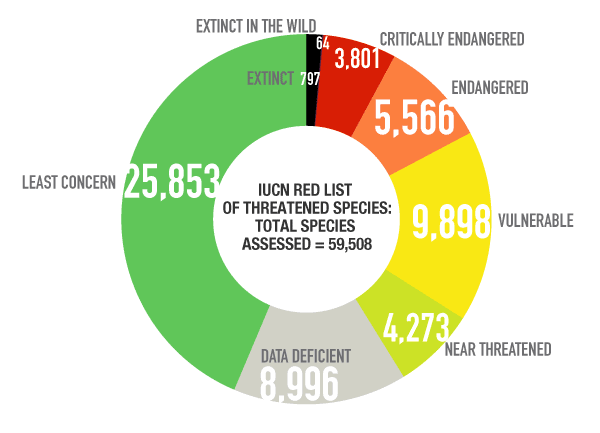
When seeking to help out a pressing cause, it all starts with education. Head over to the IUCN Red List linked below to do some research into your favourite animals and their stance in population numbers, or if you want to see the most endangered straight away, take a look at the WWF website to look at their list of most endangered species (which you 

could then consider sponsoring!). 
Thank you very much for taking the time to read, remember to stay safe, and stay educated on the vanishing species you know and love! And always keep in mind, while being aware of the species we have lost, don’t forget to look at all of the great success stories when it comes to reappearing (we’re looking at you, dodo bird).

Ecosystem services and nature based solutions blog: https://youthfornature.uk/2020/12/15/ecosystem-services-and-nature-based-solutions/

Ethical shopping resource:

giki.earth/

IUCN Red list:
https://www.iucnredlist.org/

WWF endangered list

https://www.wwf.org.uk/learn/wildlife?ds_rl=1263317&pc=ATB001001

WWF success stories! 

https://www.wwf.org.uk/success-stories

Monica’s Instagram: HERE

Ecosystem Services and Nature Based Solutions

By Monica Bhatia

It is clear to see that so much of what we humans have on earth is given to us by the natural world – many of these are what keep us alive! So if the services that ecosystems provide us are so important, surely we should be doing everything in our power to keep these ecosystems alive and healthy. Unfortunately this isn’t always a priority. So let’s discuss ecosystem services, and the nature based solutions to keep them functioning.

To begin, it is key that we understand the components; an ecosystem is a biological community of interacting organisms within their physical environment and a service is a system supplying a public need. Therefore an ecosystem service can be defined as the benefits to humans provided by these ecosystems. 

Before we continue, let’s look at the main ecosystems that make our lives oh so wonderful:
  • Tropical rainforest
  • Temperate forest
  • Boreal forest
  • Tropical grassland
  • Temperate grassland
  • Mediterranean
  • Desert
  • Tundra
  • Mountain

Now, what are the main ecosystem services? They can be split into four main categories:

1 – Provisioning services

These are the tangible goods produced or provided by ecosystems. One example of this is food, such as fruits, vegetables, nuts and seeds, which not only provides us food on a basis of survival. Another example is fuel wood, and this benefits not only individuals in regards to heat for cooking but also allows unusable wood excess to find a home and reduce waste.

2 – Regulating services

These are the benefits we gain from the regulation of ecosystem processes (regulation meaning the act of something being maintained by an authority). Examples of regulating services include pest regulation, climate regulation, and pollination. What is key to note when looking at these is the fact that we could not live without them; if pests were not regulated, crops would be devastated or even wiped out; if the climate wasn’t regulated, the earth’s surface temperature would soar even quicker, making the planet simply inhospitable sooner than is already predicted and if pollination wasn’t to take place, the habitats that wildlife rely on for food and shelter may not even exist. 

Without pest predators like birds, plant life would likely struggle to feed our global populations because pests adore munching away on plants.

3 – Cultural services

These are the non-material benefits we withdraw from ecosystems, such as a spiritual, recreational, aesthetic and educational gain. While, unlike the provisioning and regulating services, our lives don’t necessarily depend on cultural services, they provide a different type of gain; it allows traditions to be withheld throughout decades, allows families and friends to bond in the outdoors, provides self peace and joy, and allows you to educate yourself with a more holistic understanding of the world.

Did you know, just 20 minutes spent outdoors can significantly lower your stress levels?
Simply, nature provides a stunning view; just look at those trees – and mountains – and that lake!
There are an estimated 413 ecosystems in the world. That is 413 things to learn about!

4 – Support services

These are the factors necessary for maintaining these ecosystem services, such as soil formation and nutrient cycling. If these biological processes didn’t exist, nor would the animals and environments that produce all of the gains mentioned above, and our lives would be nowhere near what they are right now. 

In the same way that bricks and cement build solid foundations for our houses, nutrients and soil build up ecosystems – it’s like a construction matrial!

At this point you might be thinking, we have all of this already, and we will in years to come, so what are we trying to solve? People think this because the things mentioned above such as food and wood fuel are labelled as “renewable”. If a resource is renewable, it is meant to mean we will always be able to have it, however, this is often not the case. It can happen where over exploitation occurs – thinking it’ll never run out – yet an infinite resource can turn finite. Why don’t we look at an example:
Trees. We can always plant them, and the world is full of them. The fact that they can be grown again and again means that they are an infinite resource. Wood is in demand as we use it for heating and energy, so we cut it down. If we cut down the trees at a faster rate than we can grow them back, there is a possibility of there being a period where there are no trees (as we would still be waiting for more to grow). If you’re a bit business savvy, you could even call it supply and demand. 

So now we know where our issue lies, we can begin to ponder the solutions, and more specifically, the nature based solutions. Nature based solutions are actions that work with and enhance nature to help address social challenges. The solution begins with us – we need to take on lifestyles where we withdraw the gifts of nature that we need to survive, while allowing it to flourish and recover between periods where we take from it. If you are reading this article, I can assume that you are intrigued as to what the nature based solutions to ecosystem loss are – they can be carried out on an individual, organisational or governmental scale, but considering you may want to make a change, let’s begin with the steps you can take.

It is all about consumption really. More or less everything we buy, eat or wear is a derivative of nature, even if it isn’t so obvious, somewhere down the supply chain of the products you own, an ecosystem service comes into play. There are two main questions we can ask ourselves; what do we buy/consume, and how much do we buy/consume. You should always check when buying natural products that they are derived ethically, in a way that doesn’t harm the ecosystem it comes from, here are some marks to look out for that ensure that your product is doing as little damage as possible:

Note that these symbols don’t guarantee that the entire product is both ethical, sustainable and provide a fair wage. They merely target one section of the creation process (and sometimes transport process) and suggest that they’ve tried to follow certain guidelines.
Often the best practice is to buy when you need something and to buy local.

Additionally, we just need to buy less if it is derived from nature – remember how we mentioned supply and demand? We need to give what we take away time to be replenished. If you want to go all the way and make as little interruptions in ecosystems as possible, consider some lifestyle changes; ensure your home runs on renewable energy sources, or install a smart meter so you can keep an eye on what you use.

When we talk about organisations, we are discussing amazing groups such as the WWF, which collect funds in order to preserve these habitats and shield them from being exploited. This trend has developed and progressed into other organisations but this needs to be a more commonplace practice for businesses.

But where the most influence is held, is in our governments. If stricter environmental rules were insisted upon, we wouldn’t have products that are not ethically sourced in a way that is as unobtrusive as possible, as it simply wouldn’t be allowed – yet laws and policymakers often turn a blind eye and allow too much to be derived in the wrong way (often only focusing on economic benefit), meaning we are losing many more ecosystems than we should. (speaking your mind is the best way to show a government that you disagree with a policy – sign petitions at www.gov.uk > petition-government, or maybe express your views in an instagram post and tag @borisjohnsonuk @ukgovofficial and @ukparliment !)

I would like to thank you so much for reading, I hope I have done a decent job in educating you on ecosystems and nature based solutions – stay safe, and stay caring for the planet 🙂

Follow Monica HERE

What the heck? SSSI’s

An informatory series, to educate on topics relevant to any of our campaigns.

What are they?

A Site of Special Scientific Interest1 (SSSI) is a protected area considered special by virtue of the wildlife, geology or landform contained within it. There are over 6900 SSSI‘s in the UK! (See image below!)

Image depicting the listed SSSI’s across the UK as of 2020.
© Scottish Natural Heritage Contains Ordnance Survey data © Crown copyright and database right (2020)
© Natural England copyright. Contains Ordnance Survey data © Crown copyright and database right 2020.
© Natural Resources Wales copyright. Contains Ordnance Survey data © Crown copyright and database right 2020.
© Northern Ireland Environment Agency copyright. Contains Ordnance Survey data © Crown copyright and database right 2020.

SSSI status is a higher-level designation than a Local Wildlife Site which means they are afforded partial legal protection to prevent damage from activities such as development. In some parts of the UK SSSI’s are also protected from neglect as owners have legal obligations to look after them.2 

The specific legislation underpinning SSSI’s differs between countries but all offer similar levels of protection. They are;

  • Wildlife and Countryside Act (1981) as amended (England and Wales)
  • Nature Conservation (Scotland) Act 2004 (Scotland)
  • Nature Conservation and Amenity Lands Order 1985 (Northern Ireland).  

How are they created?

Fundamentally, SSSI’s are selected because they contain the best examples of natural heritage in the UK but the actual process of designation involves;

  1. Cataloguing features of interest.
  2. Evaluation against a set of established criteria.

The ultimate responsibility for designating SSSI status then falls to the devolved nature conservation bodies;

  • Natural England
  • NatureScot 
  • Natural Resources Wales 
  • Northern Ireland Environment Agency. 

Why is it important to look after them?

SSSI’s are a cornerstone in British nature conservation, forming a national network of protected sites, often underpinning higher-level designations such as National Parks or Natura 2000 sites.  Given the scale of wildlife decline in the UK and the continued development of the countryside it is imperative to look after SSSI’s to ensure the continued survival of a wide range of the diverse habitats, species and landforms found in the UK.  

Many SSSI’s also deliver a variety of provisioning, regulating and cultural services to society, which are so valuable, that DEFRA has concluded that the benefits of achieving favourable condition in all SSSI’s far outweighs the investment cost.

By Chrissy Derrick – Organising member

References

1) Known as an Area of Special Scientific Interest (ASSI) in Northern Ireland
2) In England since 2000

Physical Access And Nature

By Monica Bhatia

We all know that nature is incredibly beneficial to people of all ages, for a variety or different reasons, whether it be physical health such as going for a jog, or mental health, such as taking some time to clear your head. Now, if nature is so helpful for anyone, why isn’t it accessible for everyone?

To begin, we need to address the question; what actually makes nature accessible? Accessibility is defined as the quality of being able to be reached or entered, and for people with disabilities, their requirements for being able to enter nature spaces are slightly different. Examples of some simple implementations that can make a green space be classified as open to all are:

  • Wheelchair rental 
  • Disabled parking
  • Near public transport links (for those unable to drive)
  • Disabled toilets
  • Braille on maps and signs
  • Ramps for hides
  • Wheelchair friendly ramps
  • Keys given out for vehicle access gates

These small scale adaptations to the UKs green spaces could mean that more people can get out there and comfortably experience wildlife without struggle.

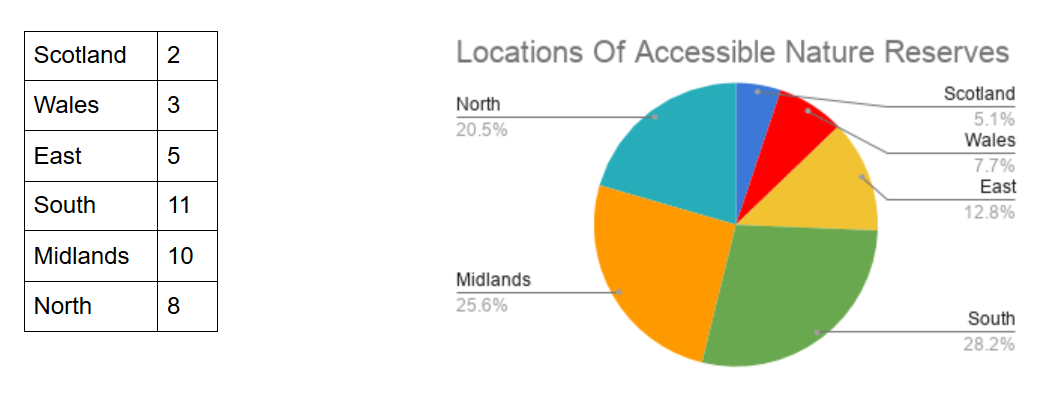
So if we know what makes a green space open to all, which green spaces have already taken on these adaptations? If we, for example, are looking at nature reserves, the statistics are as follows:
1The UK hosts a huge 341 national nature reserves (224 in England, 74 in Wales, and 43 in Scotland), yet only a small portion of these have implemented the facilities above.

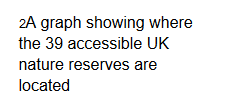
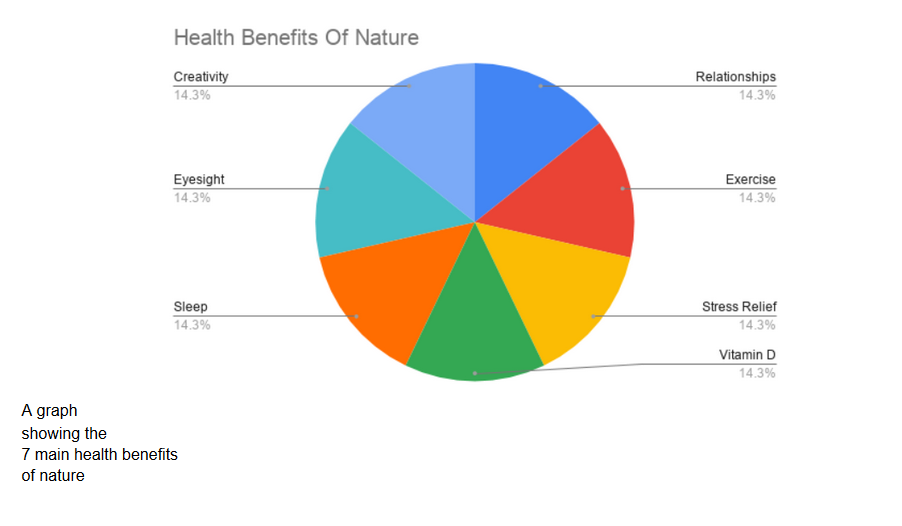
This statistic is incredibly saddening, because while some may believe that accessible green spaces are not of much importance, research by many trusts and organisations prove otherwise. 3Below is presented just why accessibility to these nature spaces is so important.

Upon knowing the vast array of the benefits nature provides, it makes the lack of green spaces such as nature reserves in the UK even more saddening – but not all hope is lost! There are many individuals and organisations trying to turn the tide. One example is the 4All For Nature & Nature For All campaign, started by a young girl living with cerebral palsy called Ellie. In her post, she explains that she has faced many disappointing experiences with inaccessible nature, stating that the location of her local nature reserve, linked with the inconsistent public transport timetable means she is unable to travel to and from the area, and her campaign sets out to ‘further educate those working in the conservation sector to make sites of natural interest as accessible as possible’.

Additionally, an example of a celebrity hero in conservation who has recognised the issue and is doing his bit is no other than Sir David Attenborough himself! In 1966, The Attenborough Nature Reserve And Centre was established – being best known for its birds, the reserve is incredibly accessible, hosting on site disabled parking and wheelchair friendly trails.

Finally, an organisation supporting the cause is us! Our #Naturenearby campaign is calling on governments to make nature accessible to ALL, so if you’re looking for ways to support the cause, be sure to sign our 5petition!

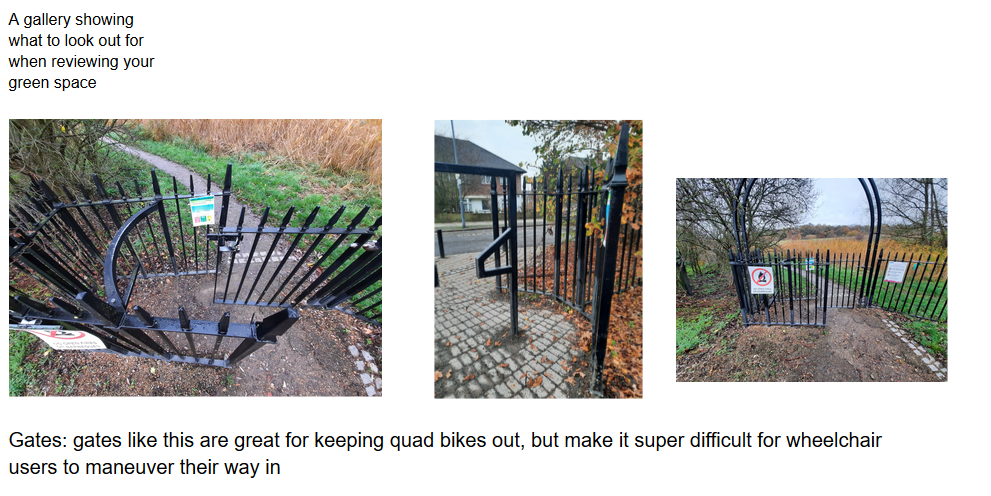
So now that you know who to support when it comes to making nature accessible to all, what can you as an individual do? I recently went to my local green space, and using the criteria of what makes a place accessible, took photographs and gathered a rough idea of how open-to-all it was. By doing this, you can inform friends and family with disabilities where they should consider going to be around nature, and if you really feel there are issues with the open spaces accessibility, with this information you could even write a 6letter or email to your MP!

1 – www.gov.uk>Parks, trails and nature reserves

2 – www.wildlifetrusts.org>Accessible nature reserves

3 – cvc.ca>Top 7 health benefits of being in nature

4 – #Attenborough90: Why nature should be accessible to all

5 – http://chng.it/DRqDtKm7Qd

Follow Monica HERE